
High-Tech Exports Grew Nearly Three Times Faster Than Global Trade in 2025 to Almost USD 5 Trillion, Boosted by the Artificial Intelligence Buildout
Time:2026-03-11
Publication Date:2026-03-11
Intellectual property ensures that innovations in high-tech industries, such as semiconductors, drones, and pharmaceuticals, are protected and leveraged on the international stage.
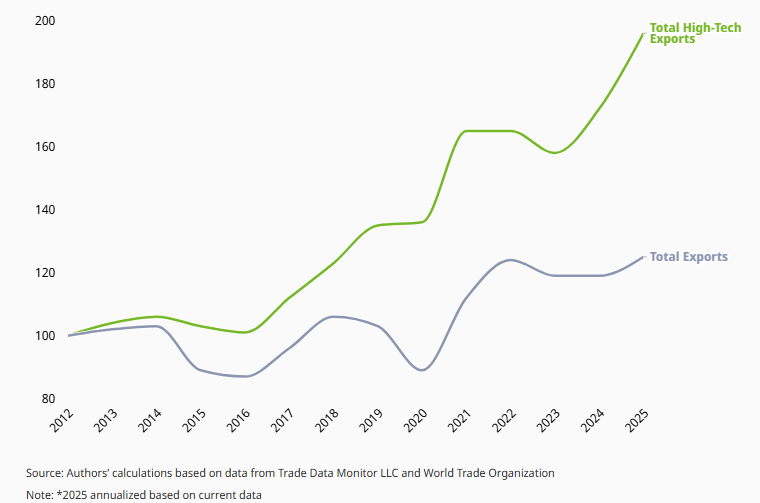
Amid a rapidly shifting global trade environment, high-tech exports reached USD 4.9 trillion in 2025, rising nearly 14% - the sharpest increase since 2021 and almost triple the 4.9% growth rate of overall global trade, according to a joint analysis by Trade Data Monitor and the World Intellectual Property Organization.
The acceleration reflects a physical infrastructure build-out driven by artificial intelligence, with large-scale investment in data centers, advanced chips, and computing hardware fueling cross-border flows. But AI was not the only driver. Robotics, aviation and space technologies, biotechnology, and a pharmaceutical surge led by weight-loss drugs also contributed.
High-Tech Trade: Resilience and Shifting Supply Chains
The record growth in high-tech trade in 2025 unfolded against a dynamic backdrop for global commerce and supply chains, a shift toward diversification of sourcing and more regional “hub-and-spoke” production and others.
High-tech trade proved more resilient than broader merchandise trade, as sustained AI-driven demand provided a powerful demand-side buffer, and as key segments of high-tech trade were less affected by trade slowdowns, including semiconductor manufacturing equipment. At the same time, in particular, Malaysia, Thailand, Viet Nam and India contributed to strong high-tech exports.
Figure 1: Total exports and high-tech exports, 2012-2025
(indexed 2012=100)
Key Sector and Country Highlights
China and the United States of America (US) maintained their roles as leading high-tech exporters. The US saw significant increases in high-tech exports, reflecting stronger demand for AI/data-center infrastructure. China saw high-tech growth in the field of chips and telecom/network components and consumer devices.
Asia’s electronics supply chain broadened, with several manufacturing and re-export hubs experiencing rapid growth in high-tech shipments, including Malaysia, Thailand, and Viet Nam. India increasingly exports high-tech, including smartphones.
In Europe, high-tech export growth was driven by non-IT sectors, including aerospace, aviation, and pharmaceuticals, with Ireland driving the region’s jump in high-tech exports in the field of hormones and other pharmaceutical materials. France and the United Kingdom (UK), in turn, showed strengths in aviation, and drone exports.
A weight-loss drug–linked boom was visible in trade flows: global exports of polypeptide/protein hormones surged, with Ireland’s and the UK’s exports rising sharply.
High-Tech Exporters in 2025
The ten largest high-tech exporters in 2025 were China, the US, Singapore, Germany, the Republic of Korea, the Netherlands, Malaysia, Viet Nam, Ireland, and Mexico. Five of these are in Asia, reflecting a geographically diverse industrial base. In 2025, the top five economies—China, the US*, Singapore, Germany* and the Republic of Korea—exported a combined total of USD 2.1 trillion of high-tech (*annualized figures for 2025 based on current data).
The US top export products included processors and controllers for electronic integrated circuits, parts for automatic data processing machines, and computer processors.
In the case of China, smartphones remain the country’s largest export category. A cluster of other Asian countries experienced strong growth in high-tech exports too, including Singapore, the Republic of Korea, Malaysia, Thailand and Viet Nam. Viet Nam also increased high-tech imports by 27.6% over the first 11 months of 2025, with purchases heavily concentrated in chips and circuits - further evidence of the country's deepening integration into global electronics supply chains.
In Europe, high-tech export growth was driven by non-IT sectors, including aerospace, aviation, and pharmaceuticals. Ireland posted the largest increase, with exports rising 40.2% in the first 11 months of 2025. The surge was driven by shipments of hormones and other raw materials used in weight-loss drugs, along with immunological products - reflecting the country's role as a pharmaceutical manufacturing hub. The UK increased shipments 16.9%, led by turbojets (USD 28.1 billion), parts for turbojets and turbo-propellers (USD 17.6 billion), and immunological products (USD 4.5 billion). France saw high-tech exports rise 13.6%, propelled by its aviation industry, including a growing drone sector.
Eastern European countries are also climbing the high-tech ladder. Poland increased exports 12.5% to USD 37.6 billion over the same period by integrating its manufacturing economy into global high-tech supply chains, including defense production. The country shipped smartphones to China, processors and controllers for electronic integrated circuits to the Netherlands and the Republic of Korea, highlighting a diversified high-tech trade portfolio.
India is ramping up high-tech exports too. In the first 11 months of 2025, its high-tech exports increased 18.2% to USD 58.6 billion. The US was India's largest high-tech destination, with shipments doubling to USD 24.2 billion, followed by the United Arab Emirates, the UK, Singapore, and China. Smartphones dominated India's export portfolio, jumping 52.3% to USD 27.6 billion. A distant second category: large turbojet exports were up 13.2% to USD 4.8 billion.
The Boom in Weight-Loss Drugs
In the first 11 months of 2025, global shipments of polypeptide, protein, and glycoprotein hormones rose by 151.1% to USD 98.9 billion - one of the most striking increases across all categories. The figures reflect surging demand for weight-loss medications such as Ozempic and Wegovy, which have expanded well beyond their origins as diabetes treatments.
Ireland led exports, rising 241% to USD 58.5 billion, reinforcing its position as a pharmaceutical manufacturing hub. The US followed with a 95.8% increase to USD 17.3 billion, while Denmark rose 63.7% to USD 3 billion and Switzerland climbed 29.5% to USD 1.2 billion.
On the import side, the US saw purchases rise 270.5% to USD 57.6 billion. Italy jumped 140.4% to USD 22.3 billion, while China increased 42.5% to USD 2.9 billion and Germany rose 20.4% to USD 2.7 billion.
Robotics: Renewed Growth in High-Tech Trade
The term "robotics" encompasses everything from self-driving taxis to manufacturing arms to AI-powered systems. Because industrial robots are often difficult to ship, manufacturing and assembly tend to happen close to the point of sale—making trade figures a partial but revealing window into market dynamics.
Total exports of industrial robots increased 12.3% to USD 6.7 billion in the first 11 months of 2025. Japan's exports rose 41.8% to USD 1.6 billion, followed by China with a 44.5% jump to USD 723.7 million. Germany saw exports decline 6.8% to USD 555.6 million - a change that may reflect competitive pressures or shifting production strategies.
The top importers were China (up 31.5% to USD 761 million), the US (up 4.6% to USD 582.5 million), and Germany (up 3.3% to USD 422.9 million). The figures reflect the continued spread of automation across manufacturing sectors, even if the pace remains modest compared with other high-tech categories.
Aviation Exports Climb in 2025
Aviation remains a pillar of the global economy, and 2025 was a strong year for the sector. Total exports increased 15.7% to USD 457.2 billion in the first 11 months - a solid performance for an industry defined by large capital investments and long production cycles.
The US led exports, rising 21.4% to USD 148.2 billion, followed by France at 17.7% growth to USD 40.2 billion and Germany up 11.3% to USD 35.6 billion. The export figures reflect both commercial aircraft deliveries and the complex global supply chains that feed aerospace manufacturing.
On the import side, US purchases fell 9.8% to USD 28.5 billion. Germany rose 52.4% to USD 17.6 billion, while China increased imports 51.3% to USD 16.4 billion. Twenty-eight countries imported over a billion dollars’ worth of aircraft and aircraft parts, including Thailand, Brazil, and Turkey, demonstrating aviation's truly global footprint.
Electric Cars: The Battery-Powered Trade
Thanks in part to advances in chips, batteries, engines, and electronics, and despite slowing consumer adoption in some markets, electric vehicle (EV) exports continued to grow throughout 2025, reshaping one of the world's largest manufacturing sectors.
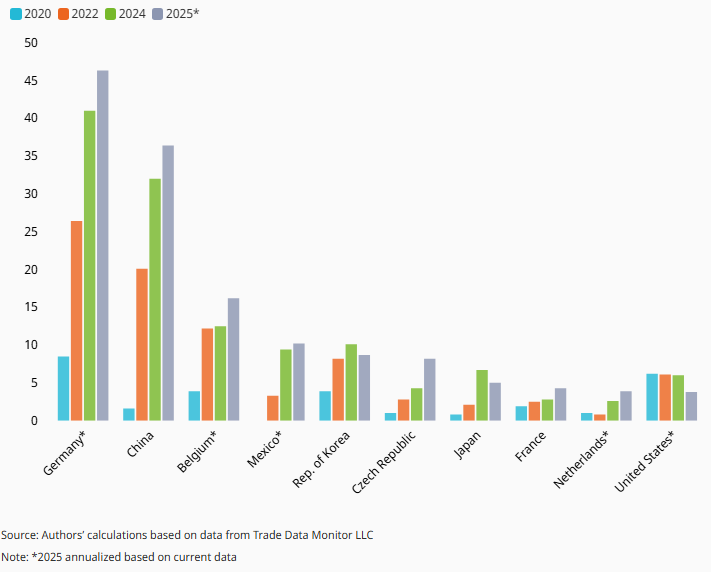
Germany exported USD 42.4 billion in electric vehicles in the first 11 months, China exported USD 32.7 billion, Belgium exported USD 13.4 billion, and Mexico shipped USD 9.4 billion, reflecting their manufacturing capabilities and trade infrastructure (see Figure 2).
Figure 2: Top 10 Electric Vehicle Exporters, USD Billions, 2020-2025*
The UK was the world's top importer of electric vehicles, purchasing USD 16.4 billion worth in the first 11 months of 2025. The US came in second at USD 16 billion, followed by Belgium at USD 12.6 billion, Germany at USD 10.9 billion, and France at USD 7.8 billion. The European concentration of imports reflects both strong environmental policies and consumer demand for cleaner transportation.
About the Data
The Global Innovation Index (GII) uses two key indicators on high-tech trade (indicators 5.3.2 and 6.3.3) through a collaboration between the World Intellectual Property Organization and Trade Data Monitor (TDM), with additional support from the United Nations Comtrade Database, the World Trade Organization, and the United Nations Conference on Trade and Development. Country-specific analyses, such as the UK country profile, provide detailed breakdowns of these metrics. The partnership ensures that innovation metrics are grounded in actual cross-border commercial activity, linking intellectual property frameworks to the tangible movement of high-tech goods that embody those innovations. TDM specializes in providing granular trade data for economic research. It obtains, processes, and publishes customs data from national governments worldwide monthly. This detailed customs-level data enables the kind of product-specific analysis that reveals emerging trends—from weight-loss drug shipments to semiconductor flows—that broader trade statistics might obscure.
Source: https://www.wipo.int/en/web/global-innovation-index/w/blogs/2026/high-tech-exports-2025
 {{item.truncatedText}}
{{item.basicDescription&&item.basicDescription.slice(0,150)}}{{item.basicDescription&&item.basicDescription.length>150?"...":""}}
{{item.truncatedText}}
{{item.basicDescription&&item.basicDescription.slice(0,150)}}{{item.basicDescription&&item.basicDescription.length>150?"...":""}}