
Keeping Your Chinese Trademark Alive: Guide on Renewal and Non-Use Cancellation
Time:2026-10-14
Publication Date:2026-10-14
Short answer: Registering a trademark in China is the entry ticket, not the finish line. Sustaining your rights comes down to three key habits: renewing on time (and avoiding reliance on the grace period), keeping genuine use evidence readily available for non-use challenges, and vigilantly monitoring both your own deadlines and lookalike filings. Neglecting any one of these can cause a mark to lapse or be cancelled.
This guide is tailored for in-house teams managing Chinese trademark portfolios, where the maintenance calendar can easily be overshadowed by day-to-day priorities.
A registration is not "own it forever"
A registered trademark has a term; it will expire without renewal in time. Additionally, after three years of registration, your mark could be challenged with a ‘non-use cancellation’ request. This means that post-registration ‘maintenance’ is just as critical as the application process.
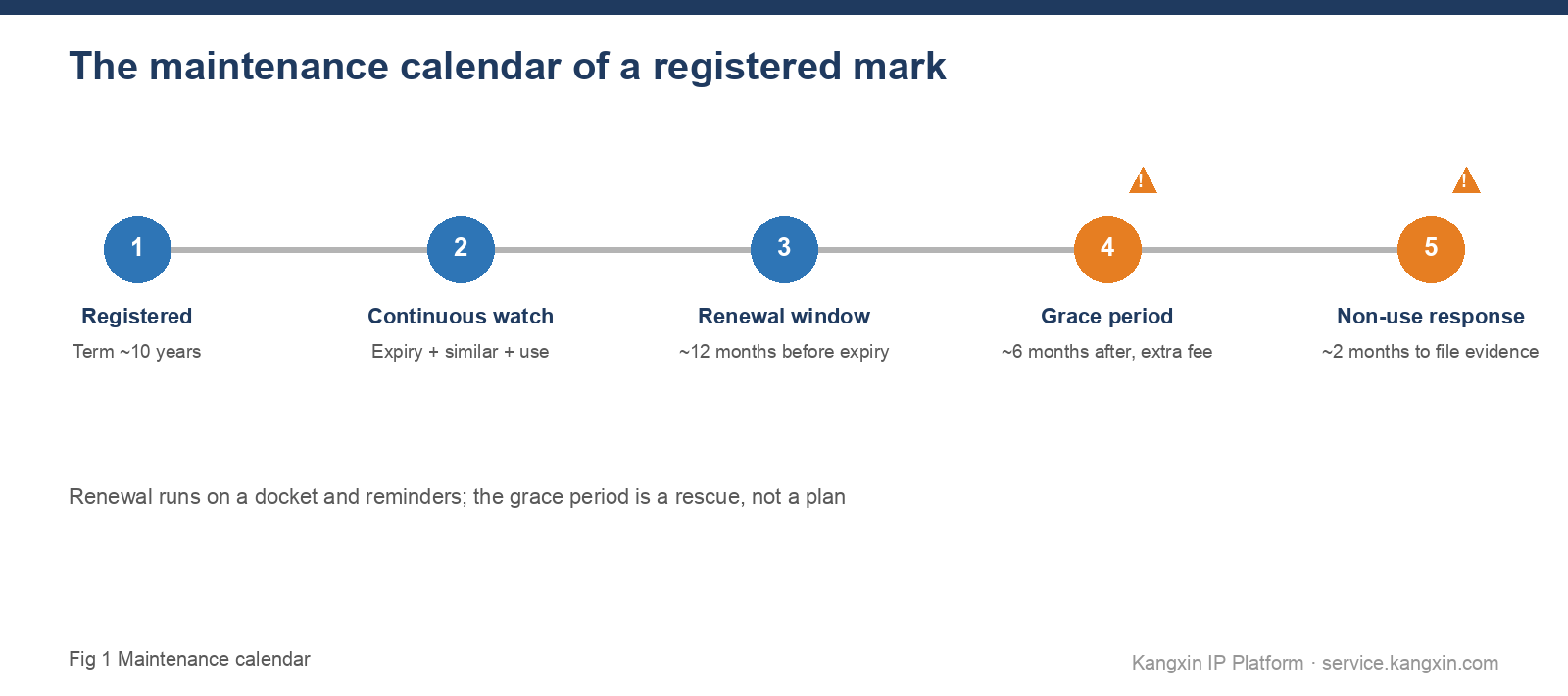
Fig 1 Maintenance calendar
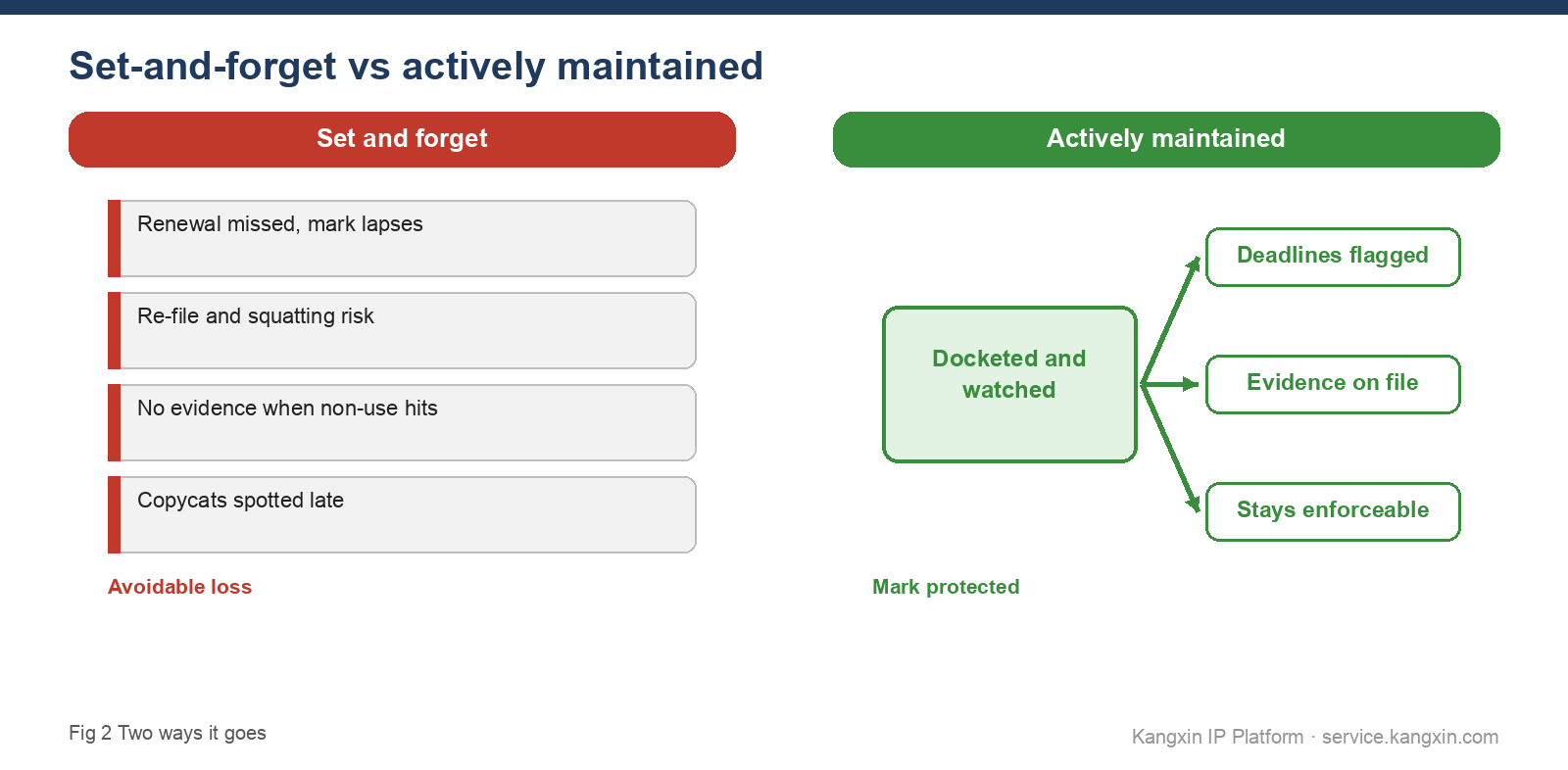
Fig 2 Two ways it goes
1. Renewal: the grace period is a rescue, not a plan
Renewal is the most basic step and the easiest to fumble — usually by simply forgetting. While a grace period is provided for remediation, please do not treat the extension period as a safety net. Please always bear the following in mind:
· Docket the expiry early. In mainland China, the validity period of a registered trademark is 10 years, and renewal can be filed within a defined window before expiry, specifically within 12 months before the trademark’s expiry date. Across a portfolio, memory fails; you need a system-based docket with multi-level reminders.
· The grace period costs extra and is the last line. Miss the normal window and the law generally allows a six-month grace period after expiry — but with an additional fee. Treat it as an emergency backstop, never as your normal cadence.
· Past the grace period, the mark lapses. If no renewal application has been filed at the expiration of the grace period, the registered trademark shall be cancelled by the National Intellectual Property Administration, PRC (“CNIPA”). Then you re-file from scratch, the timeline restarts, and someone may squat the gap — turning a missed date into an expensive recovery fight.
The lesson: renewal runs on a docket and reminders, not on memory.
2. Non-use cancellation: evidence is banked, not improvised
Non-use cancellation targets a registered mark unused for three consecutive years. When a cancellation is filed, you must submit real, lawful, public use evidence within 2 months from the receipt date of the official notification, or provide a justified reason for non-use (e.g. extraordinary event beyond the registrant’s control, government restriction, bankruptcy, or other justifiable reasons not attributable to the registrant).
In practice, cases in which justifiable reasons for non-use are successfully substantiated are infrequent. The core obligation continues to lie in providing proof of use, but the common failure: when the notice arrives, the evidence is scattered, undated, and unconvincing.
Practical steps:
· Collect use evidence continuously: Product photos showing the mark, sales contracts and invoices, marketing materials, e-commerce listing screenshots, advertising records, and etc.
· Fix a credible date on key evidence. Evidence must be generated within the prescribed three-year period. The starting point for calculating the period of continuous non-use of the registered trademark shall be determined by counting back three years from the date the applicant files a non-use cancellation with the CNIPA. For example, if the non-use cancellation application is filed on October 13, 2026, the prescribed three-year period for the evidence shall run from October 13, 2023 to October 12, 2026. Timing is often decisive. Trusted timestamps can fix the existence and time of a listing page, product image or launch record in seconds — turning "we've always used it" into a dated, checkable chain.
· Map evidence to the goods/services. Cancellation is assessed per approved goods/services, so your evidence must cover the classes and subclasses you want to keep.
3. Watching: it's your own deadlines too, not just other people's
"Trademark watching" is often read as chasing copycats. For an in-house team it is really two-directional:
· Outward: watch for confusingly similar applications and lookalikes, so you can oppose or enforce early.
· Inward: watch your own marks' expiry dates, non-use exposure and status changes — the discipline that prevents a missed renewal in the first place.
Kangxin's platform offers trademark watching, renewal and non-use handling as post-registration services, bringing "deadline reminders + similarity watch + status tracking" into one place — so maintenance moves from "someone remembers" to "the system flags it."
A one-page maintenance calendar
The cheapest way to stop losing marks is a single calendar every stakeholder can see. For each mark, put four dates on it: the renewal anchor, the renewal window opening (well before expiry), the hard expiry, and the end of the grace period. Then layer two recurring reviews on top — a quarterly use-evidence check (is there fresh, dated proof of use for the marks that matter?) and a monthly watch review (any similar filings worth opposing?). The point is not sophistication; it is that renewals stop depending on one person's memory and non-use defense stops being a fire drill. Once the portfolio grows past a few dozen marks or spans several entities, move that calendar off the spreadsheet and into a system that reminds you at multiple lead times and assigns an owner to each deadline — because a shared spreadsheet with no owner is exactly how a renewal slips.
Migration of your docket: get it clean first
If your deadlines live in spreadsheets across several outside firms, the first maintenance win is simply consolidating them into one accurate docket. Ask how historical records import, how duplicates across firms are reconciled, and who owns data quality afterward — a clean docket is what makes every reminder trustworthy. Stale status is worse than none, because it hides a missed renewal behind a green light.
FAQ
Q1: How late can I still save a renewal?
There is a normal renewal window, namely the renewal application for the marks in China can be filed within 12 months before the trademark’s expiry date. Miss it and there is generally a six-month grace period after expiry to file late (for an extra fee). Past the grace period the mark lapses and must be re-filed. Confirm the exact periods against the current law, and — better — docket the date so you never reach the grace period.
Q2: A non-use cancellation was filed and I have little evidence. Now what?
Assemble whatever real, public use from the relevant three years you can (product, contracts/invoices, marketing, e-commerce), and explain the use. Authenticity and dating matter most; timestamping evidence as you go removes the last-minute scramble.
Q3: Will an unused mark be cancelled automatically?
Not automatically — a third party has to file the request — but three consecutive years of non-use without proper reason exposes the mark to cancellation, and defensive registrations you are holding "just in case" are exactly the ones most likely to be targeted. Either put the mark to genuine use and keep dated evidence, or decide deliberately whether it is worth maintaining rather than leaving it exposed. In addition, if the trademark is not currently in use but is planned for future use, you can consider filing a new application prior to the expiration of the three-year period of the registered mark.
Q4: What evidence can prove the valid use of a trademark?
Evidence may be collected and sorted from the following aspects:
1) Product and packaging evidence: Photos of physical products, product catalogues or brochures, product labels and packaging bearing the trademark;
2) Transaction and sales evidence: Manufacturing or sales contracts (or service contracts), corresponding invoices, delivery orders, bills of lading, bank transaction records, customs import and export declarations, etc.;
3) Exhibition evidence: Records of exhibitions held in China, including photos of booths clearly showing the trademark, booth lease contracts and invoices for exhibition fees;
4) Advertising and media placement evidence: Detailed list of advertising activities (including placement duration, coverage areas, media names, advertising forms and expenses), together with supporting documents such as physical photos, web page screenshots, publicity contracts and invoices for TV, radio, newspaper, online and outdoor advertisements;
5) Honors, awards and media coverage evidence: Copies or photos of honorary certificates, awards, qualification certificates or ranking lists publicly awarded by authoritative media or the industry, as well as relevant news reports or media articles;
6) E-commerce platform sales evidence: Links/records of official flagship stores or authorized stores opened on mainstream e-commerce platforms in China (such as JD.com, Tmall, Taobao, Pinduoduo, Douyin, etc.), including screenshots of store homepages, product detail pages clearly marked with the trademark, dated sales records, purchase orders, transaction flows and customer reviews; copies of store opening agreements or authorized distribution contracts signed with e-commerce platforms; evidence of promotional activities or advertising campaigns carried out on such platforms (including activity pages, promotional graphics and corresponding contracts and invoices);
7) Social media and online promotion evidence: Evidence of official account operation and promotion activities on mainstream social media platforms in China (such as WeChat Official Accounts/Channels, Weibo, Douyin, Xiaohongshu, etc.), including account authentication/registration information, screenshots of published posts or short videos, engagement data such as readership, likes, comments and reposts, and fan statistics; records of influencer cooperation promotions, online marketing campaigns or brand live streaming;
8) OEM evidence: Manufacturing contracts, corresponding invoices, transportation documents, bank transaction records, customs import and export declarations, etc.
Q5: We have hundreds of marks across entities — how do we manage renewals and non-use risk?
Managing deadlines and status by entity and class with a docket and watch system. This is a core value of a trademark management system (IPMS).
Q6: What's the first maintenance step after registration?
Build a complete docket (registration number, class, expiry, use status) and switch on expiry and similarity watching. The docket is the foundation for everything else.
Q7: How far ahead should renewal reminders fire?
Earlier than you think. A single alert at expiry is not a back-stop. Set multiple lead times — for example a year out, a quarter out, and a final reminder — each with a named owner, so one missed email never equals a lapsed mark.
Q8: Does watching really help with renewals, or is it just for copycats?
Both. A good watch service tracks your own status changes and upcoming deadlines alongside third-party filings, so the same tool that flags a lookalike also flags the renewal you were about to miss.
 {{item.truncatedText}}
{{item.basicDescription&&item.basicDescription.slice(0,150)}}{{item.basicDescription&&item.basicDescription.length>150?"...":""}}
{{item.truncatedText}}
{{item.basicDescription&&item.basicDescription.slice(0,150)}}{{item.basicDescription&&item.basicDescription.length>150?"...":""}}