
From "Zun" Vessel to "Zun" Tower? A New Benchmark for the Protection of Architectural Works
Time:2026-10-20
Publication Date:2026-10-20
Hot Topic Introduction: When Beijing's Tallest Building Was Printed on a Liquor Bottle
In August 2025, the Beijing Intellectual Property Court upheld the original judgment in the second instance regarding a case between an investment company and a liquor company. The court determined that the Beijing CITIC Tower (China Zun) constitutes an architectural work within the meaning of the Copyright Law. The liquor company’s use of its exterior in the design of a white spirit bottle was ruled as infringement, resulting in an award of RMB 300,000 in economic losses plus RMB 150,000 in reasonable expenses.
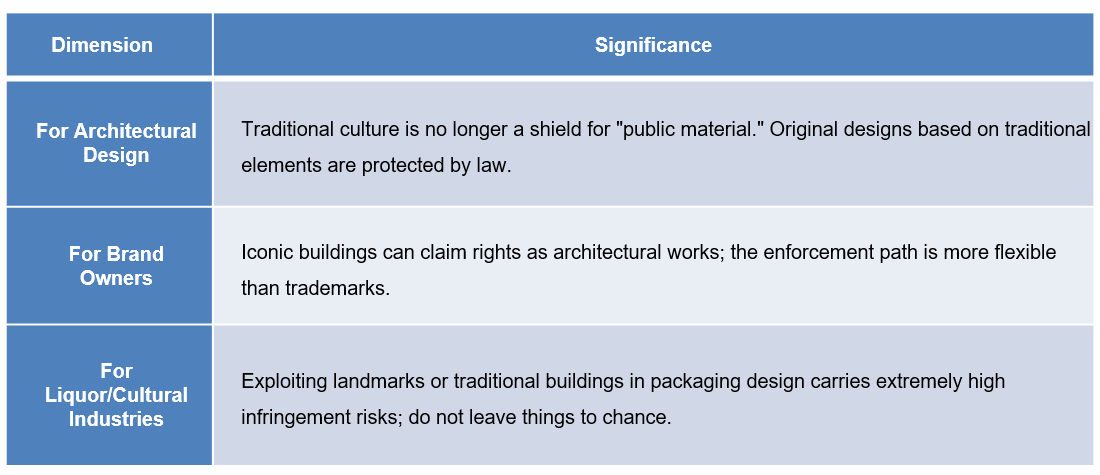
One building, one bottle of liquor, and a judgment of RMB 450,000. This case answers a question that the architectural design industry has long awaited: can traditional Chinese cultural elements be "exclusively" protected?
Deep Analysis: Two Key Legal Determinations
① Qualitative Breakthrough: Traditional Cultural Architecture = Architectural Work
The exterior design of the CITIC Tower was inspired by the "Zun," a ritual bronze vessel from the Shang Dynasty. The court of first instance clarified: although the creation referenced traditional cultural elements, it formed a unique aesthetic and artistic expression distinguishable from the ritual vessel "Zun" in both its overall appearance and local details. It possesses originality and thus constitutes an architectural work.
Key Standard: It is not that "using traditional elements" precludes protection; rather, it depends on whether you have created an original aesthetic expression based on those traditional foundations.
② Determination of Infringement: Substantial Similarity + Possibility of Access
The court determined that the bottle design post-dated the completion of the CITIC Tower and that the liquor company, being a local enterprise in the same city, had the possibility of accessing the architectural work. The exterior of the bottle was substantially similar to the CITIC Tower, and the liquor company placed advertisements for the same product in the vicinity of the tower—indicating clear intent of infringement.
The distributor, a certain liquor shareholding company, bore joint and several liability within the scope of 20,000 RMB due to its failure to fulfill its reasonable duty of review.
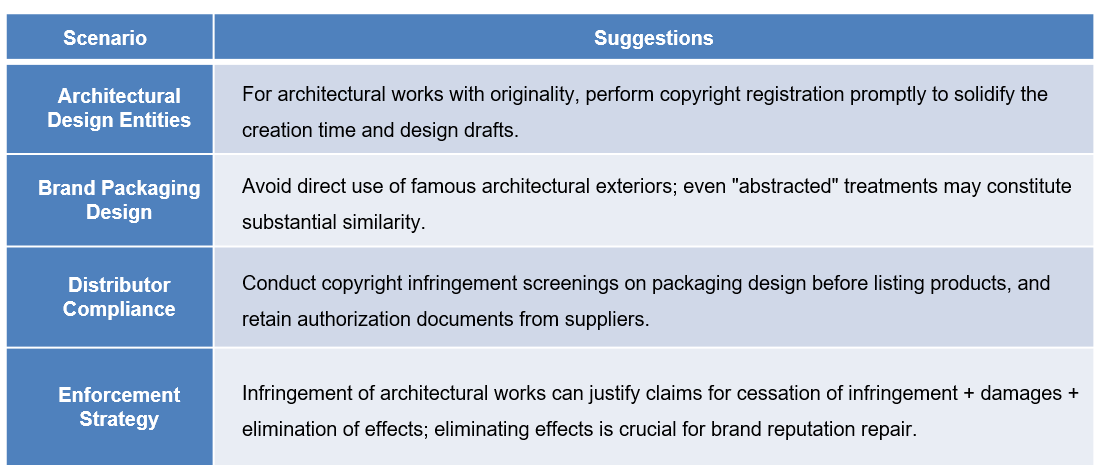
Risk Warning: Distributors should not assume they are exempt from liability simply because they are "just selling goods." Failure to perform a reasonable duty of review will still lead to compensation liability.
Why Is This Case Important?
Practical Advice
Conclusion
The landmark value of this case lies in transforming Chinese traditional cultural architecture from "freely usable by anyone" to "using requires accountability." Innovation does not come from thin air; creating original expressions upon tradition is equally deserving of legal protection.
For enterprises, whether you are an architectural designer or a brand owner, the most important thing to do now is—confirm the rights of your original achievements as early as possible.
If you require copyright registration for architectural works, infringement screening for packaging designs, or brand IP enforcement solutions, please log in to the Kangxin IP platform. Our digital content and architectural design protection team can provide you with a one-stop solution.
 {{item.truncatedText}}
{{item.basicDescription&&item.basicDescription.slice(0,150)}}{{item.basicDescription&&item.basicDescription.length>150?"...":""}}