
My Chinese Supplier Registered My Trademark — What Can I Do? (China, 2026 Guide)
Time:2026-08-25
Publication Date:2026-08-25
Key takeaways (TL;DR)
• China is a first-to-file jurisdiction, but a supplier registering its customer’s brand is one of the situations the law explicitly targets: Article 15 of the PRC Trademark Law bars agents, representatives and parties with contractual or business dealings from registering a mark they know belongs to someone else.
• Your remedy depends on where the squatted filing stands: oppose it during the 3-month publication window (official fee CNY 500 per class), invalidate it within 5 years of registration (official fee CNY 750 per class), or — if it has been registered for over 3 years and isn’t being used — file a non-use cancellation (official fee CNY 500 per class). Fees as published by CNIPA as of August 2026; check the latest official schedule.
• The evidence that wins these cases is mostly already in your inbox: the OEM/supply agreement, purchase orders, invoices, packaging artwork you sent, and emails showing the supplier knew the mark was yours.
• File your own application in parallel on day one. When the squatted mark falls, the earliest pending application takes the slot — you want that to be yours, not a second squatter’s.
• Foreign companies without a place of business in China must act through a licensed Chinese trademark agency (Article 18, PRC Trademark Law) — this step is mandatory, not optional.
Why could my supplier register my brand at all?
Direct answer: because Chinese trademark rights go to whoever files first, not whoever uses the brand first. Your years of sales in the US or EU create no automatic rights in China; until you (or someone else) files with CNIPA, the name is up for grabs.
That said, “first-to-file” is not “anything goes.” Chinese law contains specific anti-bad-faith provisions, and the supplier scenario is the textbook case they were written for. What the squatter typically does with the registration also tells you how urgent this is: a registered mark holder in China can demand license fees, threaten your other suppliers, file complaints to take down your listings on Chinese e-commerce platforms — and, most disruptively for OEM sellers, record the mark with China Customs and interfere with your export shipments.
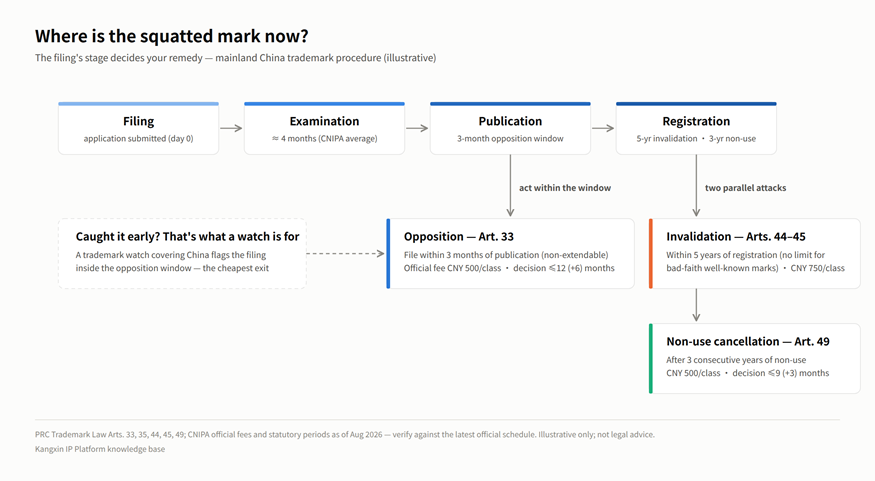
Figure 1 | Where is the squatted mark now? The filing’s stage decides your remedy
What legal grounds can I use against a supplier’s registration?
Direct answer: the four workhorses are Article 15 (bad-faith filing by an agent or business partner), Article 32 (prior use with a certain influence), Article 4 (bad-faith filing with no intent to use), and Article 44.1 (registration obtained by fraud or other improper means). In a supplier case you will usually plead several together.
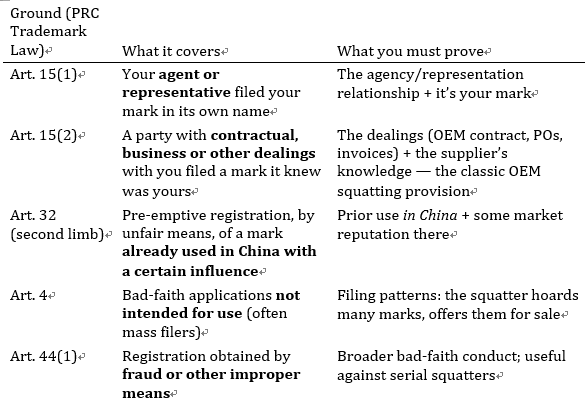
Two practical notes. First, Article 15(2) is the provision most precisely aimed at your situation — it does not require your brand to be famous in China, only that the relationship existed and the supplier knew the mark. Second, Article 32’s “use in China” requirement means purely foreign sales may not qualify; if all your manufacturing was OEM-for-export, lean on Article 15 rather than Article 32.
The mark is still an application — how do I oppose it?
Direct answer: if CNIPA has preliminarily approved and published the application, you have a 3-month, non-extendable window to file an opposition (Article 33). As a prior-rights holder or interested party you may invoke the relative grounds above; the official fee is CNY 500 per class.
Timeline and mechanics, as provided by law (Article 35): CNIPA decides within 12 months from the end of the publication period, extendable by 6 months in complicated cases. If you win, the application is refused; if you lose, the mark registers, and your next stop is invalidation. This is why monitoring matters — an opposition costs a fraction of an invalidation-plus-litigation campaign, but only if you catch the filing inside the window. A trademark watch covering China flags these filings automatically.
The mark is already registered — invalidation, cancellation or buy-back?
Direct answer: run a three-track assessment — invalidate on bad-faith grounds, cancel for non-use if it’s been registered 3+ years, and price a buy-back in parallel. The cheapest path is often a combination.
Invalidation (Articles 44–45). For relative grounds including Article 15 and Article 32, an invalidation request must be filed within 5 years of registration (Article 45); for a well-known mark registered in bad faith, the 5-year cap does not apply. Statutory decision periods: 12 months (extendable 6) for Article 45 requests; 9 months (extendable 3) for Article 44 requests. Official fee: CNY 750 per class. Decisions can be appealed to the Beijing IP Court, so budget for the possibility of a second round.
Non-use cancellation (Article 49). Any party may request cancellation of a mark unused for 3 consecutive years. Official fee CNY 500 per class; CNIPA decides within 9 months (extendable 3). Squatters frequently cannot produce genuine use evidence, which makes this a quiet, low-cost pincer — file it alongside the invalidation.
Negotiated assignment (buy-back). Sometimes fastest, especially when production deadlines loom. A recorded assignment through CNIPA transfers the registration cleanly. Negotiate after your invalidation/cancellation is on file, not before: a squatter facing a credible invalidation prices very differently from one holding all the cards. Never pay against a promise — pay against a signed assignment submitted for recordal.
And in every scenario: refile immediately. File your own application for the mark (and the Chinese-character version of your brand — see FAQ) at the outset. Applications are examined in filing order, so when the squatted registration falls, your pending application is positioned to register.
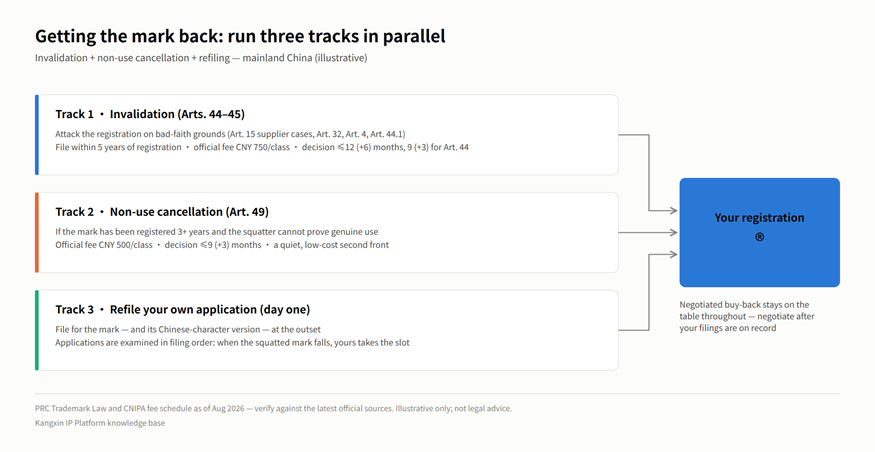
Figure 2 | Run three tracks in parallel: invalidation, non-use cancellation and refiling
What evidence do I need to collect?
Direct answer: prove two things — the relationship and the supplier’s knowledge of your mark — plus, where available, your prior use.
A practical checklist for an Article 15(2) case:
1. The relationship: OEM/supply agreement, purchase orders, pro-forma and commercial invoices, payment records (wire transfer slips), bills of lading, customs export declarations naming the supplier.
2. Knowledge of the mark: emails or chat records (WeChat/QQ logs are commonly used evidence in China) where the mark appears; artwork, die-lines or packaging files you sent; product samples bearing the mark; NDAs referencing the brand.
3. Your ownership: trademark registrations in your home market, domain registrations, dated marketing materials, Amazon/Shopify storefront records.
4. The squatter’s bad faith (supporting): the supplier’s other trademark filings (a hoarding pattern supports Articles 4 and 44), any demand to be paid for the mark — preserve those messages.
Evidence formed outside China generally needs translation into Chinese, and notarization/legalization may be required for certain documents in contentious proceedings — your Chinese agency will confirm what needs formalizing before filing.
How long will the whole fight take, and what does it cost?
Direct answer: plan on roughly 1–2 years for a contested invalidation through the CNIPA stage (statutory 12+6 months, plus preparation and possible court appeal), and official fees in the hundreds of RMB per class per action — the real budget items are evidence preparation and professional fees, which vary by case.
Interim damage control while the case runs: keep customs disruption risk on your radar (check whether the squatter has recorded the mark with China Customs); consider whether your export model fits within the case law on OEM manufacturing for export; and secure alternative branding for the China market if timing is critical. These are case-specific calls — get advice before shipping against a live squatted registration.
FAQ
Q: Do I need a Chinese lawyer or agency, or can I file myself? A: Foreign applicants with no place of business in China must act through a licensed Chinese trademark agency (Article 18, PRC Trademark Law). This applies to applications, oppositions, invalidations and cancellations alike. (Madrid designations of China can be filed via WIPO, but contentious proceedings still require a Chinese agency.)
Q: The 5-year invalidation window has passed. Am I out of options? A: Not necessarily. The 5-year limit applies to relative-grounds invalidation; Article 44(1) (fraud or other improper means) and non-use cancellation are not subject to it, and a buy-back is always on the table. Well-known marks registered in bad faith are also exempt from the 5-year cap — though “well-known” is a high bar.
Q: Should I just pay the supplier what they’re asking? A: Get a legal assessment first. If your Article 15 evidence is strong, filing an invalidation typically improves your negotiating position dramatically — and some squatters abandon marks rather than defend them. Paying quickly without pressure tends to invite a higher price and repeat behavior.
Q: Can I keep manufacturing with a different supplier while the dispute runs? A: This is one of the most fact-sensitive questions in Chinese trademark practice — the treatment of OEM-for-export has shifted across court decisions. Do not assume export-only production is safe while a hostile registration is in force; take specific advice on your shipping routes and Customs exposure.
Q: Should I register the Chinese-character version of my brand too? A: Yes, in almost every case. Chinese consumers, media and — importantly — squatters will create a Chinese name for your brand if you don’t. Registering your chosen Chinese transliteration alongside the Latin-script mark closes the most common second front.
Next step: check the register before you negotiate anything
Before responding to your supplier, see exactly what they filed, in which classes, and when — the stage of the filing determines your entire strategy. Kangxin’s platform offers free self-service trademark search across 44 jurisdictions (170M+ records), including China’s register, so you can locate the squatted filing in minutes. If you need to act, our team — a 30-year Beijing firm and CNIPA-recorded agency, working in English — handles oppositions, invalidations, non-use cancellations and negotiated buy-backs at transparent fixed fees (official fees + service fees quoted upfront). For law firms: we act as China counsel on referral matters under fixed fee schedules, and we never contact your clients directly.
 {{item.truncatedText}}
{{item.basicDescription&&item.basicDescription.slice(0,150)}}{{item.basicDescription&&item.basicDescription.length>150?"...":""}}
{{item.truncatedText}}
{{item.basicDescription&&item.basicDescription.slice(0,150)}}{{item.basicDescription&&item.basicDescription.length>150?"...":""}}