Expanding From Amazon US to Europe and Japan: Should You File Madrid or Country by Country, and What Will It Cost? (2026)
Time:2026-08-26
Publication Date:2026-08-26
Key takeaways (TL;DR)
• Short answer: at three or more countries, Madrid usually wins on cost and admin; at one or two, direct national filings are often simpler and sometimes safer. For the classic US → EU + UK + Japan corridor (three designations), Madrid is typically the cheaper opening move — but the decision isn’t only about filing fees.
• Madrid is one application, one language, one fee payment — not one examination. Each designated office (EUIPO, UKIPO, JPO) still examines your mark under its own law and can refuse it; a refusal must be answered through a local representative in that jurisdiction, at local cost.
• Madrid’s structural catch is dependency: for 5 years, your international registration stands or falls with your US home application/registration. If the US mark is narrowed or cancelled in that window (“central attack”), the foreign coverage collapses with it — recoverable only by paying to transform into national filings.
• US goods descriptions travel badly. A Madrid filing can only cover what your US mark covers, and USPTO practice forces narrow, use-based specifications — while direct EU and Japan filings could claim broader coverage. Sellers planning a wide product roadmap often file nationally for exactly this reason.
• Amazon Brand Registry works either way: it accepts trademarks registered with the EUIPO, UKIPO, and JPO among the offices it recognizes, whether the registration arrived via Madrid or direct filing — and note that an EU trademark does not cover the UK since Brexit, so amazon.co.uk needs a separate UK right.
What is the actual difference between Madrid and country-by-country filing?
Direct answer: Madrid is a central filing and management system, not a global trademark — you file once through WIPO based on your US mark and “designate” countries, but each country still decides independently whether to protect you.
Under the Madrid Protocol, a US applicant files one international application through the USPTO (as office of origin) based on an existing US application or registration. WIPO records the international registration and forwards it to each designated office — for our corridor, the EUIPO (covering all 27 EU member states as one designation), the UKIPO, and the JPO. Each office then examines the designation under its own law within a treaty deadline (12 or 18 months, depending on the office) and either grants protection or issues a provisional refusal.
Country-by-country (national) filing means engaging each office directly: one EU trademark application at the EUIPO, one UK application, one Japan application — each with its own local agent where needed, its own language, its own fee schedule, and its own prosecution.
The two routes end in the same place — a bundle of national/regional rights enforceable in each market. What differs is cost structure, who manages renewals (one WIPO renewal vs three local ones), how flexible the coverage is, and what happens when something goes wrong.
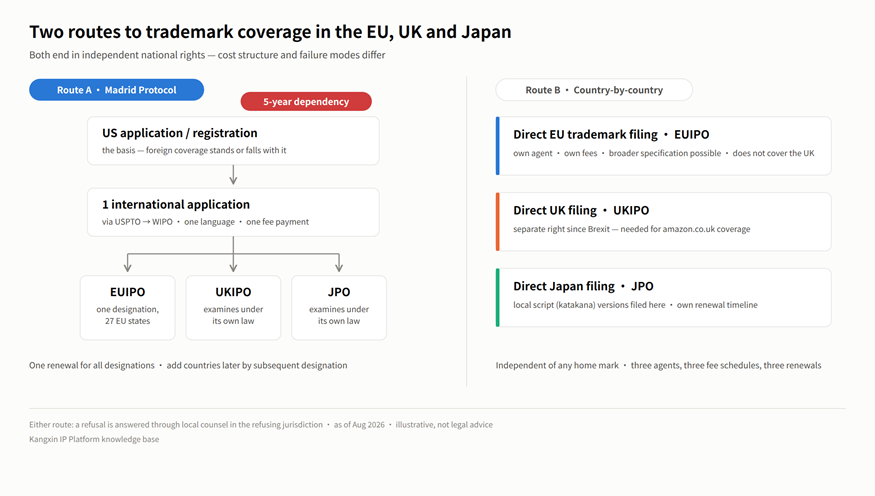
Figure 1 | Two routes to trademark coverage in the EU, UK and Japan
What does each route cost for EU + UK + Japan?
Direct answer: for three designations, Madrid’s single-filing structure usually undercuts three separate national filings with local agent fees — but run the numbers on your actual classes before deciding, because individual fees per country have narrowed the gap.
Cost components, as of August 2026 (official fees change; verify against WIPO’s fee calculator and each office’s current schedule before budgeting):
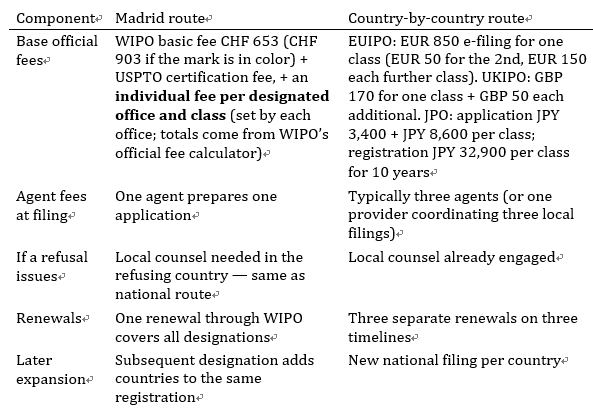
Three budgeting notes. First, the smooth-case saving of Madrid is real but concentrated in agent fees and long-run administration, not official fees — several offices’ individual fees under Madrid are set close to their direct-filing fees. Second, the comparison flips if refusals are likely: a provisional refusal in Japan or an opposition in the EU puts you into local-counsel spend on top of the Madrid fees you already paid. Third, factor renewals across a 10-year horizon: one consolidated renewal versus three national renewal dockets is where portfolio owners feel the difference most.
What are Madrid’s hidden constraints that sellers discover too late?
Direct answer: dependency on the US mark, inheritance of the narrow US goods description, and the fact that refusals throw you back to local counsel anyway.
The 5-year dependency (“central attack”). For five years from the international registration date, the entire Madrid registration depends on the US basic mark. If a competitor petitions to cancel your US registration — or the USPTO refuses the underlying application, or you miss a US maintenance filing — every designation falls with it. The rescue mechanism, transformation into national applications, preserves the filing dates but costs a fresh set of national filing fees precisely when things have gone wrong. US-based registrations are a known weak basis in this respect: US marks face use requirements and cancellation exposure that many other home registrations don’t.
The specification ceiling. A Madrid filing cannot claim more than the US basic mark covers, and USPTO practice requires narrow, specific goods descriptions tied to actual or intended use. Direct EU and Japan applications could claim materially broader specifications — useful headroom for a brand whose product roadmap will widen. Filing Madrid from a narrow US spec locks the narrow scope into all three markets.
Refusals are local either way. In the smooth case Madrid never needs a local agent abroad. But if the JPO issues a provisional refusal (for example, conflict with a prior similar mark) or an EU opposition arrives, you must appoint a local representative and respond under local law and deadlines — the “no local agent” saving exists only until it doesn’t. Budget for this contingency rather than being surprised by it.
None of these is a reason to avoid Madrid; they are reasons to check three boxes before choosing it: the US basis is solid (registered or low-risk application, spec broad enough to live with), no near-term threat to the US mark, and the goods description fits the actual expansion plan.
When is country-by-country filing the better choice?
Direct answer: when you need broader coverage than your US spec, when your US basis is shaky or still pending, when the mark itself differs by market, or when you’re only adding one or two countries.
Concrete situations where direct national filings win: your US application is young and could still be refused (Madrid would inherit that risk for five years); you want wide EU/Japan specifications for products you haven’t launched in the US; you use a different logo or transliteration in Japan (Madrid requires the same mark as the basis — a katakana version needs its own Japanese filing regardless); you are entering exactly one new market this year (a single direct filing is simpler than standing up an international registration); or you anticipate conflicts and want local counsel steering the application from day one rather than after a refusal.
Timing also matters for marketplace onboarding. A smooth direct EUTM registration commonly completes in around 4–6 months if no opposition arises; a Madrid designation adds WIPO processing at the front and gives the EUIPO the treaty refusal window — in practice the direct route often reaches “registered” earlier (timelines vary by office and case; as of August 2026). If Brand Registry access in a specific store is the critical path, ask which route gets that specific certificate soonest — and note that Amazon also accepts pending applications from some offices for Brand Registry enrollment, which can decouple store launch from registration timing (check Amazon’s current Brand Registry eligibility rules for each store before relying on this).
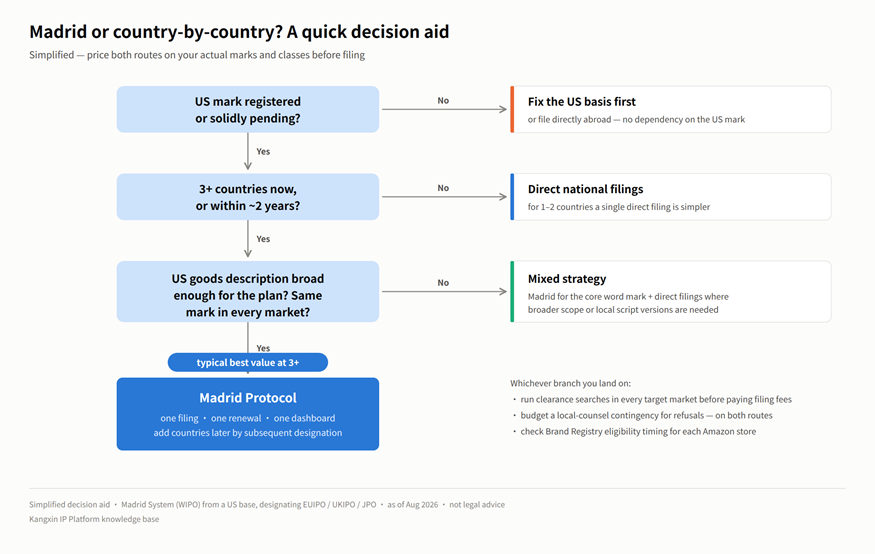
Figure 2 | Madrid or country-by-country? A simplified decision aid
Can I mix the two routes?
Direct answer: yes — mixed strategies are common and often optimal: Madrid for the core word mark across many countries, direct filings where you need broad specs, local script versions, or maximum speed.
A typical seller playbook for the US → EU + UK + Japan corridor looks like this: file Madrid designating the EU, UK, and Japan for the core word mark (cheapest wide coverage, one renewal); file a direct Japanese application for the katakana version the local team will actually use in marketing; and where a product-line expansion is planned, file a direct EUTM with the broader specification alongside. Later markets — Canada, Mexico, Australia, all Madrid members — join by subsequent designation on the same registration rather than new filings. The mix costs slightly more up front than a pure Madrid play, but it removes the single points of failure (dependency, narrow spec) that generate the expensive surprises.
Whichever mix you choose, do the clearance search before filing anywhere: a knockout conflict in one target market is far cheaper to discover at the search stage than as a refusal or opposition after fees are paid in three jurisdictions.
Frequently asked questions (FAQ)
Q: Do I need a trademark in each country before opening the Amazon store there? A: You can open a store without one, but Brand Registry — which unlocks brand gating, A+ content, and faster counterfeit takedowns — requires a trademark from an office Amazon recognizes for that store (the EUIPO, UKIPO, and JPO are all on the accepted list, and pending applications are accepted from some offices). Selling unprotected in a first-to-file market also exposes you to squatters registering your brand locally. File before or at launch, not after traction.
Q: My US registration is only six months old. Is it safe as a Madrid basis? A: A granted US registration is a workable basis, but remember the 5-year dependency: any cancellation action or missed maintenance filing against the US mark within that window hits all designations. If the US mark has known vulnerabilities (descriptiveness challenges, thin use evidence), consider direct foreign filings that stand independently.
Q: Can I add more countries to a Madrid registration later? A: Yes — that is one of Madrid’s best features. A subsequent designation extends the existing international registration to additional member countries (fees per added country apply), keeping one registration number and one renewal date for the whole portfolio.
Q: What happens if a designated office refuses my Madrid designation? A: The refusal affects only that country; the other designations continue unaffected. You respond through a local representative in the refusing jurisdiction within its deadline, exactly as you would for a direct national application. Budget local-counsel contingency into any Madrid plan.
Q: Does my EU trademark cover the UK for amazon.co.uk? A: No. Since Brexit, an EU trademark does not extend to the UK. Existing EUTMs registered before 1 January 2021 were cloned into comparable UK rights, but new EU filings need a separate UK filing (direct or as a Madrid designation) for UK coverage.
Next step: price both routes on your actual marks and classes
The right answer depends on your class count, your US specification, and how many markets your roadmap really includes — all knowable today. Kangxin files trademarks in 110+ countries through both routes, and manages the result — filings, refusal responses through local counsel, renewals, and watch services — in one dashboard, so a Madrid registration and direct national filings sit in the same portfolio view. Book a free strategy consultation for a side-by-side cost quote on your marks, and run a free trademark search across 43 jurisdictions first to catch conflicts before any fees are paid.
Internal links: “China trademark registration for foreign companies” (the manufacturing-side counterpart of this expansion question), “My Chinese supplier registered my trademark — what now?” (why first-to-file markets punish waiting), “Does China customs IP recordal actually stop fake exports?” (border layer once registrations exist). Conversion entry: free strategy consultation + free 43-jurisdiction trademark search.
 {{item.truncatedText}}
{{item.basicDescription&&item.basicDescription.slice(0,150)}}{{item.basicDescription&&item.basicDescription.length>150?"...":""}}
{{item.truncatedText}}
{{item.basicDescription&&item.basicDescription.slice(0,150)}}{{item.basicDescription&&item.basicDescription.length>150?"...":""}}