
How Do I Trace Counterfeit Listings Back to the Source Factory in China? (2026)
Time:2026-08-31
Publication Date:2026-08-31
Key takeaways (TL;DR)
• Takedown-only programs are the worst ROI in brand protection: you pay for every delisting, while relisting costs the counterfeiter almost nothing. Supply concentrates in a small number of source factories — eliminating one source typically cuts off the goods behind dozens of retail storefronts at once.
• The trace runs in five steps: preserve the listing evidence → make a test purchase → mine the physical product, logistics and seller disclosures for entity leads → check upstream (wholesale platforms, packaging printers) → verify the candidate factory on the ground. Most cases lock onto a candidate source by steps three and four.
• The test purchase must be evidenced in a way enforcement bodies will accept: a notarized purchase, or timestamp-based evidence preservation executed by a lawyer under a documented protocol. Ordinary screenshots and a courier receipt carry limited weight in later proceedings.
• Once the factory is identified you have three strike routes: an administrative raid (fast, low-cost, on-site seizure — fines up to 5× illegal turnover where turnover is CNY 50,000 or more, otherwise up to CNY 250,000, per Trademark Law Article 60); criminal referral (counterfeiting a registered trademark is prosecutable from CNY 50,000 in illegal business volume or CNY 30,000 in illegal gains, per Criminal Law Articles 213–215 and the prosecution standards, as of August 2026); and civil litigation for damages and an injunction. The routes chain: raid records often become the key evidence for the criminal and civil follow-up.
• The trace is only as strong as your rights basis in China: a Chinese trademark registration covering the copied goods is the foundation for both administrative raids and the criminal offense; design patents and copyright recordals add tools. If your China filings are not in order, fix that first.
Why doesn’t taking listings down solve the problem?
Direct answer: because listings are only the retail tail of the chain — one source factory feeds multi-level distribution, and a delisted product is back under a new storefront within days. Brand protection leads know the loop: a pre-season takedown sweep removes hundreds of listings and the KPI looks good, then two weeks later the same search terms return the same goods. The reason sits on the supply side. The counterfeiter’s fixed assets — molds, printing plates, packaging, the distribution network — all live offline, and no platform complaint touches them. What actually changes the economics is raising the factory’s cost and legal risk of producing: molds seized, inventory confiscated, operators fined or prosecuted. That is what makes counterfeits recede from a category.
The mature posture is therefore two layers running in parallel: bulk takedowns to control the visible stock, plus source tracing to shut off new production. This article covers the second layer — for the takedown mechanics on China’s platforms, see the companion guide on removing counterfeits from Taobao and 1688.
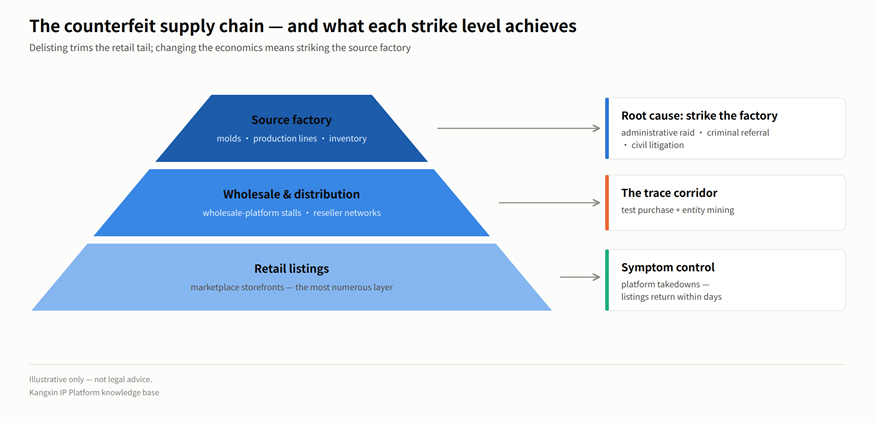
Figure 1 | The counterfeit supply chain and what each strike level achieves
What leads can we actually pull out of a counterfeit listing?
Direct answer: more than it looks — the storefront’s business disclosures, the product page and buyer-review photos are the free first layer; the test purchase, with the physical product, packaging and logistics paperwork it brings back, is the second and decisive layer.
First layer: the listing itself. Under Article 27 of China’s E-Commerce Law, platforms must collect and verify the real identity and license information of sellers applying to trade, and most platforms publish the seller’s business license on the storefront page. Record the storefront name, the disclosed corporate entity, its registered address and opening date, then run the entity through China’s public corporate registry channels for shareholders, affiliates and business scope. A retail storefront frequently sits in front of a "trading company" — and when that trading company’s affiliates include a "products factory" or a "packaging factory", the trace is already half done. Read the detail page and buyer-review photos item by item: batch numbers, hang tags, certificates naming a commissioning party and a manufacturer, and origin markings are leads the counterfeit reports on itself.
Second layer: the test purchase. On receipt, harvest four clusters: the physical product and packaging (workmanship, materials and security features compared point-by-point against the genuine article, formalized into an identification opinion); logistics data (shipping origin, sender name and phone — an origin clustering around a known industrial-belt township is a strong pointer); in-parcel paperwork (certificates, manuals, warranty cards and the printers named on them); and the payment and invoicing entity (does the payee match the disclosed storefront entity?). The whole purchase must be preserved in a form later proceedings will accept: a notarized purchase, or timestamp-based evidence preservation executed by a lawyer under a documented protocol, keeping the chain from order to unboxing intact and entity-specific.
Third layer: upstream checks. Image-search the product on wholesale platforms for identical items offered as "factory direct" or "OEM/custom branding accepted"; identical mold signatures (parting lines, gate marks) indicate a common source. Packaging print is the other under-used thread — counterfeit boxes and tags are usually printed near the factory, and printer order records can become linking evidence in the administrative or criminal file.
What does the on-the-ground investigation involve — and is it legal?
Direct answer: its job is to turn a "candidate source" into a "raidable target" — verifying the real production site, current output, inventory and scale — and it must stay strictly within lawful bounds. Addresses mined online are often registered addresses rather than working plants, so the site’s operating status has to be verified in person. The investigation also answers the two questions enforcement authorities weigh before acting: is stock physically on site (whether a raid can catch goods in hand), and how large is the operation (whether the case is administrative or criminal in scale).
This step is specialist work with real compliance sensitivity. It is normally executed by qualified, experienced investigators instructed through your agency, and lawful methods are the boundary: public-record information and observation in the course of ordinary commercial dealings — for example approaching as a buyer to understand products and capacity — are the safe zone. Intrusive methods do not just void the evidence; they expose the brand itself to liability. Agree the investigation plan and its compliance limits with your agency before anyone travels. Timing matters as much as method: tipping the factory off — say, by sending a demand letter first — usually means inventory moved and a raid that hits an empty room. The standard sequence for a sizeable out-of-province target is: investigation confirms stock on site → complaint to the local Administration for Market Regulation with a coordinated surprise inspection → the seizure record then drives the criminal referral or civil claim.
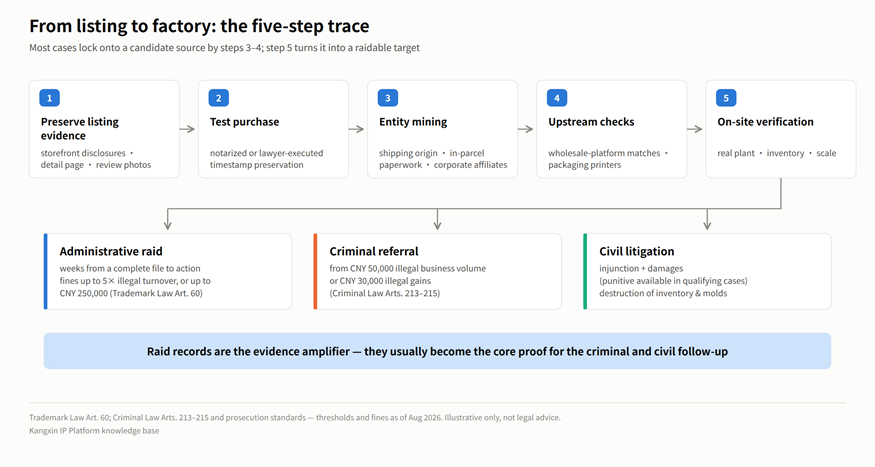
Figure 2 | From listing to factory: the five-step trace and the three strike routes (as of Aug 2026)
Administrative raid, criminal referral or civil lawsuit — which strike do we choose?
Direct answer: small and fast — administrative; large or egregious — push criminal; damages and deterrent judgment — civil. The routes are not mutually exclusive and are usually chained: administrative first to break the case open, criminal or civil to follow through.
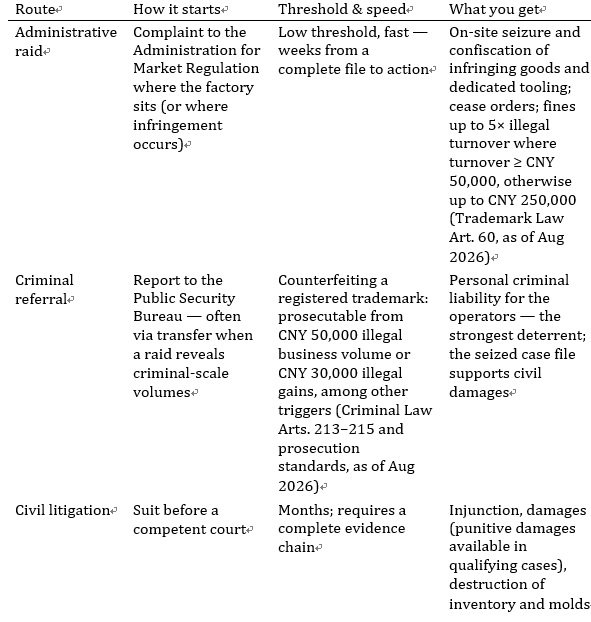
Two practice notes. First, the raid record is a natural evidence amplifier: output volumes, ledgers and molds documented on site are close to impossible to obtain later in a civil case, which is why even damages-driven strategies usually open with an administrative raid. Second, the criminal route has the highest evidence bar — the report file should carry the rights certificates, an identification opinion, the full test-purchase record and scale indicators, and whether the thresholds are met and which offense to pursue is a call for your counsel, not the complaint desk.
After the strike, how do we stop the factory coming back?
Direct answer: convert the one-off strike into a standing mechanism — watch for relisting, watch the punished entity’s affiliates, and put interception layers at customs and the wholesale belt. Four concrete pieces: continuous monitoring across 150+ e-commerce platforms, using image matching to flag new listings and "shell-swap" storefronts sharing a name, address or product with the struck entity; a watchlist on the raided factory’s principals (new companies under the same legal representative, new signage at the same address); customs IP recordal for brands with export exposure — recordation carries no official fee and runs for 10 years, making the border a second interception line (as of August 2026); and a results dashboard — delistings, seizure volumes, fines and judgments — that keeps next year’s enforcement budget defensible in front of management.
Frequently asked questions (FAQ)
Q: Can we report a factory with just the listing URL? A: Generally no. Administrative and criminal procedures need evidence pointing at an identified entity; a listing screenshot neither locates the factory nor meets filing requirements. The working order is test purchase → evidence preservation → entity lock-on → complaint. The more complete the file, the faster authorities move.
Q: Do we need a Chinese trademark registration, or do our home-country registrations work? A: You need China. Administrative raids and the counterfeiting offense are both predicated on a trademark registered in mainland China covering the copied goods; foreign registrations do not ground them. Design patents and copyright recordals in China add parallel tools. If the mark is still pending, close the rights gap before investing in the trace.
Q: Is hiring investigators to watch a factory legal in China? A: Lawful investigation stays within public information and observation in ordinary commercial dealings — approaching as a buyer, for instance. Entering plants covertly, taking records or tailing individuals is unlawful: the evidence is void and liability can rebound onto the brand. Make the compliance plan the first thing you review, and run all investigators through your agency under a single protocol.
Q: The factory was raided but reopened under a new name. Now what? A: This is exactly why strike and monitoring are configured as a pair. After a raid, put the entity’s legal representative, shareholders and operating address on the watchlist so new companies and new storefronts surface fast, and treat repeat offenders as such — a second strike can push for heavier administrative penalties or the criminal route on recidivism grounds, which raises their cost of coming back sharply.
Q: How long does the whole trace take, and what does it cost? A: Straightforward cases — clear leads, single factory, stock on site — often run from test purchase to raid in a few months; multi-entity chains take longer. Cost scales with the number of purchases, the investigation scope and the strike route, which is why the trace usually starts from your best-selling counterfeited SKU rather than everything at once. A route-and-feasibility assessment on your actual listing sample is the cheapest way to scope it.
Next step: spend the enforcement budget where the goods come from
If your program is stuck in the delist–relist loop, part of the takedown budget belongs in tracing. Kangxin runs the full chain in-house and in one dashboard: marketplace monitoring across 150+ platforms, test purchases with notarized or lawyer-executed timestamp evidence preservation, entity mining, on-the-ground investigation, and the administrative raid, criminal referral and civil litigation that follow — with the online monitoring data and offline strike results reported together, ready for management. Book a free strategy consultation: on a sample of your current counterfeit listings, we can assess traceability and the best strike route before you commit budget.
 {{item.truncatedText}}
{{item.basicDescription&&item.basicDescription.slice(0,150)}}{{item.basicDescription&&item.basicDescription.length>150?"...":""}}
{{item.truncatedText}}
{{item.basicDescription&&item.basicDescription.slice(0,150)}}{{item.basicDescription&&item.basicDescription.length>150?"...":""}}