
How Can I Get Real-Time Status on Our Asia Trademark Portfolio Instead of Waiting for Law Firm Reports? (2026)
Time:2026-08-31
Publication Date:2026-08-31
Key takeaways (TL;DR)
• Short answer: stop relying on human report cycles and connect to the official registers themselves. Modern portfolio platforms sync docket data directly from official trademark registers — so a status change at the CNIPA or JPO appears on your dashboard when the register publishes it, not when a quarterly report is compiled.
• The lag you’re experiencing is structural, not negligence. A status change in China typically travels: official register → local agent’s docketing team → (often) a forwarding firm → a batch report to you. Each hop adds days to months. No amount of “please report faster” emails fixes an architecture problem.
• “Real-time” honestly means “as fresh as the official register.” Offices publish on their own schedules — some update within days, others in weekly or monthly cycles. A register-synced dashboard eliminates the human relay lag, which is the largest and most variable component; it cannot make an office publish faster.
• You don’t have to change counsel to get visibility. A portfolio platform can sit alongside your existing law firms as a data layer: firms keep prosecuting; the register feed keeps you current; deadlines are double-checked by an independent docket. Non-lock-in matters — your data should remain exportable and yours if you ever leave.
• Vet vendors on data sources, jurisdiction depth, and security — ask which registers are synced automatically versus updated by hand, how Asia-specific statuses are normalized into English, and for security certifications (ISO 27001-family) plus a written data-ownership clause, before you load 2,000 marks into anything.
Why does our Asia trademark status arrive months late?
Direct answer: because status travels through a human relay chain — register, local agent, forwarding counsel, report cycle — and each link batches its work.
Consider what happens when the CNIPA issues a refusal on one of your Chinese applications. The register updates. The local Chinese agency’s docketing clerk picks it up on their next sweep and drafts a reporting letter. If your company works through a US or European firm that instructs the Chinese agency (the common two-layer structure for Fortune 500 portfolios), that firm receives the letter, re-dockets it, and folds it into its own client-reporting rhythm. You see it in the next status report — often weeks after the register spoke, occasionally months if the matter isn’t deadline-critical.
Multiply that by every renewal confirmation, opposition, office action, and registration certificate across China, Japan, Korea, and Southeast Asia, and the picture your spreadsheet shows management is systematically stale. The practical symptoms are familiar to anyone owning an Asia docket: you learn a mark registered when the certificate arrives, not when it registered; you can’t answer “what’s the current status of our TM in Vietnam?” in a meeting without emailing someone and waiting a time zone; and your annual portfolio review reconciles three versions of the truth — your docket, your firm’s docket, and the registers.
None of this means your firms are doing a poor job. Reporting letters exist for a good reason: they carry analysis and recommendations, not just data. The fix is not faster letters — it is separating the data layer (what the register says, machine-readable, continuous) from the advice layer (what to do about it, human, considered), and getting the data layer directly.
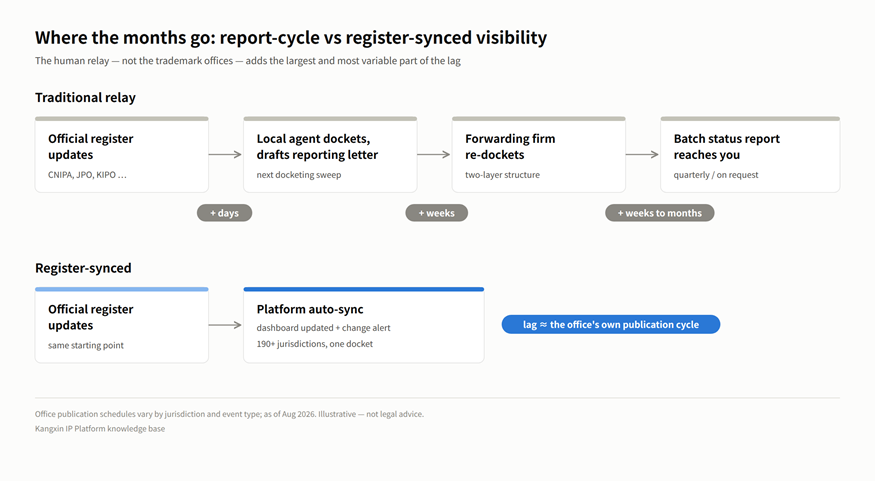
Figure 1 | Where the months go: report-cycle vs register-synced visibility
What does “real-time” portfolio status actually mean?
Direct answer: a dashboard whose records are synchronized with the official trademark registers automatically — so your view is as current as each office’s published data, with alerts when anything changes.
It’s worth being precise, because “real-time” is a marketing word and trademark counsel are rightly allergic to overclaiming. Three layers of freshness exist:
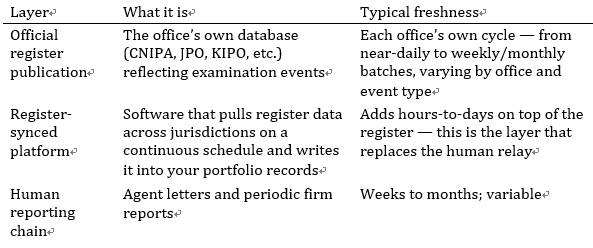
A credible platform claim is therefore: your dashboard matches the official register, continuously, across the jurisdictions that matter to you — for a platform built for Asia-inclusive portfolios, that means register coverage across 190+ jurisdictions feeding one docket. What no honest vendor claims: knowing an examiner’s decision before the register publishes it. When you evaluate tools, ask specifically which jurisdictions are auto-synced from registers and which are maintained by hand — coverage depth in China and the rest of Asia is exactly where generalist tools built around Western registers run thin, and hand-maintained records quietly reintroduce the lag you were escaping.
Freshness alone isn’t the whole ask, either. The same register feed should drive independent deadline monitoring — renewals and response deadlines calculated from register events, not from whether a reporting letter arrived — which gives you a safety net under your firms’ dockets rather than a replacement for them. For a counsel whose personal exposure is a missed deadline in a market twelve time zones away, that double-check is the quiet, main value.
How do I get live status without replacing our outside counsel?
Direct answer: add the platform as a data layer alongside your firms — they keep prosecuting and advising; the register feed keeps you current; and your data stays yours.
The workable model, used by in-house teams that have solved this, has three properties:
Counsel-neutral by design. The platform holds the portfolio records and syncs them with the registers; your existing law firms and local agents continue to handle filings, office actions, oppositions, and strategy. Nothing about live visibility requires moving work. In practice it makes the relationship easier: status questions stop consuming your firms’ (billable) time, and reporting letters can return to what they’re good at — analysis and recommendations rather than data relay.
Independent of any one provider — including the platform. Ask for the data-ownership clause in writing: records exportable in standard formats at any time, no deletion or hostage terms on exit. A platform operated by an IP firm should be explicit that using the software does not oblige you to send it casework, and that if you ever switch systems or agents, the data goes with you. (Kangxin’s platform puts this non-lock-in commitment in the contract; whoever you evaluate, insist on the same.)
Auditable. Live status is also an audit story: register-synced records give you one version of the truth for annual reviews, due diligence, and the “how do you supervise foreign counsel?” question that compliance functions increasingly ask. Look for change logs on every record and role-based permissions, so the dashboard is evidence, not just a viewer.
There’s a budget-cycle point worth making to whoever approves the line item: the platform layer is priced as software, and what it displaces is not counsel — it’s the internal hours spent chasing status, reconciling spreadsheets, and assembling management reports by hand, plus the tail risk of a deadline living only in someone’s inbox.
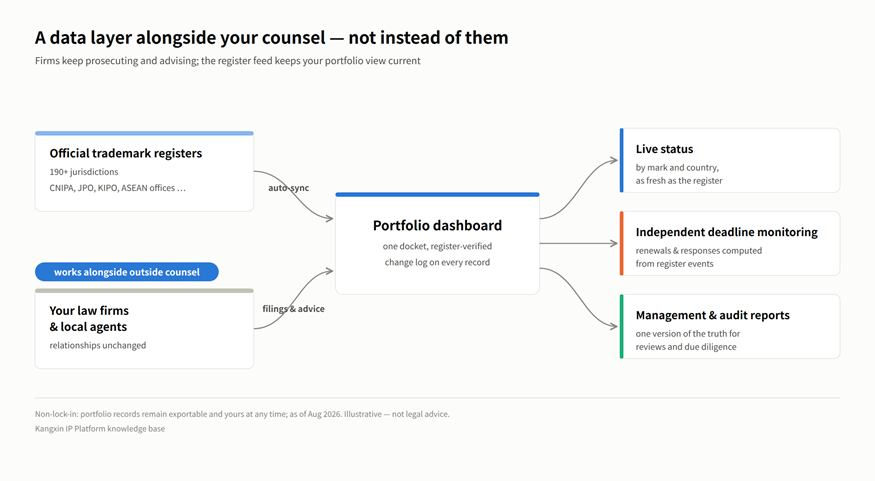
Figure 2 | A data layer alongside your counsel: register sync in, live status out
What should I ask a vendor before loading 2,000 marks into their system?
Direct answer: six questions separate register-synced platforms from pretty spreadsheets — data sources, Asia depth, deadline logic, security, data ownership, and migration.
1. Data sources: Which jurisdictions sync automatically from official registers, on what schedule? Which are manual? Ask for the list, not a slogan.
2. Asia depth: How are China-specific proceedings (oppositions, invalidations, non-use cancellations) and Japanese/Korean status codes represented in English? A tool that renders CNIPA statuses as raw untranslated strings will not survive contact with your team.
3. Deadline logic: Are renewal and response deadlines computed from register events with independent verification, or typed in by whoever remembers? What happens when a register correction changes a date?
4. Security and residency: Certifications in the ISO 27001 family (27001/27017/27701), where data is hosted, and what cross-border transfer terms apply. For a China-based provider, ask for the security white paper and a data-processing agreement up front — a serious one will have both ready, including China’s own MLPS Level 3 accreditation for its domestic infrastructure.
5. Data ownership and exit: Export formats, exit assistance, and a written commitment that the data is yours — see the non-lock-in point above.
6. Migration: Who does the initial load and verification? The right answer is a managed import: your existing schedules and firm dockets loaded by the vendor, then reconciled against the official registers, with a discrepancy report back to you. That reconciliation regularly surfaces a handful of surprises per thousand marks — lapsed registrations nobody reported, renewal dates that drifted, marks recorded in the wrong entity’s name — which is an uncomfortable but excellent first deliverable.
How long does it take to stand this up for a real portfolio?
Direct answer: for a portfolio in the low thousands of marks, expect weeks, not quarters — the pacing item is reconciliation against the registers, not software setup.
A realistic sequence: export whatever you have (spreadsheets, firm docket reports); managed import by the vendor; automated match against official registers across your jurisdictions; a discrepancy report you review with your firms (this is where the lapsed-mark surprises surface — better now than in due diligence); then business-as-usual, with register sync keeping records current and your firms’ reporting letters continuing for matters that need judgment. Run the old process in parallel for one reporting cycle as a check, then let the dashboard become the single source of status. No big-bang cutover, and at no point does any firm relationship need to change.
Frequently asked questions (FAQ)
Q: Our law firm already gives us portal access. Isn’t that the same thing? A: A firm portal shows that firm’s docket — genuinely useful, but scoped to the matters that firm handles, refreshed on its docketing rhythm. If your Asia portfolio runs through several firms and local agents (the norm), a per-firm portal per slice still leaves you assembling the whole picture by hand. A register-synced platform covers the portfolio across all counsel, and its freshness comes from the registers rather than any firm’s workflow.
Q: Can register data really be trusted for deadlines? A: Register data is the authoritative record of what the office has done — it is exactly what you want status read from. Deadline calculation on top of it needs care (grace periods, local rules, office corrections), which is why the credible setup pairs automated register sync with professional verification, and why you keep counsel in the loop for anything ambiguous. What register-synced docketing removes is the failure mode where a deadline exists only in a letter someone didn’t forward.
Q: We’re mid-sized — 300 marks, six Asian countries. Is this overkill? A: The relay-lag problem is size-independent; the economics just change shape. At 300 marks the case is less about reporting overhead and more about the deadline safety net and answering status questions instantly. Platforms priced as subscriptions (rather than enterprise implementations) make the smaller-portfolio math work — this is worth asking about directly, since heavyweight enterprise IP systems are typically scoped and priced for portfolios several times that size.
Q: What about our patents and renewals in Asia — same problem, same fix? A: Largely yes. Patent annuities are the sharpest version of the visibility problem because a missed payment is usually fatal to the right. The same register-and-dashboard architecture extends to patent renewals — if you’re auditing that side of the house, see our companion piece on patent annuity invoices and FX transparency.
Q: Will our data end up training someone’s AI or benchmarking database? A: Ask every vendor this in writing. The answer you want: your portfolio data is used to provide the service to you, full stop — no resale, no cross-client analytics without consent, deletion on exit. Get it into the DPA.
Next step: see your own portfolio live before you decide anything
The fastest way to evaluate register-synced visibility is to watch it run on your own marks. Kangxin’s platform manages trademark portfolios across 110+ countries with automatic register synchronization across 190+ jurisdictions, independent deadline monitoring, and audit-ready reporting — designed to work alongside your outside counsel, with a contractual non-lock-in commitment that your data remains yours. Book a free consultation and a walkthrough with a slice of your actual Asia docket, and see what the registers say your portfolio looks like today.
 {{item.truncatedText}}
{{item.basicDescription&&item.basicDescription.slice(0,150)}}{{item.basicDescription&&item.basicDescription.length>150?"...":""}}
{{item.truncatedText}}
{{item.basicDescription&&item.basicDescription.slice(0,150)}}{{item.basicDescription&&item.basicDescription.length>150?"...":""}}