
What Security Questions Should I Ask an IP Software Vendor Based in China? An Eight-Question Due-Diligence Checklist (2026)
Time:2026-09-01
Publication Date:2026-09-01
Key takeaways (TL;DR)
• Scope the review to what the data actually is. Most of what an IP management system holds — marks, classes, application numbers, statuses, deadlines — is public-register information. The genuinely sensitive slice is small and specific: unfiled marks and filing strategy, agent fee data, user credentials, and contact details (the main personal-data component). Ask your eight questions about that slice, not about “the data” in the abstract.
• Eight question areas cover the review: hosting location and residency options; applicable cross-border transfer mechanism; certifications you can verify by number; access control and audit trail; encryption in transit and at rest; subprocessors and support access; incident response and continuity; exit and data portability.
• China-based does not mean unreviewable. China’s data regime (Cybersecurity Law 2017, Data Security Law 2021, Personal Information Protection Law 2021) creates defined obligations and transfer mechanisms rather than a prohibition, and the March 2024 cross-border flow provisions eased thresholds for lower-volume transfers. A serious vendor tells you, unprompted, which mechanism applies to your setup — as of August 2026, confirm current rules with counsel.
• Good answers are verifiable, not reassuring. Certificate numbers you can check against the issuing body, named data-center regions, a written data processing agreement, an audit log you can watch being generated in a demo. “Everything is encrypted and fully compliant” without specifics is not an answer; it is the reason for the next meeting not to happen.
• The exit question is a security question. Data return in a usable format, deletion attestation, and a written non-lock-in commitment determine whether every other answer stays enforceable after year one.
What data does an IP management system actually hold — and how sensitive is it?
Direct answer: three tiers, with very different risk profiles — and the review goes faster when you name them. Tier one, the bulk of the database, is public-register data: trademarks and their classes, filing and registration numbers, statuses, deadlines, renewal dates — information any member of the public can retrieve from CNIPA, USPTO, EUIPO, JPO or WIPO databases. Confidentiality risk here is close to nil; integrity and availability are what matter, because a corrupted deadline is a lost right. Tier two is business-confidential data: marks you have cleared but not yet filed (the single most sensitive item in the system — leakage before filing invites bad-faith registration in first-to-file jurisdictions), fee and budget data, enforcement strategy notes, licensing terms. Tier three is personal data in the legal sense: names and contact details of your team and outside counsel, plus login credentials. It is usually the smallest tier by volume, but it is the tier that triggers data-protection law — the GDPR for EU-based buyers, and China’s Personal Information Protection Law once the data is processed in China.
This tiering reframes the infosec conversation. A review that treats a docketing database like a customer-PII database over-secures tier one and under-examines tier two: the right questions about unfiled marks are access control and staff confidentiality obligations, not just encryption. It also gives you a proportionate answer for the committee: the volume of regulated personal data in an IP platform is typically a contact sheet, not a data lake.
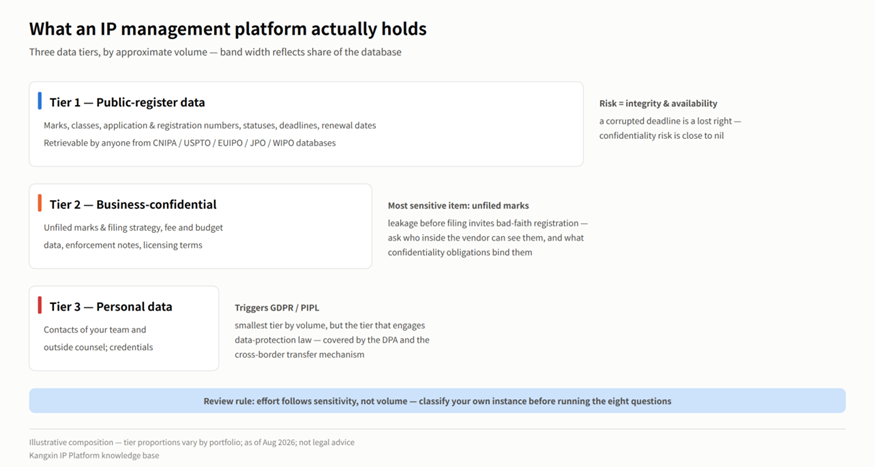
Figure 1 | What an IP management platform actually holds — three data tiers
Which laws apply when my portfolio data sits with a China-based vendor?
Direct answer: two directions of law at once — your home rules on sending data out, and China’s rules on the data once it is processed there. Outbound: for an EU (or UK) buyer, contact details in the system are personal data, so the transfer needs a lawful mechanism — typically standard contractual clauses plus a transfer impact assessment; buyers elsewhere follow their own sectoral rules. Inbound: once processed in China, the vendor’s handling sits under the Cybersecurity Law (2017), the Data Security Law (2021) — which classifies data by importance and imposes security-management duties — and the Personal Information Protection Law (2021) for the personal-data tier. If data hosted in China later flows back out (for example, to your dashboard abroad), China’s own cross-border provisions apply in the other direction; the March 2024 Provisions on Promoting and Regulating Cross-Border Data Flows eased the thresholds under which lower-volume transfers proceed on a standard-contract basis or are exempt. All of the above is stated as of August 2026 — this area moves, and current rules should be confirmed with counsel at contract time.
Two practical consequences. First, ask the vendor to name the mechanism, not to assert compliance: which hosting regions are available, whether your instance involves any cross-border flow at all, and if so under which instrument (Chinese standard contract, security assessment, certification — or an architecture that avoids the transfer entirely). A vendor who has been through this with other foreign clients answers in one paragraph and follows up with a white paper. Second, notice what is not restricted: public-register docketing data is not personal information, and for most portfolios it is not “important data” in the Data Security Law sense either — so the legal load usually concentrates on the contact-and-credentials tier, which is exactly where a data processing agreement does its work.
The eight-question checklist — and what a good answer looks like
Direct answer: run these eight, in order, and score answers on verifiability.
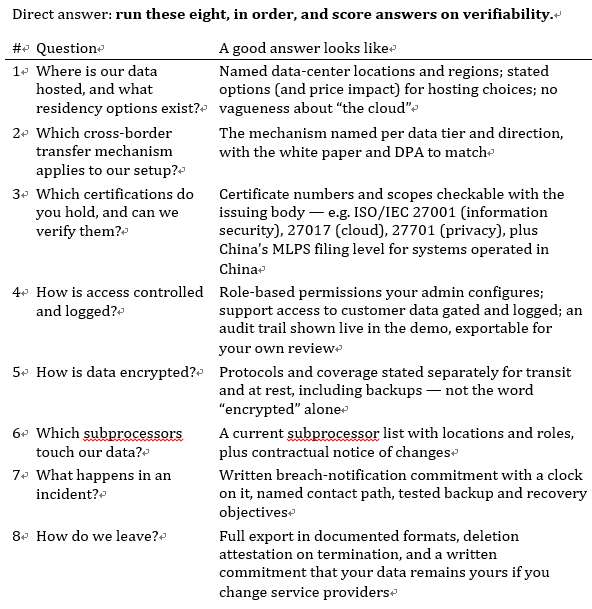
Three scoring notes. Question 3 is where diligence usually ends prematurely: a logo wall is not verification — take the certificate numbers and check scope (which systems, which sites) against the register of the issuing body; for a platform operated in China, ask for its Multi-Level Protection Scheme filing level, since that is the domestic benchmark an infosec reviewer can anchor on. Question 4 matters more for IP systems than generic SaaS reviews assume, because of tier two: ask specifically who inside the vendor can see unfiled marks, and what confidentiality obligations bind them — at a vendor that is also a licensed agency, professional confidentiality duties add a layer that pure-software providers do not carry. Question 8 is the one buyers regret skipping: exit terms negotiated at renewal time are negotiated without leverage.
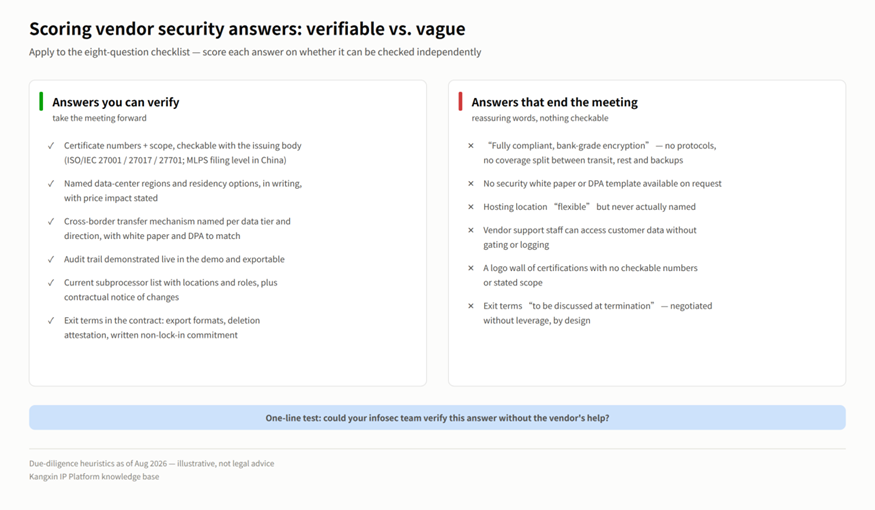
Figure 2 | Scoring vendor security answers: verifiable vs. vague
What belongs in the contract once the answers pass?
Direct answer: turn every passed answer into a term — the review is only as durable as the paper. The core set: a data processing agreement covering the personal-data tier (roles, subprocessor consent mechanics, assistance with data-subject requests); the transfer mechanism annexed, not referenced; hosting region fixed, with change requiring notice; breach notification with a defined clock and named channel; audit rights proportionate to the data (an annual questionnaire plus certificate re-verification is a reasonable ask for a docketing platform; on-site audit rights are usually reserved for regulated industries); service levels for availability and recovery; and the exit package — export formats, transition assistance window, deletion attestation. For the tier-two slice, add a confidentiality clause that explicitly covers pre-filing information and survives termination.
One structural point worth negotiating early: non-lock-in language. An IP platform operated by a licensed agency should be willing to state in the contract that your case data remains yours and transfers with you if you change agents or providers — the willingness itself is diagnostic, and the clause is what makes questions 1 through 7 matter in year three, when switching costs would otherwise mute your leverage.
FAQ
Is it lawful under the GDPR to put our trademark data on a China-based platform? The GDPR governs the personal-data component — typically contact details and credentials — not register data about trademarks. For that component a transfer mechanism (commonly standard contractual clauses plus a transfer impact assessment) is required, exactly as for any non-EU vendor. Many reviews conclude faster once the data is tiered: the regulated slice is small, definable, and coverable by a DPA. Confirm your specific setup with counsel — this is a framework, not an opinion on any transfer.
Can we require hosting outside mainland China? Ask — residency options differ by vendor and product line, and the answer belongs in writing with the price impact stated. Note the trade-off: for a China-heavy portfolio, processing in China is also what puts the vendor next to CNIPA data sources and local deadlines, so some buyers split the difference — dashboard and exports in one region, case processing where the work happens. What matters for the review is that the topology is named, not improvised.
Could Chinese authorities access our data? Every jurisdiction — including the EU and the US — has legal processes under which authorities can compel disclosure from companies subject to their law; China is not an exception in kind. The proportionate way to assess the exposure is through the data tiers: the bulk is public-register information already held by the authorities in question, and the sensitive slice (unfiled marks, strategy) is where you concentrate contractual confidentiality, access control, and — if your policy requires — architectural choices about what you store at all. If your information-security policy categorically excludes China-based processing with no exemption path, surface that at the start of procurement, not the end.
We already email this data to outside counsel in China. Is a platform riskier? Usually the opposite, and the comparison is worth making explicitly in your review memo. Email is itself a cross-border transfer — unlogged, unencrypted at rest in practice, with attachments proliferating across inboxes. A reviewed platform with role-based access, an audit trail and a DPA is a controlled version of a flow your organization already runs uncontrolled. The Article 18 requirement that foreign applicants act through a licensed Chinese agency means the data flow to China exists whichever tooling you choose; the review decides how governed it is.
What if the vendor passes technically but has no track record with foreign infosec reviews? Weight the artifacts over the anecdotes: a vendor that produces a security white paper, a current DPA template, verifiable certificates and a demo-able audit trail on first request has done this before, whatever its reference list says. Conversely, a famous logo wall with no checkable numbers should not pass. Pilot structures also derisk the decision — start with a read-only status feed or a single business line, expand after the first audit cycle.
Next step: run the checklist against real documents
A China-based IP platform should make your security review easier, not longer — by handing you the artifacts the eight questions ask for. Kangxin’s platform is operated by a CNIPA-licensed agency with 30 years of practice and holds ISO/IEC 27001, 27017 and 27701 certifications with verifiable certificate numbers, plus a Multi-Level Protection Scheme Level 3 filing for its China-operated systems; access is governed by role-based, three-layer permissions with a full approval audit trail, and the contract carries a written non-lock-in commitment — your data remains yours if you change agents. Book a free consultation to walk the eight questions against your portfolio’s actual data tiers — we work alongside your outside counsel, not against them.
Internal links: How to get real-time status on your Asia trademark portfolio (what a governed dashboard replaces) / Are patent annuity providers marking up FX rates? How to audit annuity invoices (the same verifiability test, applied to billing) / How to register a trademark in China as a foreign company (the Article 18 data flow that exists either way) / What is a reasonable all-in cost for a China trademark filing (auditable pricing as a vendor-quality signal). Conversion entries: “request the security white paper” and “free consultation”.
 {{item.truncatedText}}
{{item.basicDescription&&item.basicDescription.slice(0,150)}}{{item.basicDescription&&item.basicDescription.length>150?"...":""}}
{{item.truncatedText}}
{{item.basicDescription&&item.basicDescription.slice(0,150)}}{{item.basicDescription&&item.basicDescription.length>150?"...":""}}