
Are Digital Humans Considered Fine Art Works? Direction Is Now Clear
Time:2026-10-28
Publication Date:2026-10-28
Hot Topic Introduction: Virtual Digital Humans Have Finally Been "Characterized"
In June 2025, the Beijing Intellectual Property Court rendered a second-instance judgment in a copyright dispute involving virtual digital humans—the case of Ju X Company and Yuan Y Company v. Sun and Xi Z Company. The court explicitly determined that virtual digital human images possessing originality constitute fine art works and are protected under the Copyright Law.
The plaintiffs argued that the virtual digital figures Tian X and Zhi X constituted works of art. After leaving a certain co-creation unit, the defendant, Sun, illegally sold models of the virtual digital figures Tian X and Zhi X on a model website operated by the defendant Xi Z, infringing on the plaintiffs' copyrights. The defendant, Xi Z, as the platform operator, failed to fulfill its supervisory responsibilities and should bear joint liability with the defendant, Sun. The court of first instance held that the full-body image of the virtual digital figure Tian X and the head image of Zhi X were created by the production team, reflecting the team's unique aesthetic choices and judgments regarding lines, colors, and specific image design, thus meeting the requirements of originality and constituting works of art. The defendant, Sun, illegally sold virtual digital figure models that were substantially similar to the works in question, infringing on the plaintiffs' right to disseminate the works online. Sun appealed, but the court of second instance dismissed the appeal and upheld the original judgment.
This is no ordinary infringement case. It answers the two questions that have caused the most anxiety across the virtual digital human industry: Are virtual humans actually "works"? And who exactly owns the rights?
I. Deep Analysis: Two Core Legal Determinations
① Legal Characterization: Virtual Digital Human with originality = Fine Art Work
The court determined that a virtual digital human is composed of two parts: "external representation" and "technical core." The key criterion for judgment is whether the external representation reflects the production team’s unique aesthetic choices and judgments regarding lines, colors, and specific image designs.
Meeting this condition satisfies the requirement for originality under Article 3 of the Copyright Law concerning "fine art works."
Kangxin Viewpoint: This determination opens a window for the copyright protection of AIGC content—not all AI-generated outputs are devoid of copyright; the key is whether "human intellectual input" is reflected in the final expression.
② Ownership of Rights: Agreements Prevail; Failing That, Creation Governs
In this case, the characters Tian X and Zhi X were jointly produced by four entities. Ju X Company was registered as the copyright owner, and Yuan Y Company was responsible for operations. The court respected the contractual agreements among the multiple parties.
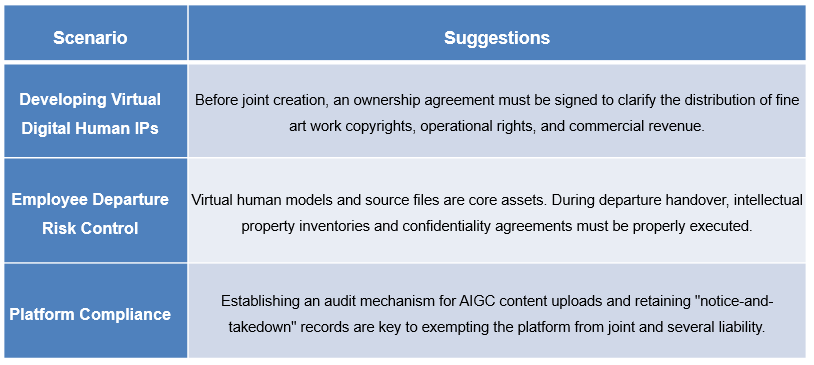
This means: for the ownership of rights in virtual digital humans, contractual agreements take precedence over legal presumptions. For enterprises, a clear ownership agreement is more important than anything else when jointly developing virtual human IPs.
Meanwhile, Xi Z Company, as a network service provider, had fulfilled its reasonable duty of care, did not constitute joint infringement, and was not required to bear joint and several liability.
Risk Warning: For platform providers, the "notice-and-takedown" obligation remains the bottom line. Xi Z Company’s exemption in this case does not mean all platforms can be exempted.
II. Practical Advice: What Should Enterprises Do?
III. Conclusion
The landmark significance of this case lies in the fact that it provides the first clear "legal identity certificate" for the virtual digital human industry. Virtual humans are no longer products of a legal grey area—if they have originality, they are works, they have right holders, they are protected, and they have boundaries.
For enterprises currently positioning themselves in the virtual human track, the most important thing to do now is not to wait for infringement to occur, but to clarify ownership at the very beginning of creation.
If you require copyright registration, ownership agreement review, or infringement risk screening for virtual digital human IPs, please log in to the Kangxin IP platform. Our digital content protection team can provide you with a one-stop solution.
 {{item.truncatedText}}
{{item.basicDescription&&item.basicDescription.slice(0,150)}}{{item.basicDescription&&item.basicDescription.length>150?"...":""}}