
From Reality to Virtuality: International Brands' Trademark Strategies and Legal Essentials in the Metaverse
Time:2024-08-30
Publication Date:2024-08-30
With the rise of the metaverse concept, the registration of related trademarks has become an essential part of the global enterprise layout for future markets. Different countries and regions have varying perceptions, registration strategies, and protection strengths regarding metaverse trademarks. We will start from an international perspective to analyze the registration of metaverse-related trademarks in major economies such as the United States, China, Japan, Europe, and South Korea, and discuss the trademark registration strategies and specific goods and services items of major international metaverse companies.
International Status of Metaverse Trademark Registration
1. The U.S. Market
In the United States, the registration of metaverse-related trademarks continues to rise. Data from the United States Patent and Trademark Office (USPTO) shows that many companies have applied for the registration of metaverse-related trademarks in various categories of goods and services, covering fields such as software, entertainment, advertising, and education. For example, Nike's registered trademark "NIKELAND" specifies goods including downloadable virtual goods, interactive game software, etc., fully reflecting the deep integration of brands and the virtual world in the metaverse. There have also been numerous trademark registration applications directly for "METAVERSE", however, the success rate of registration is not very high.
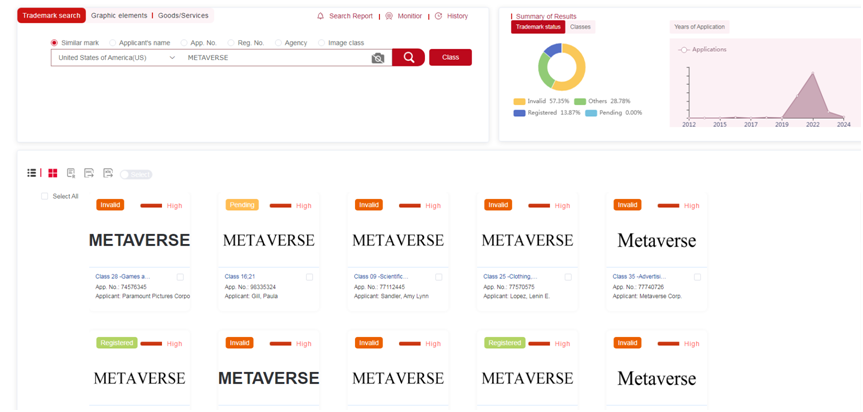
Image source: Kangxin IP Platform
2. The Chinese Market
As one of the world's largest countries for trademark registration, there is also a boom of the registration of metaverse trademarks in China. According to data released by the National Intellectual Property Administration, in recent years the number of applications for trademarks related to "元宇宙" and "METAVERSE" has surged, with a large number of trademarks in the form of "XX+ 元宇宙(metaverse)" appearing, such as Tencent applying for "王者元宇宙", Alibaba applying for "阿里元宇宙", "淘宝元宇宙", NetEase applying for "网易元宇宙", and so on. These applications cover industries such as technology, education, entertainment, and finance, reflecting the widespread attention and active layout of Chinese companies in the metaverse market. However, the National Intellectual Property Administration has actively discouraged or rejected these frenzy-like metaverse trademark applications. The National Intellectual Property Administration believes that the metaverse is a new technology and cannot be monopolized as a trademark by anyone; therefore, the examination of related trademarks is becoming increasingly strict in order to crack down on malicious registrations that do not have the purpose of use.
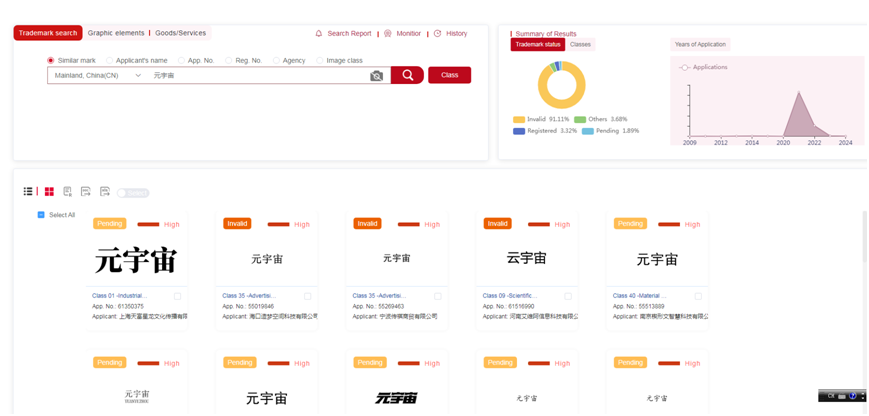
Image source: Kangxin IP Platform
3. Japanese, European, and South Korean Markets
Japan, Europe, and South Korea, and other countries and regions have also witnessed a boom in the registration of metaverse trademarks. Companies in these areas actively protect their brand rights in the metaverse field through their own or international trademark registration systems. Especially in South Korea, with the rapid development of the metaverse industry, the government and enterprises' attention to metaverse trademarks is continuously increasing, promoting a rapid increase in the volume of related trademark registrations.
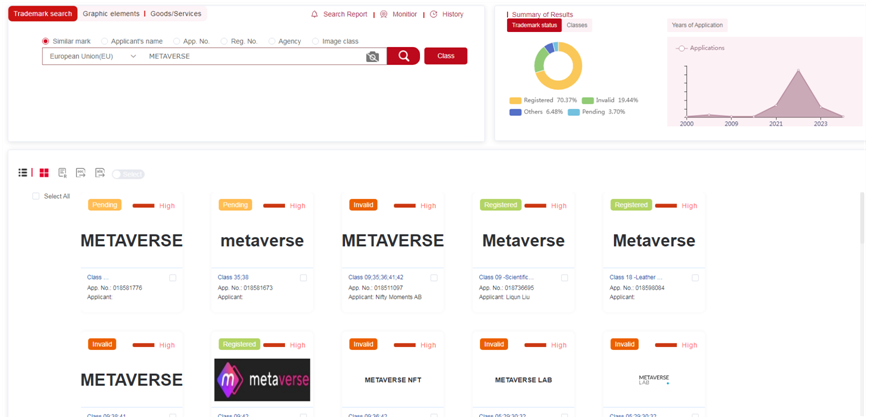
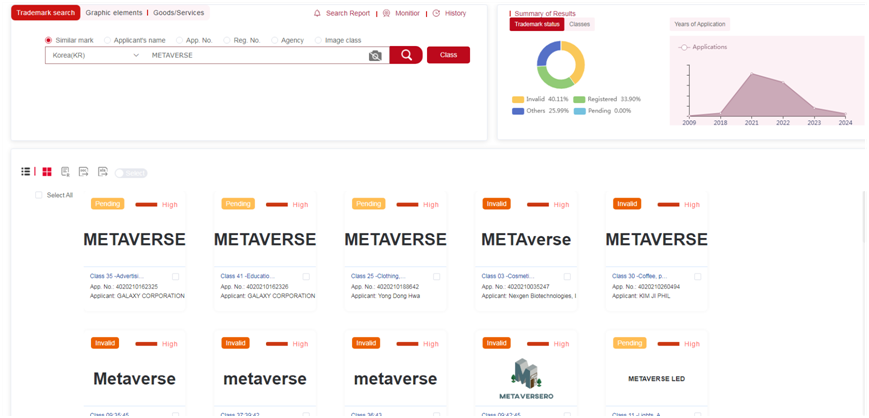
Image source: Kangxin IP Platform
Trademark Registration Strategies of Major International Metaverse Companies
1. Class Selection
Major international metaverse companies usually choose classes closely related to their business when registering trademarks. These classes include but are not limited to Class 9 (computer software, electronic devices, etc.), Class 35 (advertising sales, business management, etc.), Class 41 (educational entertainment, online games, etc.), and Class 42 (computer programming, design, etc.). By registering trademarks in these core categories, companies can effectively protect their brand rights in the metaverse field.
2. Specific Goods and Services Items
In terms of goods and services items, major international metaverse companies focus on innovative descriptions that combine with the characteristics of the metaverse. For example, downloadable virtual goods, interactive experiences in online virtual worlds, software applications related to virtual reality and augmented reality technologies, etc. The choice of these specific goods and services items not only reflects the companies' deep understanding of the metaverse market but also lays a solid foundation for their brand building and market expansion in the metaverse field.
However, it is worth noting that China does not accept direct expressions of virtual goods or services, nor does it accept expressions related to non-fungible tokens (NFT). However, in order to cater to international development trends and meet the needs of enterprise innovation and development, the National Intellectual Property Administration regularly updates and adds some expressions related to virtual goods/services in the "Chinese Classification of Goods and Services for Trademark Registration" to meet the needs of enterprises. For example, “virtual space game software; virtual reality game software; downloadable virtual reality computer game software; downloadable application software for virtual environments; virtual reality headsets; virtual reality goggles” in Class 9; “marketing through product placement for others in virtual environments” in Class 35; “electronic funds transfer provided via blockchain technology” in Class 36; “virtual reality game hall service; hosting art exhibitions using virtual reality technology; entertainment services provided in virtual environments; virtual reality game services provided on-line from a computer network” in Class 41; “design and development of virtual reality software; hosting virtual environments; providing virtual computer systems through cloud computingin Class 42, etc..
Another feasible solution is to choose appropriate virtual related goods or services when extending the Madrid International registration to designate China. For example, the goods/services items under Class 9 and Class 35 below have been approved and granted for protection by the National Intellectual Property Administration in trademark registrations designating China in the International registration:
Class 9: Downloadable virtual goods, namely, computer programs featuring eyewear, accessories for electronic apparatus, namely, bags, pouches, cases, covers and fascias specially adapted for mobile phones, for earphones, for computers, for cameras [photography], for digital tablets and mp3 players, horological and chronometric instruments, jewelry, furniture and furnishings, crockery, household linen, leatherware, clothing, shoes, headgear, accessories for clothing, toys, perfume, Eau de Cologne, soap, works of art for use in virtual environments; software for managing transactions using blockchain technology; downloadable computer software for use as a digital wallet
Class 35: Advertising promotion and advertising of downloadable virtual goods, namely, computer programs featuring eyewear, accessories for electronic apparatus, namely, bags, pouches, cases, covers and fascias specially adapted for mobile phones, for earphones, for computers, for cameras [photography], for digital tablets and mp3 players, horological and chronometric instruments, jewelry, furniture and furnishings, crockery, household linen, leatherware, clothing, shoes, headgear, accessories for clothing, toys, perfume, Eau de Cologne, soap, bath or shower gels and bath salts for cosmetic use, cosmetics for skin, body, face and nail care, creams, milks, lotions, gels and powders for the face, body and hands for cosmetic use, make-up preparations, body deodorants, perfumed candles, air fragrance reed diffusers, etc.
In the process of trademark registration and protection in the metaverse, the Kangxin IP Platform (eservice.kangxin.com) provides strong support for companies with its powerful time series big data analysis capabilities.
Trend Insight and Strategy Formulation: Collect and analyze global metaverse trademark registration data to help companies understand market trends, review standards, and competitor strategies, and formulate accurate trademark registration and protection strategies.
Risk Early Warning and Response: Monitor global trademark registration dynamics in real-time, provide early warning of potential infringement risks, and offer professional legal analysis and response strategy recommendations to help companies maintain their brand rights in a timely manner.
Decision Support and Optimization: Assess the value and prospects of trademark registration through big data analysis, provide decision support such as success rate prediction and brand layout suggestions, and help companies optimize their registration strategies to improve success rates and efficiency.
As one of the important directions for the future development of the internet, trademark registration and protection in the metaverse have become a focus of global enterprises. By deeply analyzing the metaverse trademark registration situation in major economies such as the United States, China, Japan, Europe, and South Korea, as well as the trademark registration strategies of major international metaverse companies, we can find that companies' brand layout in the metaverse field is showing characteristics of diversification and innovation.
Enterprises need to closely monitor market dynamics and policy changes, actively use professional service platform-provided data analysis and decision support services, and continuously enhance their brand competitiveness and market influence in the metaverse field.
 {{item.truncatedText}}
{{item.basicDescription&&item.basicDescription.slice(0,150)}}{{item.basicDescription&&item.basicDescription.length>150?"...":""}}
{{item.truncatedText}}
{{item.basicDescription&&item.basicDescription.slice(0,150)}}{{item.basicDescription&&item.basicDescription.length>150?"...":""}}