
Guide to Trademark Renewal in Iceland
Time:2025-12-25
Publication Date:2025-12-25
Iceland is an important economic hub in the Nordic region. For companies looking to protect brands in the Nordic market, understanding Iceland’s trademark renewal framework is crucial. This guide summarizes the key rules under Iceland’s Trade Mark Act and current practice. It draws on information from Icelandic law firms and the Icelandic Intellectual Property Office (ISIPO) so that businesses know exactly when to renew, what fees apply and how to avoid losing rights.
1 Duration of protection
Iceland uses a registration system—protection starts on the date on which the application is filed and lasts ten years. Registration can be renewed indefinitely for further ten‑year terms. For example, a mark registered on 15 May 2020 will remain valid until 14 May 2030. Renewal will extend protection to 14 May 2040 and so on. No declaration of use is needed at renewal; however, marks that are not used for five years after registration or during any continuous five‑year period may be invalidated upon request. Owners should therefore retain evidence of use—such as product labels, advertising contracts or customs documents—to defend against non‑use cancellation.
2 Renewal window and grace periods
Iceland has a “six‑plus‑six” rule for renewals. Renewal can be filed up to six months before the expiry date, and a six‑month grace period is available after expiration. A late renewal during the grace period attracts an extra fee. If the owner misses this window, the mark is cancelled and can only be re‑established within two months for an additional charge. Failing to renew within this extended period means a new application is required. The table below summarises these time frames.
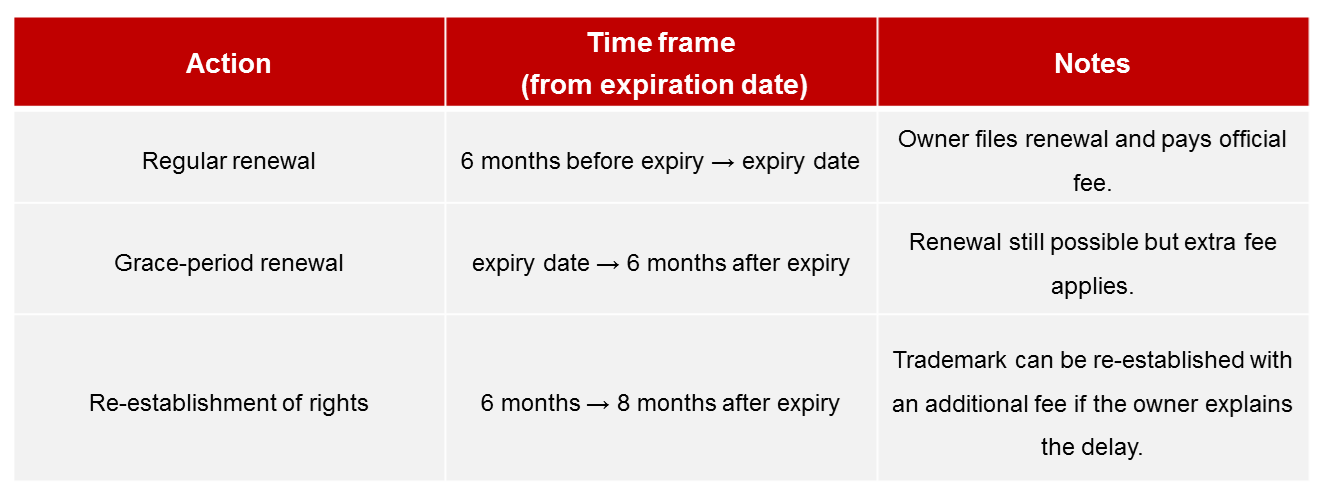
Example: a mark expiring on 14 May 2030 should be renewed between 15 November 2029 and 14 May 2030. If missed, renewal is still possible until 14 November 2030, and re‑establishment can be sought until 14 January 2031.
3 Fees and payment methods
ISIPO sets renewal fees. According to its February 2025 fee schedule, the application/renewal fee is ISK 40,600 for one class, with ISK 8,900 for each additional class. A resumption of rights (re‑establishment) request costs ISK 13,000. Fees must be paid within the period specified in ISIPO’s invoice, and payment can be made by bank transfer or online. The office warns that it never sends unofficial payment requests. If using an agent, expect an additional service charge; some law firms quote all‑inclusive fees covering professional work and official charges.
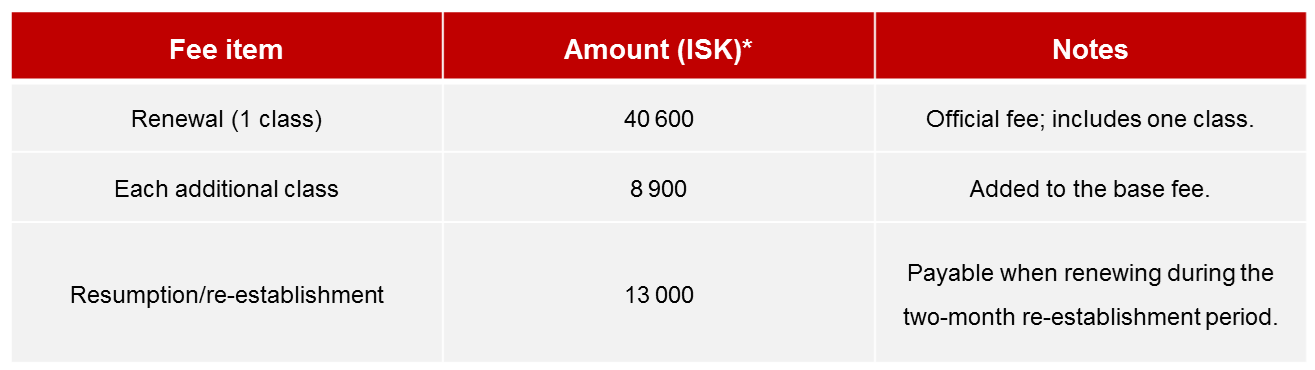
*Icelandic króna (ISK). Exchange rates fluctuate; 1 USD ≈ 139 ISK in mid‑2025 (approx. US$292 for a 40 600 ISK renewal).
4 Consequences of non‑use
Iceland does not require owners to file proof of use when renewing. Nonetheless, under the Trade Mark Act, a trademark that has not been used for five years may be cancelled if a third party petitions for revocation. Use includes use in a slightly altered form that does not affect distinctiveness or use on goods solely for export. Owners should therefore maintain consistent use and keep evidence such as packaging, advertisements and sales records.
5 Renewal during ownership changes
Changes of ownership or name do not stop the renewal clock. Renewal applications must be filed in the name of the current owner on the register, even if a transfer is being processed. Once ISIPO approves the transfer, it will link the renewed registration to the new owner. Businesses should promptly update contact details, because ISIPO’s renewal reminders are sent to the recorded address. Failure to update details can lead to missed notices and loss of rights.
6 Managing multiple trademarks
Companies that own numerous Icelandic trademarks need systems to track renewal deadlines. Many IP‑management platforms offer automated reminders, real‑time status updates and document storage. These tools help monitor expiry dates across jurisdictions and generate alerts six months before deadlines, reducing the risk of accidental lapses. A platform should allow collaboration between in‑house counsel, external agents and overseas offices, and should adhere to recognised security standards (e.g., ISO/IEC 27001) to protect confidential data. Although ISIPO sends reminders, ultimate responsibility for tracking renewals rests with the trademark owner.
7 Practical tips
1.Calendar deadlines early. Mark the expiry date at registration and create alerts six and twelve months ahead. Early planning avoids last‑minute rushes and ensures funds are available for renewal fees.
2.Keep evidence of use. Even though proof of use is not required for renewal, maintain records to defend against non‑use challenges.
3.Monitor ownership details. Ensure ISIPO always has up‑to‑date contact information, especially after corporate reorganisations.
4.Consult professionals for transfers or complex portfolios. Lawyers or agents experienced in Icelandic practice can file renewals, update ownership records and address office actions.
8 Conclusion
Renewing a trademark in Iceland is straightforward provided that owners observe key timelines and pay the required fees. Protection lasts for ten years from the filing date and can be renewed indefinitely. Renewal should be filed within six months before expiry and no later than six months after, with a further two‑month window for re‑establishing rights. The official fee for a single‑class renewal is 40 600 ISK (plus 8 900 ISK for each additional class), and no evidence of use is required. By maintaining active use, keeping contact details current and using reliable IP‑management tools, companies can protect their brands in the Icelandic and broader Nordic markets for the long term.
 {{item.truncatedText}}
{{item.basicDescription&&item.basicDescription.slice(0,150)}}{{item.basicDescription&&item.basicDescription.length>150?"...":""}}
{{item.truncatedText}}
{{item.basicDescription&&item.basicDescription.slice(0,150)}}{{item.basicDescription&&item.basicDescription.length>150?"...":""}}