
Defending Rights: A Practical Guide to Trademark Protection on Douyin
Time:2024-12-27
Publication Date:2024-12-27
With the rise of short videos and live-streaming e-commerce, Douyin has become one of the key channels for product sales. However, trademark infringement issues have also surfaced, severely undermining the legitimate rights of trademark owners. This article explores the phenomenon of trademark infringement on the Douyin platform through actual cases, analyzing various solutions available to trademark owners upon discovering infringements, including Douyin's complaint process, evidence collection, notarization, civil litigation, and administrative enforcement. The goal is to provide comprehensive and professional guidance for trademark owners in protecting their rights.
1. Analysis of Trademark Infringement Cases on Douyin
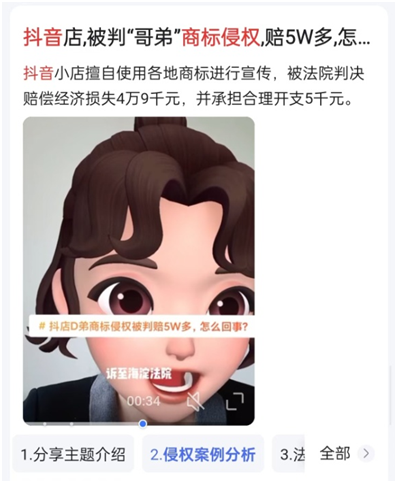
In recent years, numerous cases of trademark infringement on Douyin have emerged. For instance, the owner of a well-known clothing brand found that its registered trademark was used without authorization by a Douyin shop for similar products, leading to consumer confusion. The trademark owner preserved evidence of the infringement by taking screenshots and discovered that the shop not only used identical or similar marks but also promoted the products widely through live broadcasts and short videos, severely infringing on their trademark rights.
[Image Source: Internet]
2. Solutions After Discovering Infringement
1. Douyin's Complaint Process
Upon discovering infringement, trademark owners should first attempt to resolve the issue through Douyin's internal complaint mechanism. The specific process is as follows:
The first method: submit a complaint within the Douyin APP. Enter the personal center page, find the "Settings" option, select "Feedback and Help", in the "About" section, enter the interface and select "Infringement Report", select the report type, and then select the video to be complained in the video list, fill in the detailed complaint information, and submit the complaint;
or click "..." from the personal page of the reported person's account - "Report" - "User Report" - "Infringement of Rights" to report, etc.
The second method: send complaint materials to the email address jubao@douyin.com, including but not limited to the identity proof materials and contact information of the right holder and preliminary proof materials of infringement (infringing account, infringing content link, infringement evidence screenshot, etc.).
Wait for Processing: After submitting the complaint, patiently await Douyin’s review. Douyin has a dedicated intellectual property protection mechanism that investigates complaints based on relevant laws and regulations.
2. Evidence Collection and notarization
To ensure the accuracy and effectiveness of the complaint, trademark owners should conduct or commission professional investigator(s) to gather evidence. The evidence collection should include:
Infringement Evidence: Screenshots or screen recordings of the infringing content, documenting the time, place, and manner of the infringement.
Product Verification: Purchase the infringing product for physical examination to confirm that the trademark used on the product is identical or similar to the registered trademark.
Infringer Information: Obtain the true identity of the infringer through Douyin or other channels, providing a basis for subsequent rights protection.
For important evidence of infringement, trademark owners may choose to have the evidence notarized to enhance its legal validity. The notarization process includes:
Submit an Application: Submit a notarization application to a notary office, providing identification, authorization letters, and infringement evidence.
Notarization Process: Under supervision, the notary public extracts, preserves, and describes the infringement evidence, ensuring the authenticity and legality of the notarization process.
Obtain Notarial Deed: The notary office issues a notarial deed based on the notarization process, serving as crucial evidence for subsequent rights protection.
4. Civil Litigation
If the complaint through Douyin does not effectively resolve the infringement issue, trademark owners may choose to file a civil lawsuit in court. The litigation process includes:
Preparation for lawsuit: Collect and organize infringement evidence, draft the complaint, and specify the legal requests and reasons.
Submit the lawsuit: File the Bill of Complaint and related evidence with the competent court and pay the litigation fees.
Court hearing: After the court accepts the case, a hearing is organized where both parties present evidence and arguments.
Judgment Enforcement: The court makes a judgment based on facts and laws, and the infringer is required to fulfill the judgment obligations, including ceasing the infringement and compensating for losses.
5. Administrative Enforcement
Trademark owners may also choose to report infringement to market supervision departments or other administrative authorities, requesting legal action. These authorities will investigate the infringement based on relevant laws and regulations, and may impose administrative penalties if necessary.
In facing trademark infringement issues on Douyin, trademark owners should actively take measures to safeguard their legitimate rights. By utilizing Douyin's complaint process, evidence collection and notarization, civil litigation, and administrative enforcement, they can establish a comprehensive and multi-layered rights protection system.
Additionally, it is advisable for trademark owners to enhance their brand protection awareness by registering trademarks and seeking copyright and patent protections, regularly monitoring online market trends to promptly identify and address infringement, promoting genuine product information through official channels to raise consumer awareness and strengthening collaboration and communication with other businesses or organizations to advance intellectual property protection efforts.
Utilizing third-party platforms for protection, such as Kangxin IP Platform (eservice.kangxin.com), can help brand owners monitor various mainstream e-commerce platforms in China, automatically screening for suspected infringements, excluding whitelisted entities, and providing one-click options to report infringement links or conduct offline investigations. By adopting such multifaceted trademark monitoring and protection strategies, the brand can maintain a competitive edge in an increasingly fierce market.
 {{item.truncatedText}}
{{item.basicDescription&&item.basicDescription.slice(0,150)}}{{item.basicDescription&&item.basicDescription.length>150?"...":""}}
{{item.truncatedText}}
{{item.basicDescription&&item.basicDescription.slice(0,150)}}{{item.basicDescription&&item.basicDescription.length>150?"...":""}}