
Global Strategic Analysis of Facebook’s Trademark Portfolio: A Model for Intellectual Property Protection
Time:2025-05-21
Publication Date:2025-05-21
As one of the world’s largest social networking platforms, Facebook (now under Meta) has not only revolutionized how people connect but has also demonstrated a forward-thinking and comprehensive approach to intellectual property (IP) protection.
This article, leveraging statistical analysis from Kangxin IP Platform (service.kangxin.com), explores key insights into Facebook’s trademark application trends, classification distribution, and strategic considerations across major regions, including the US, China, Japan, Europe, South Korea, and the World Intellectual Property Organization (WIPO). Additionally, we examine the challenges Facebook has encountered in global trademark registration, including registration barriers and disputes, to analyze the successes and challenges of its trademark strategy.
Overview of Facebook
Facebook was originally founded on February 4, 2004, by Mark Zuckerberg in a Harvard University dormitory under the name “thefacebook,” initially serving Harvard students. The platform rapidly expanded its user base worldwide, becoming a bridge that connects people across the globe. As of 2023, Facebook's monthly active users (MAU) have exceeded 2.9 billion, with an immense volume of content generated daily.
User demographics indicate that Facebook serves a diverse group spanning different age ranges, from teenagers to the elderly, with varied professional backgrounds and interests. Beyond being a social platform, Facebook has built a diversified ecosystem incorporating advertising, payments, and content sharing. In recent years, Meta has expanded its business into the metaverse sector, covering emerging technologies such as virtual reality (VR), augmented reality (AR), and NFTs.
Analysis of Facebook’s Trademark Portfolio
1. Applicant Analysis
Using data from the Kangxin IP Platform, we can conduct an in-depth analysis of Facebook’s trademark applications from multiple perspectives.
(1) Trends in Trademark Application Volume
Since its inception, Facebook’s trademark applications have shown a steady upward trend. Particularly in key markets such as the US, China, Japan, Europe, South Korea, and WIPO, Facebook has maintained a high level of trademark filings, reflecting its strong emphasis on IP protection and its forward-looking approach to global market expansion.
United States: As Facebook’s country of origin, the US has the highest number of trademark applications, covering everything from core business to derivative services.
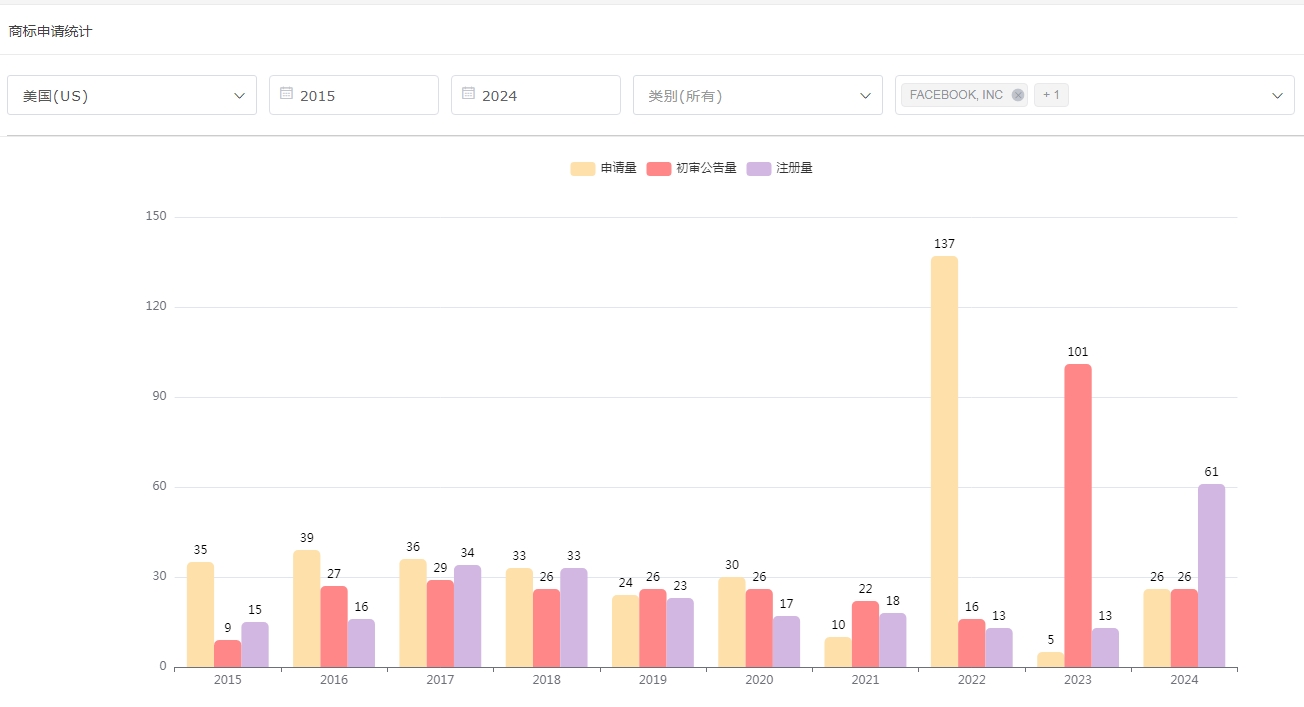
Statistics on US trademark applications over the past decade (Source: Kangxin IP Platform)
Europe: Facebook’s trademark applications in Europe have increased steadily, especially in key markets such as the UK, Germany, and France.
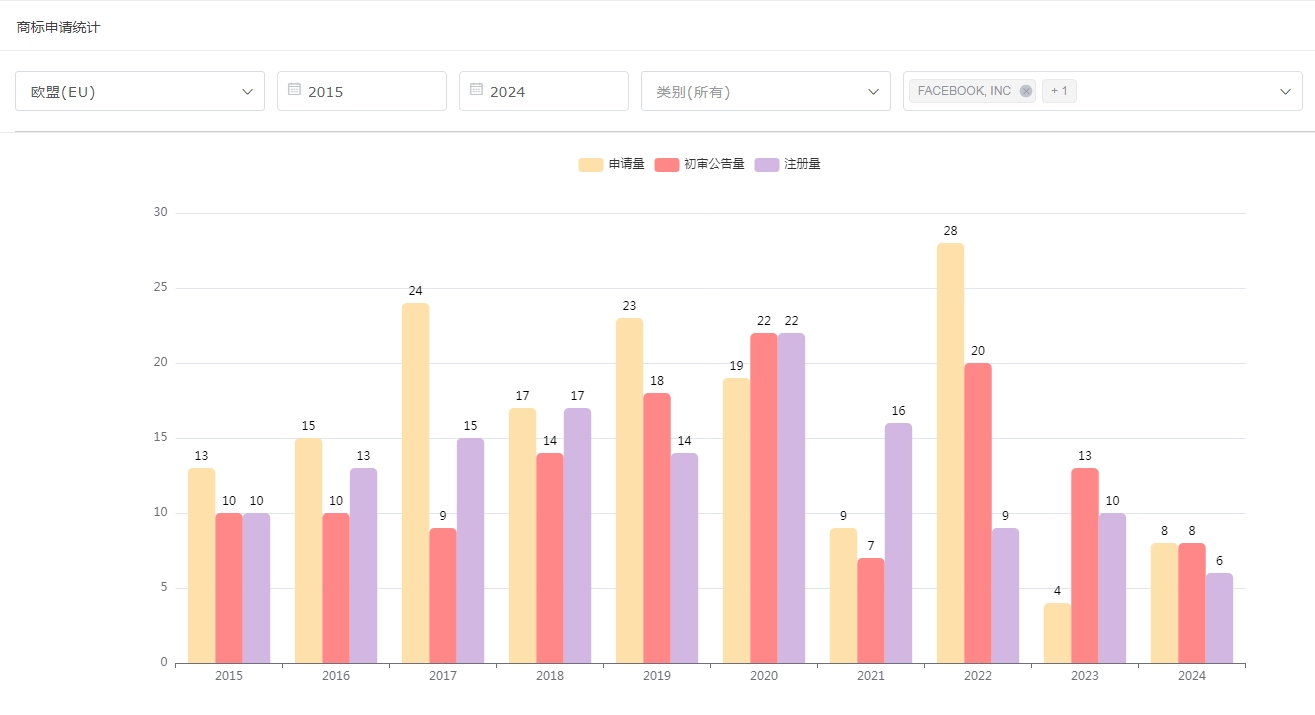
Statistics on EU trademark applications over the past decade (Source: Kangxin IP Platform)
Asia: Facebook has also significantly increased its trademark filings in China, Japan, and South Korea. Despite operational restrictions in China, Facebook has proactively built a trademark presence to secure future opportunities.
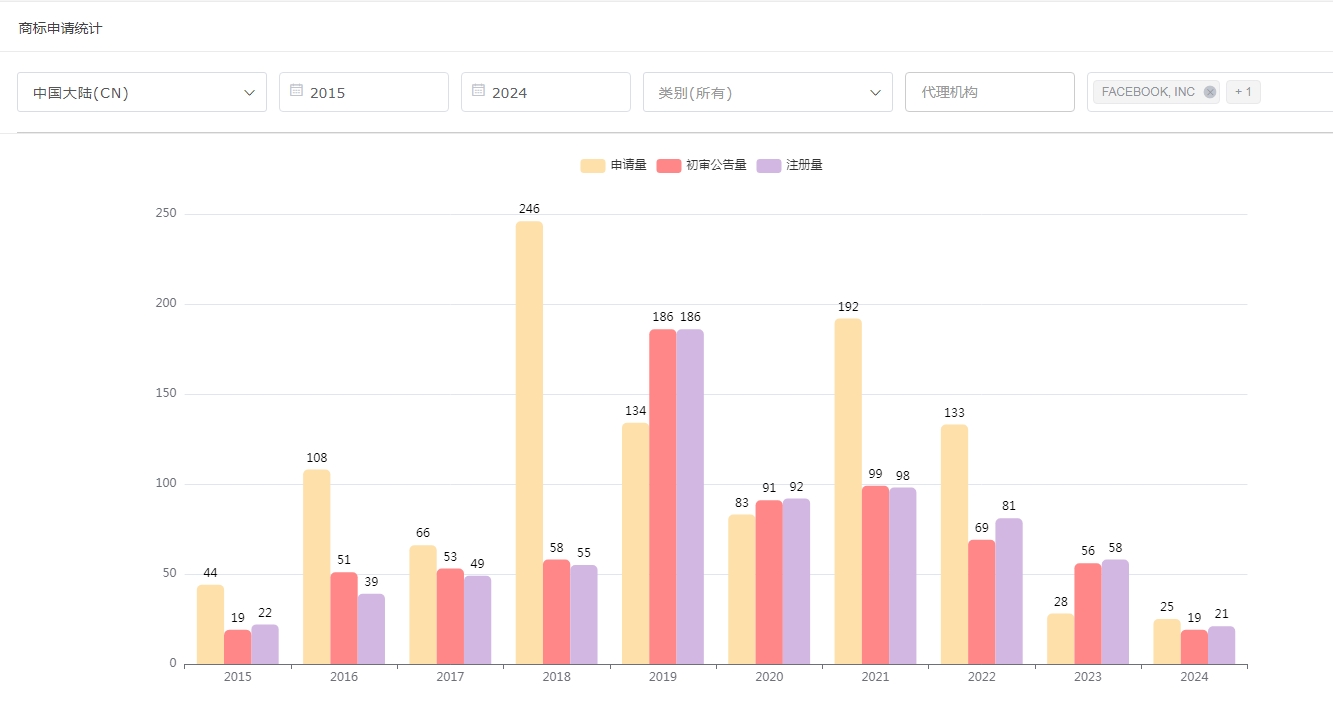
Statistics on trademark applications in China over the past decade (Source: Kangxin IP Platform)
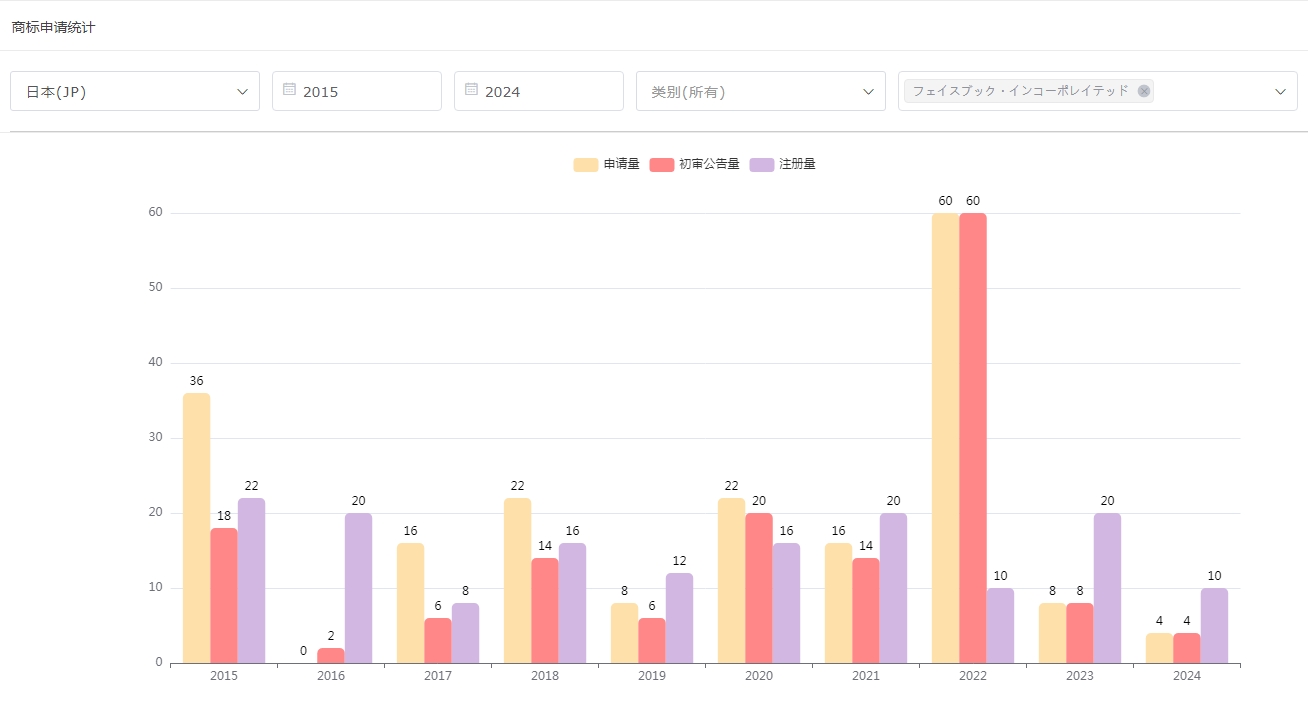
Statistics on trademark applications in Japan over the past decade (Source: Kangxin IP Platform)
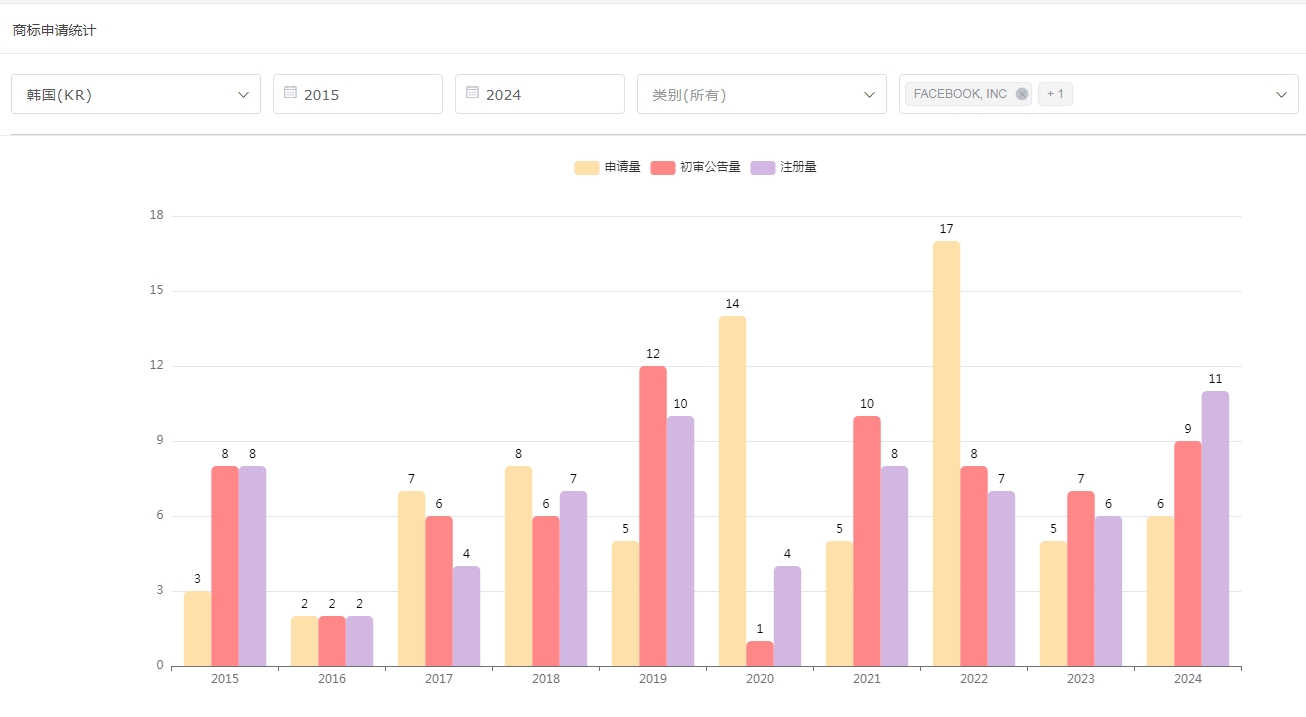
Statistics on trademark applications in South Korea over the past decade (Source: Kangxin IP Platform)
In recent years, Meta has expanded its business into the metaverse sector, covering emerging technologies such as virtual reality (VR), augmented reality (AR), and NFTs.
(2) Distribution by Goods and Services Classification
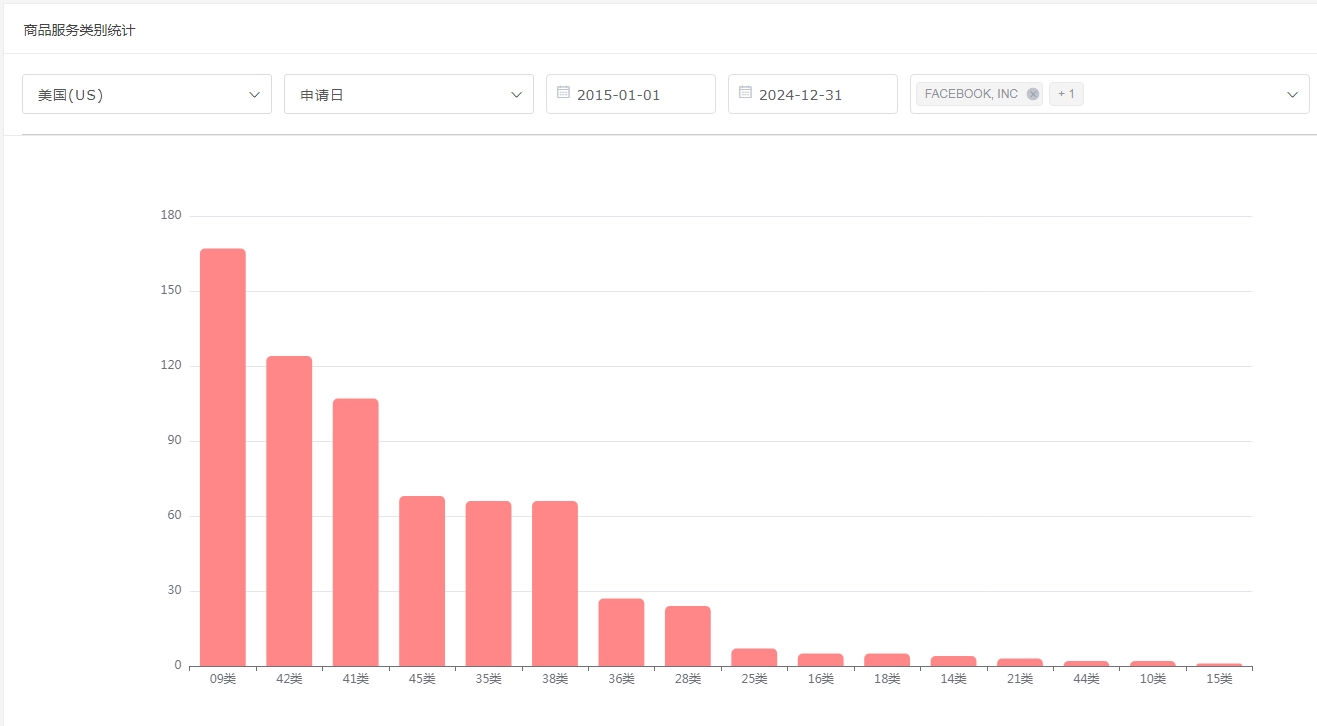
Statistics on US trademark applications by goods and services classification (Source: Kangxin IP Platform)
Facebook’s trademark applications cover a wide range of goods and services categories, including but not limited to:
Class 9: Computer software, applications, electronic devices.
Class 42: Data processing, cloud computing, software development.
Class 41: Education, entertainment, cultural and sports activities.
Class 45: Legal services, social services.
Class 35: Advertising, business management, online promotions.
Class 38: Telecommunications, social networking services.
This comprehensive classification strategy not only protects Facebook’s core business but also secures opportunities for future business expansion.
(3) Distribution Across Similar Groups
Facebook carefully structures its trademark applications across different similar groups to ensure brand exclusivity and recognition in various sectors. For example:
In Class 38, Facebook prioritizes trademarks related to “providing online social networking services” and “instant messaging services.”
In Class 35, the focus is on trademarks related to “online advertising services” and “business management services.”
This strategy helps prevent brand dilution and unauthorized use, safeguarding Facebook’s market position.
(4) Facebook’s Global Trademark Footprint
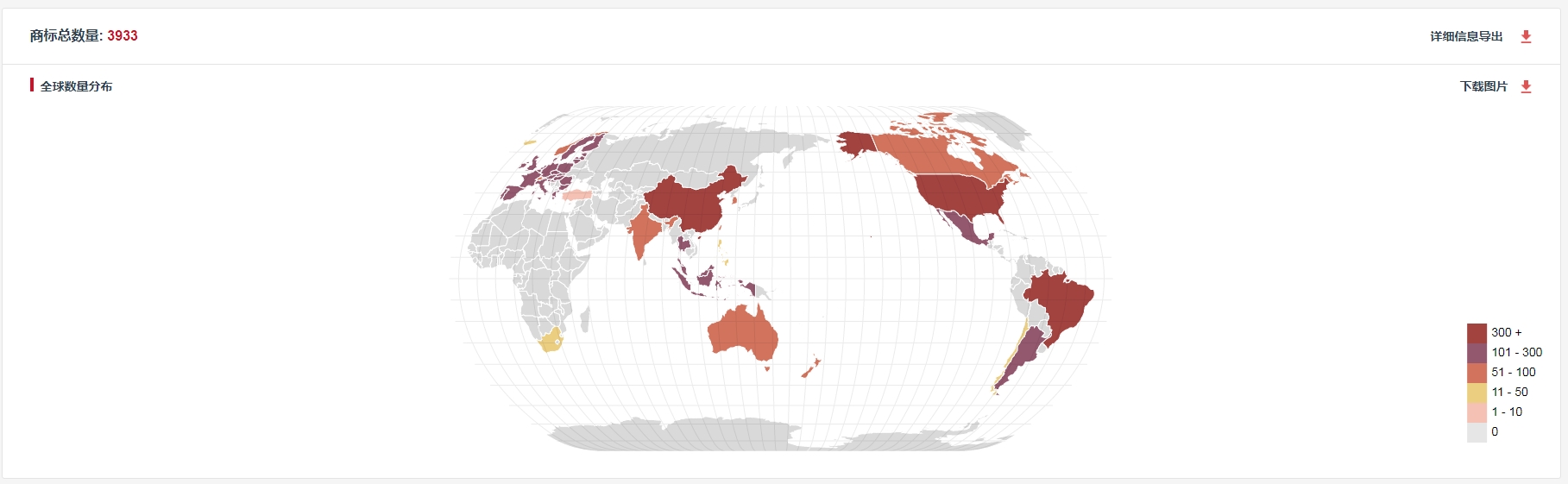
Global trademark distribution (Source: Kangxin IP Platform)
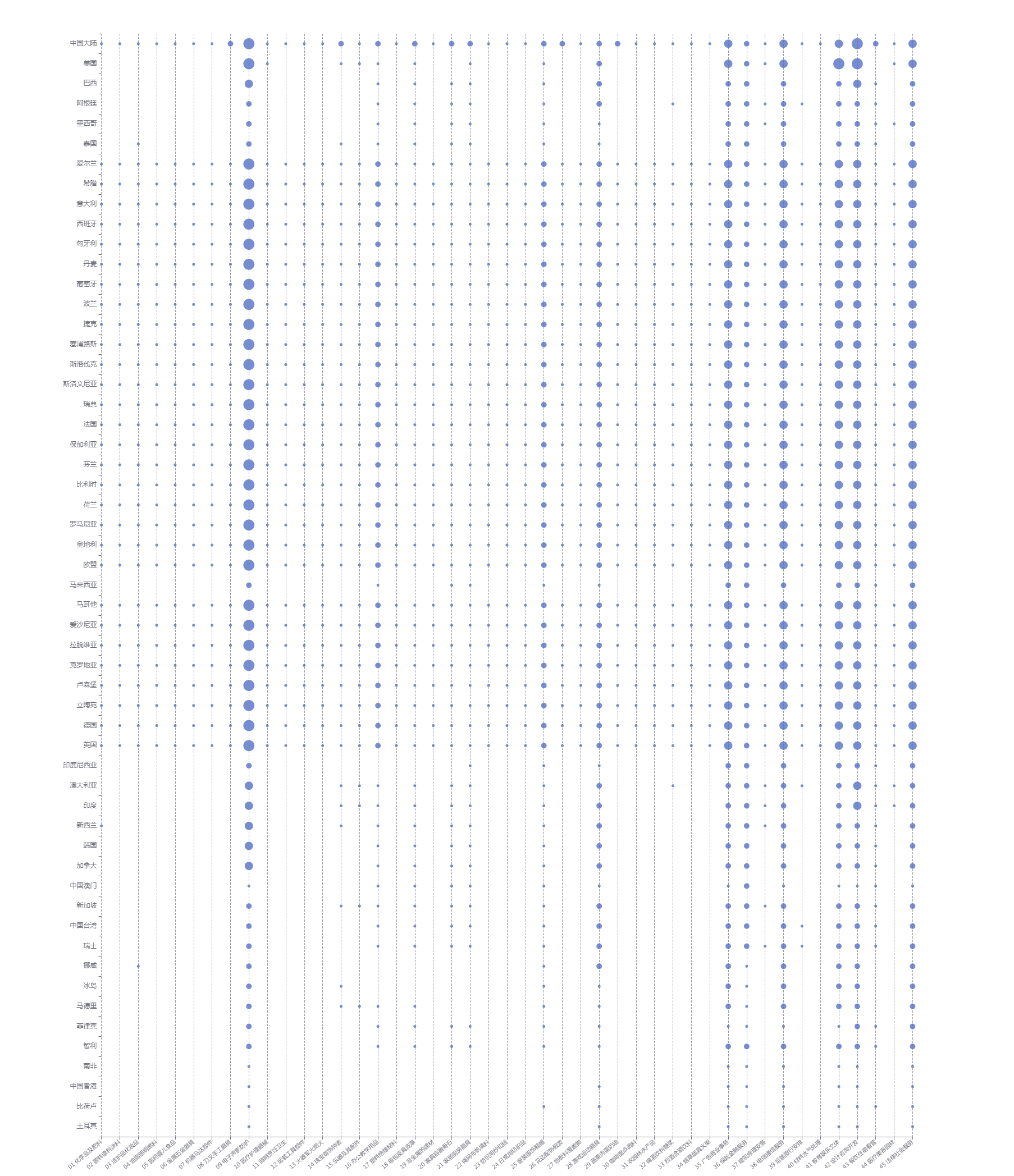
Classification distribution by country (Source: Kangxin IP Platform)
By analyzing trademark maps and bubble charts, we can see Facebook’s extensive global trademark presence. From North America to Europe and from Asia to Oceania, Facebook’s trademarks cover a vast geographic footprint, particularly in economically developed and high-potential markets such as the US, China, Japan, Europe, and South Korea.
In recent years, Meta has also seen a significant increase in trademark applications in emerging markets such as India, Brazil, and Indonesia, particularly in classes 35 (advertising services) and 45 (social services).
Trademark Registration Barriers and Disputes
Despite its strategic success, Facebook has faced several trademark registration challenges and disputes worldwide.
1. China
Although Facebook has not officially entered the Chinese market, it has proactively applied for Chinese trademarks in anticipation of potential future expansion. However, due to prior registrations by local entities, Facebook has encountered challenges in securing certain trademarks. For instance, the Chinese transliteration of “Facebook” (“脸书”) was preemptively registered by third parties, complicating its branding strategy in China. This case highlights the competitive and complex nature of the Chinese trademark landscape.
2. Europe
In Europe, Facebook has also faced trademark infringement lawsuits. For example, in a case before the Paris Court of Appeal, Meta (Facebook’s parent company) sued a website called “Fuckbook,” alleging trademark infringement and damage to Facebook’s brand reputation. Facebook ultimately won the case, reinforcing the importance of proactive trademark defense in international markets.
3. Other Countries
Outside China, the US, and Europe, Facebook has also encountered trademark registration disputes in various regions, such as:
India: A local company attempted to register a trademark similar to Facebook, which Facebook successfully blocked through legal action.
Australia: Facebook faced initial trademark registration conflicts due to existing local trademarks but resolved the issue through negotiations.
Brazil: Meta's trademark applications have faced challenges due to similarities with local trademarks in certain classes. However, Meta has successfully protected its trademark rights through evidence supplementation and legal actions.
These cases, though varied in specifics, underscore the necessity of robust trademark protection strategies in the globalization process.
Key Takeaways and Strategic Insights
Facebook’s trademark strategy exemplifies a well-structured and forward-looking approach to IP protection. Through extensive trademark filings in key regions such as the US, China, Japan, Europe, South Korea, and WIPO, Facebook has safeguarded its core business while laying a solid foundation for future expansion. However, the registration challenges and disputes encountered highlight the need for meticulous trademark planning in global markets.
Success Factors
1.Comprehensive Coverage: Facebook’s trademarks span multiple categories and similar groups, ensuring all-round brand protection.
2.Proactive Strategy: The company applies for trademarks well in advance of entering new markets, preventing trademark squatting.
3.Legal Defenses: Facebook actively pursues legal action to resolve trademark disputes and defend its brand rights.
4.Emerging Market Expansion: Meta has been actively laying out trademarks in emerging markets like India and Brazil, reserving space for future business expansion.
Challenges and Lessons Learned
1.Localization Challenges: Trademark laws vary by country, requiring customized trademark strategies.
2.Defensive Registrations: Registering defensive trademarks in core markets to prevent brand exploitation by third parties.
3.Ongoing Monitoring: Establishing a trademark surveillance system to detect and address potential conflicts in a timely manner.
4.Complexity of Brand Extension: As Meta expands into the metaverse, its trademark strategy must tackle new legal and technical challenges, like the trademark classification of virtual goods and services.
5.Cultural Differences: In some markets, Facebook's brand image may be challenged by cultural differences. For instance, social media use is strictly regulated in the Middle East.
Facebook’s trademark portfolio serves as a valuable case study for businesses aiming to strengthen their IP protection in the global market. As markets grow increasingly complex and dynamic, companies must adopt proactive and comprehensive trademark strategies to secure long-term brand development. By learning from Facebook’s experience, businesses can better navigate the challenges of globalization and achieve sustainable brand success.
 {{item.truncatedText}}
{{item.basicDescription&&item.basicDescription.slice(0,150)}}{{item.basicDescription&&item.basicDescription.length>150?"...":""}}
{{item.truncatedText}}
{{item.basicDescription&&item.basicDescription.slice(0,150)}}{{item.basicDescription&&item.basicDescription.length>150?"...":""}}