
Twitter (X) Trademark Strategy: Strategies, Challenges, and Future Prospects
Time:2025-10-10
Publication Date:2025-10-10
In the digital age, social media platforms have become an indispensable part of people’s daily lives. Twitter, the social media giant symbolized by a blue bird, has captivated hundreds of millions of users worldwide since its launch in 2006 with its unique short-form content sharing and interactive communication style. However, following Elon Musk’s acquisition and subsequent rebranding, Twitter officially became X. This shift not only marks a new beginning for the brand but also poses fresh challenges to its trademark strategy in the global intellectual property landscape.
This article provides an in-depth analysis of Twitter (X)’s trademark strategy, examining trends in application volume across China, the U.S., Japan, Europe, South Korea, and the World Intellectual Property Organization (WIPO), as well as the distribution of goods and services categories, similar group classifications, trademark mapping, and recent obstacles and disputes encountered in trademark registration. (All data screenshots in this article are sourced from the Kangxin IP Platform.)
Overview of Twitter (X)
Twitter, now rebranded as X, was first launched on March 21, 2006, quickly rising to prominence as a popular platform for users worldwide to share short content and engage in interactive exchanges. Its registered user base has surpassed hundreds of millions, with monthly active users reaching new highs. Through posts (tweets) limited to 280 characters, users share a variety of content—including text, images, videos, and links—spanning news, personal opinions, daily life, entertainment, political commentary, business updates, and more.
Twitter (X) boasts a diverse user base, spanning over 200 countries and regions globally. Its audience includes a wide range of demographics, predominantly young people, tech enthusiasts, journalists, politicians, and corporate brands. These users leverage Twitter (X) to access the latest information, express personal views, and participate in discussions on social issues, forming a vast social network.
Trademark Strategy Analysis
Application Volume Trends in China, U.S., Japan, Europe, South Korea, and WIPO
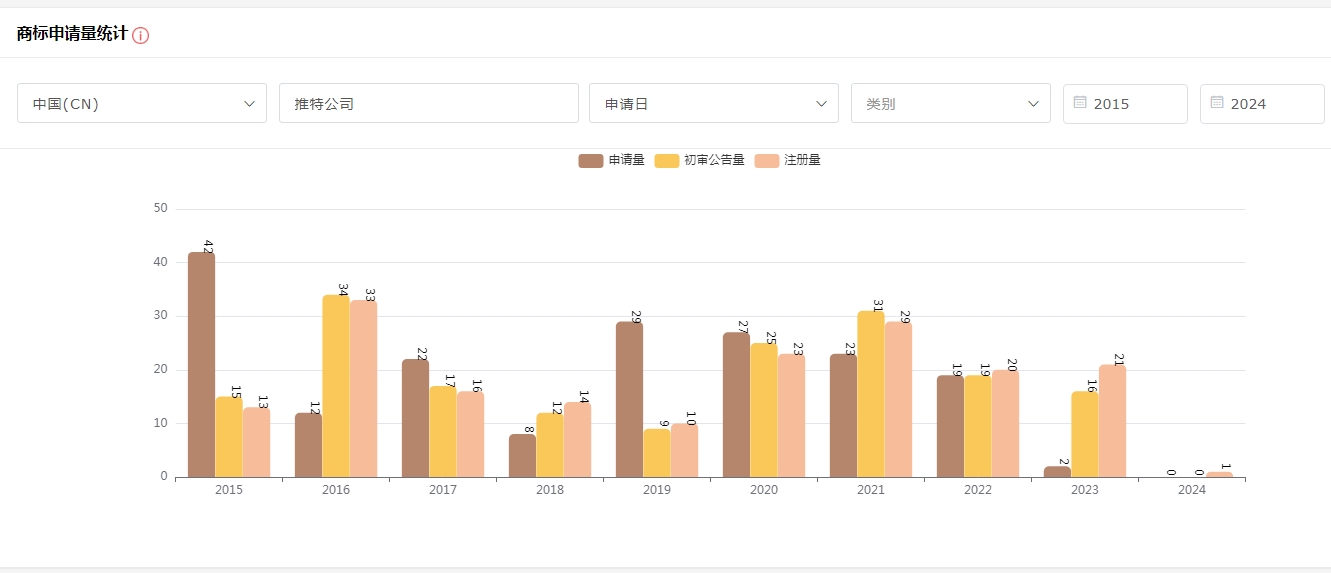
1). China
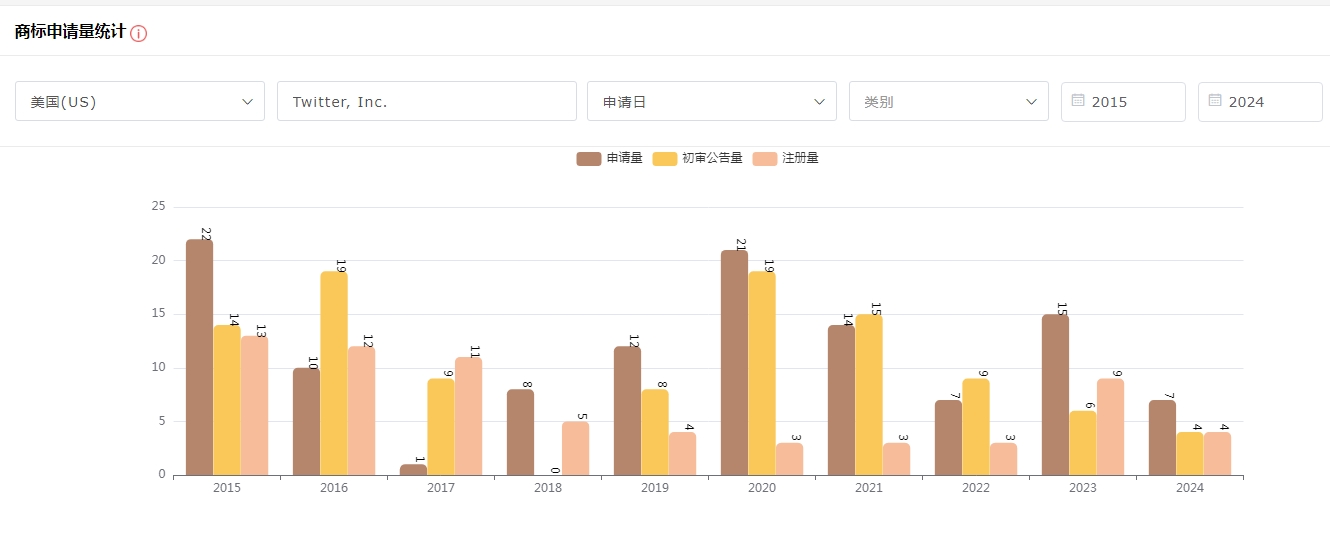
2). United States
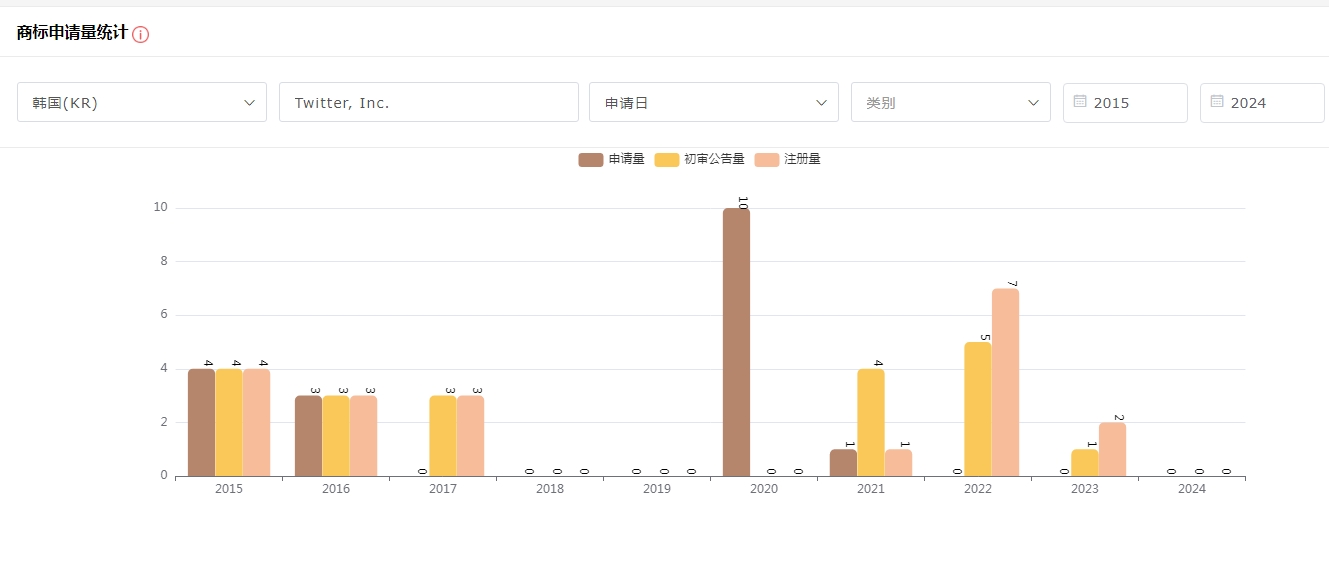
3). South Korea
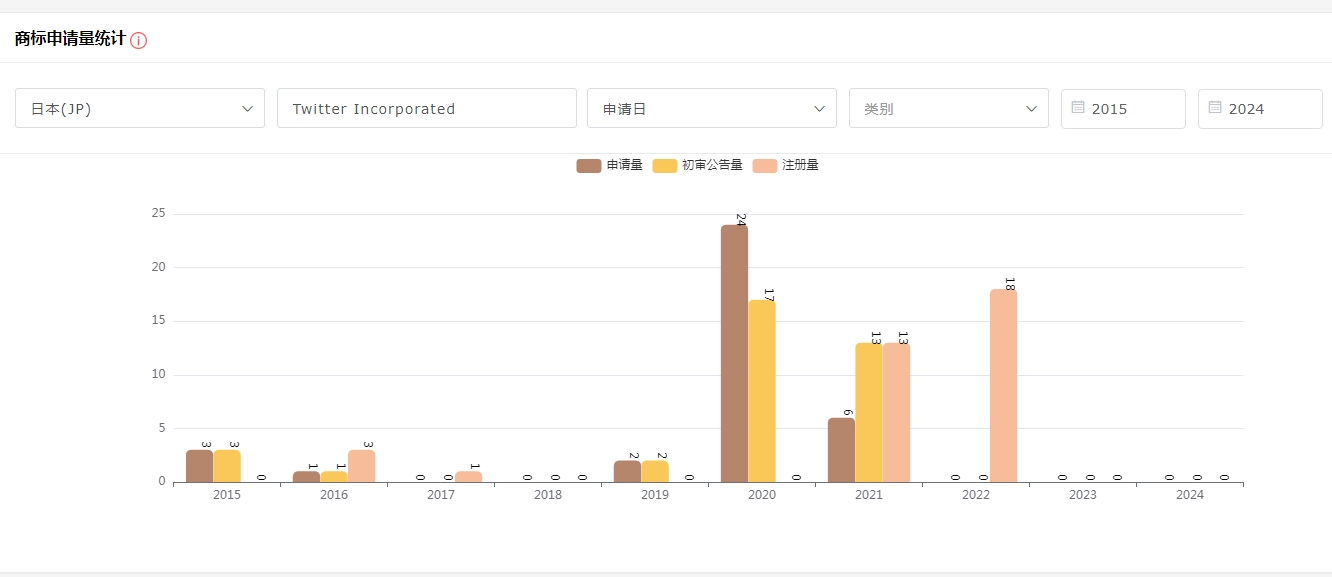
4). Japan
5). European Union
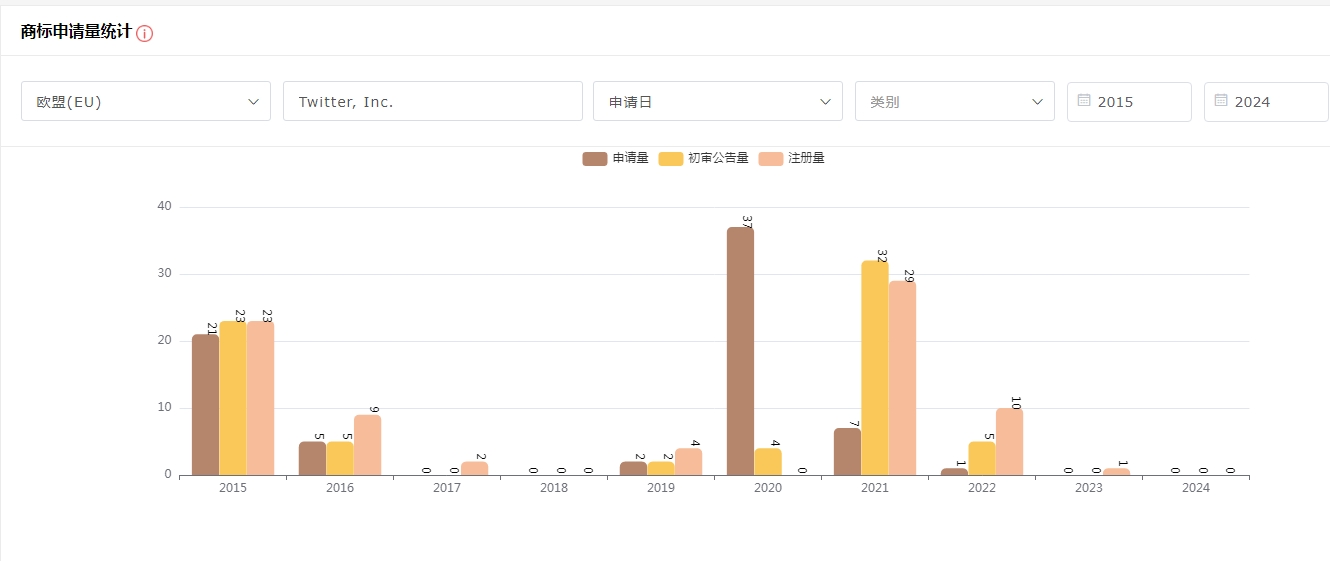
6). WIPO
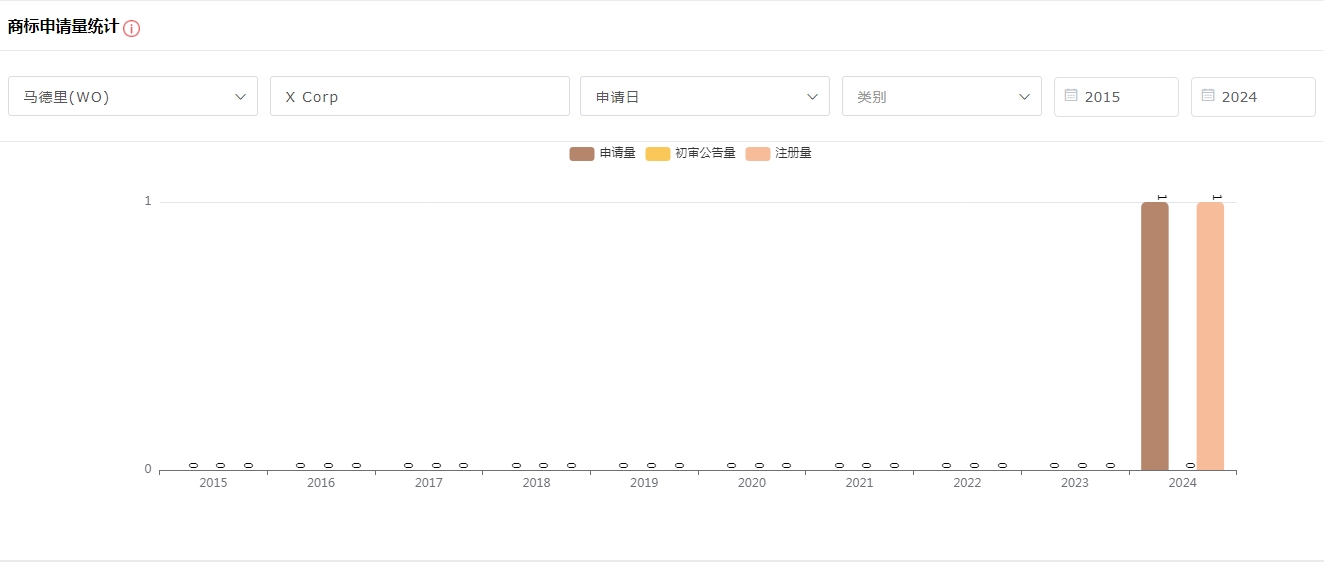
Twitter (X) has demonstrated a proactive approach to its trademark strategy. Application volumes in China, the U.S., Japan, Europe, South Korea, and WIPO show a steady upward trend. Particularly after Musk’s acquisition and the rebranding to X, Twitter (X) has significantly increased its trademark filings to strengthen brand protection and support market expansion. The application volume trends indicate a higher concentration in Europe and the U.S., aligning with its primary markets, while in Asia, filings are gradually rising as Twitter (X) expands its business presence.
Distribution of Goods and Services Categories
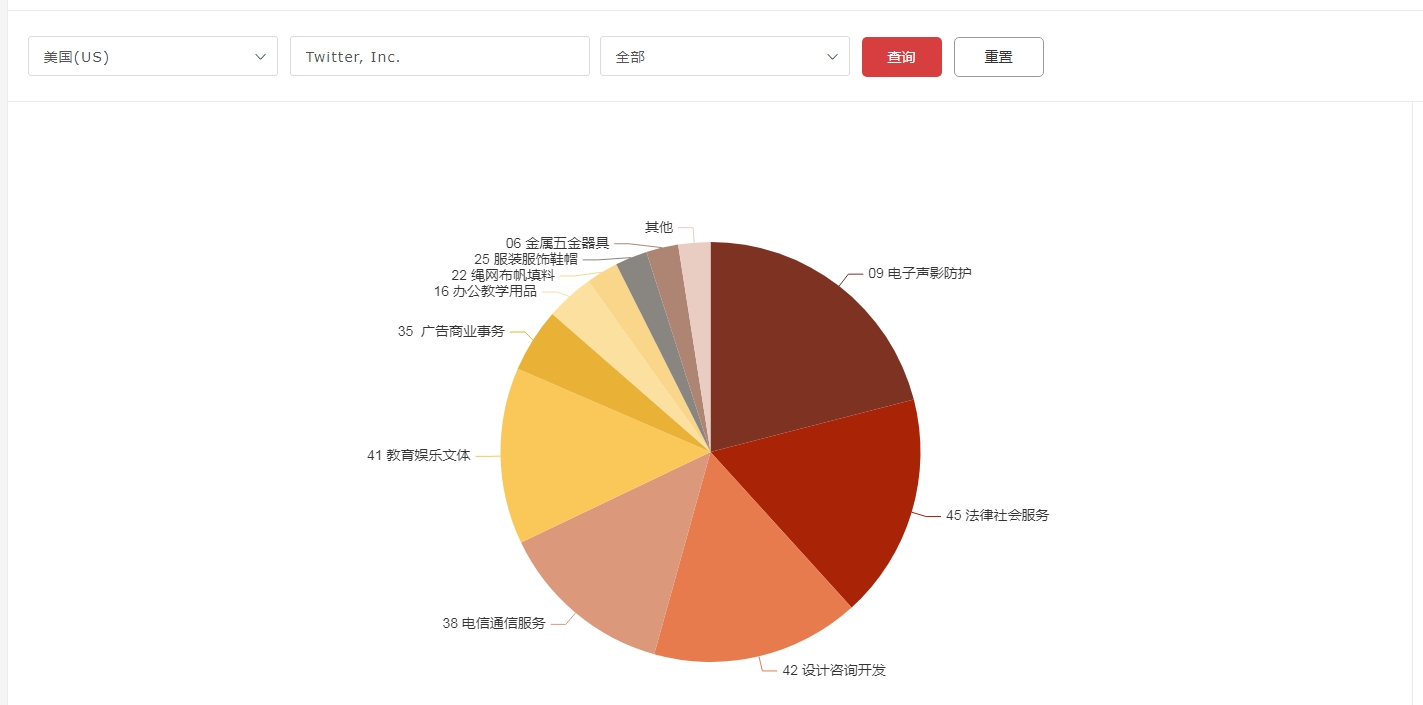
Twitter (X)’s trademark applications span a broad range of goods and services categories. In goods, filings primarily cover electronic products, computer software, and network communication equipment—items closely tied to social media operations. In services, categories include social media services, advertising, data processing, and e-commerce. This comprehensive approach reflects Twitter (X)’s strategic intent to diversify its business and secure its market position across multiple domains through trademark protection.
Similar Group Distribution
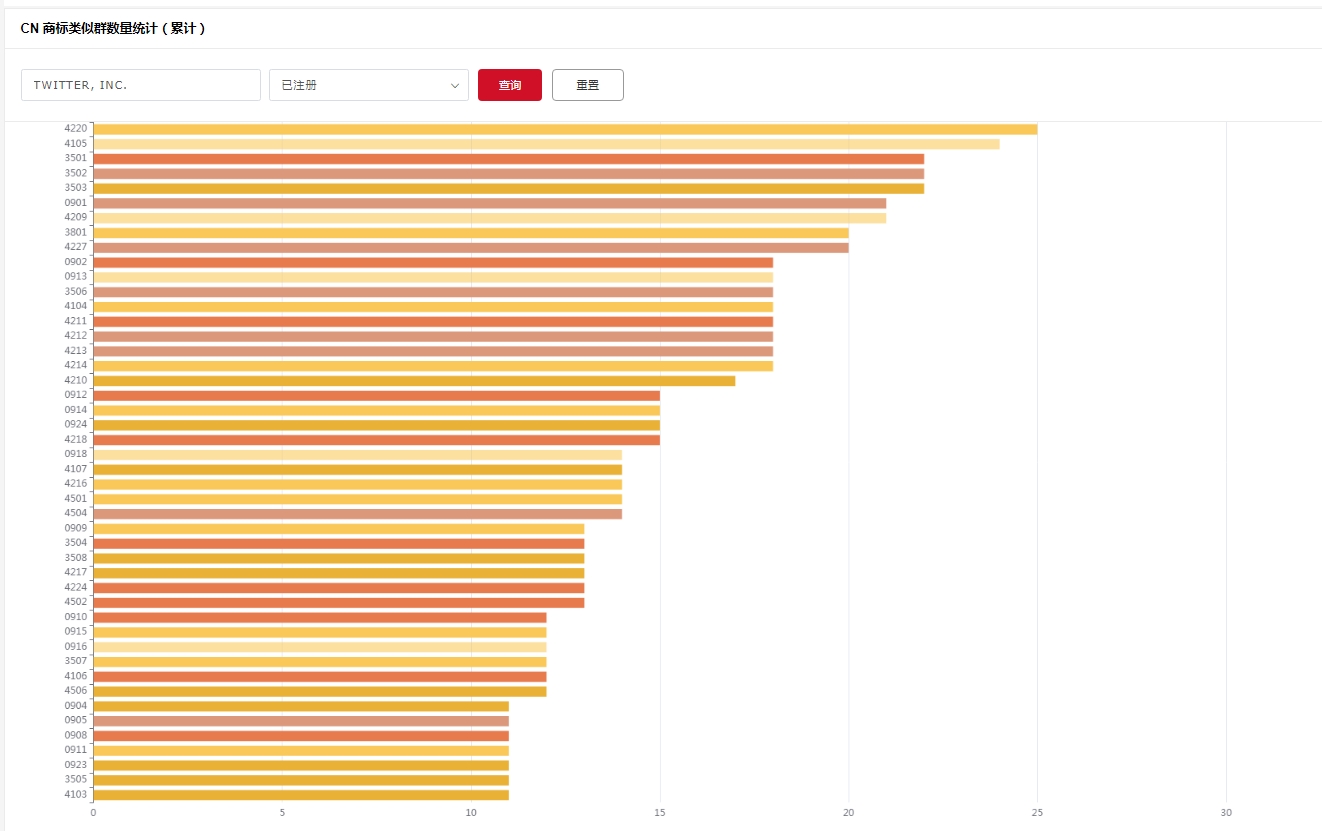
In terms of similar group classifications, Twitter (X) prioritizes safeguarding its core business. Its trademark applications are concentrated in groups related to social media, network communication, and data processing, ensuring brand distinctiveness and competitiveness in these critical areas. Additionally, Twitter (X) proactively files for trademarks in areas tied to potential future business expansions, laying the groundwork to mitigate intellectual property risks.
Trademark Map and Bubble Chart
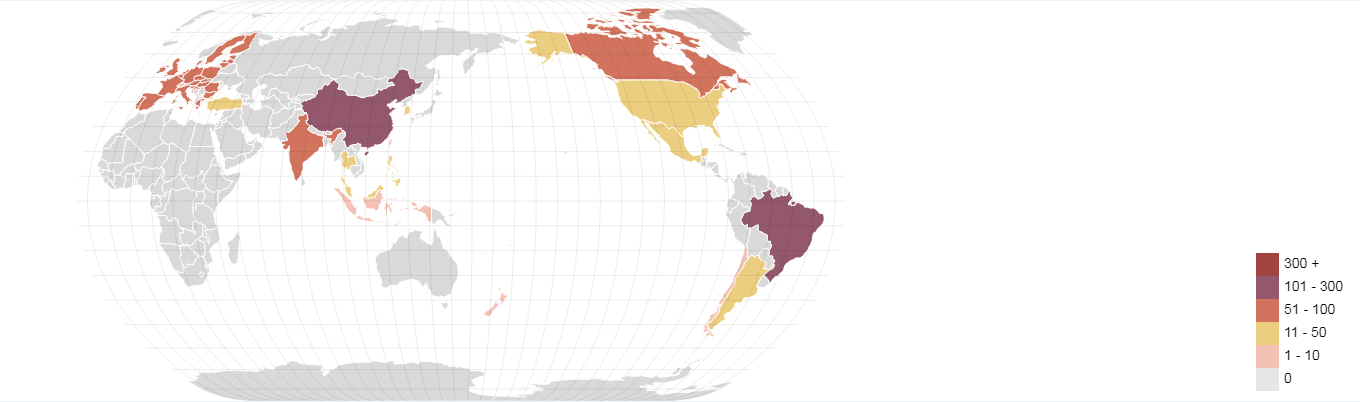
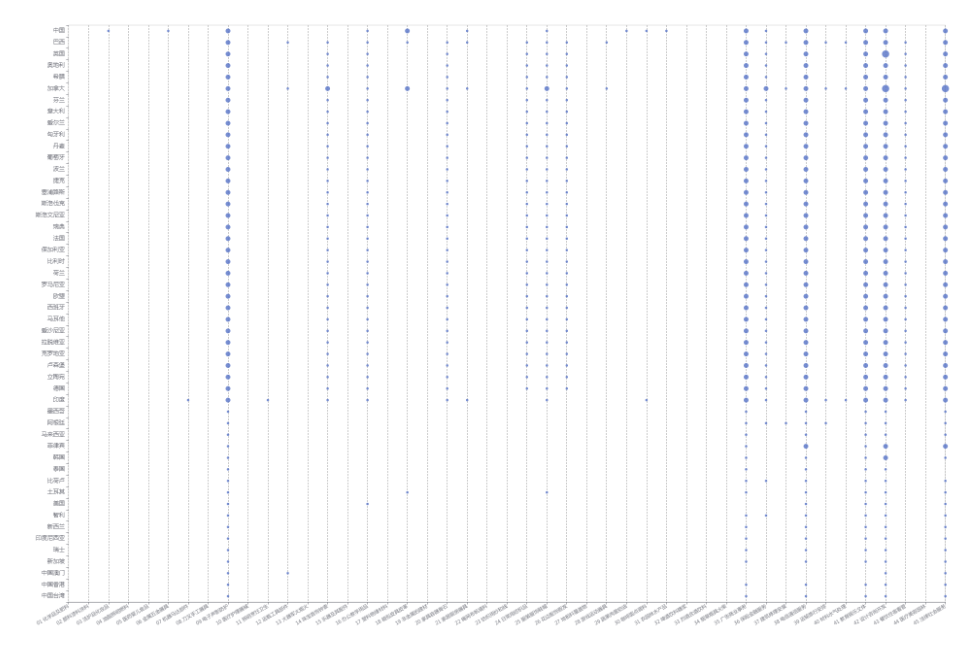
Through a trademark map, Twitter (X)’s global trademark strategy becomes evident, with a strong focus on North America, Europe, and Asia—particularly in China, the U.S., Japan, South Korea, and key European countries, where application volumes stand out. These regions are not only Twitter (X)’s primary markets but also hotspots for global intellectual property competition. A bubble chart further illustrates the intensity of Twitter (X)’s trademark activity across countries and its focus areas within various goods and services categories.
Trademark Registration Obstacles and Dispute Cases
United States: Trademark Infringement Lawsuit with X Social Media
In the U.S., Twitter (X) faced a trademark infringement lawsuit from X Social Media, which alleged that Twitter (X)’s new name infringed on its X-inclusive trademark rights. X Social Media sought a court order to halt the use of the X name and demanded compensation. The case garnered significant attention, highlighting potential vulnerabilities in Twitter (X)’s trademark strategy. Although Twitter (X) ultimately resolved the dispute, the incident underscores the need for greater caution in future trademark planning.
Europe: Trademark Dispute with Microsoft’s Xbox
In Europe, Twitter (X) encountered a trademark dispute with Microsoft’s Xbox. Microsoft has held an X-related trademark since 2003 tied to Xbox video game system communications, and Twitter (X)’s new name and logo risked causing confusion. While the issue has not escalated to litigation, it has prompted discussions between the two parties. Through proactive communication, Twitter (X) reached a settlement with Microsoft, averting potential legal risks.
Other Countries: Insufficient Distinctiveness Issues
In certain countries and regions, Twitter (X) faced challenges during trademark registration due to insufficient distinctiveness of the standalone letter “X,” which lacks uniqueness in trademark law. This issue has surfaced in multiple jurisdictions, posing obstacles to Twitter (X)’s global trademark strategy. To address this, Twitter (X) has employed strategies such as incorporating specific graphic elements or descriptive terms to enhance distinctiveness and secure registrations successfully.
Conclusion and Future Outlook
As a globally recognized social media platform, Twitter (X) has adopted a proactive and comprehensive approach to its trademark strategy. Through extensive filings in China, the U.S., Japan, Europe, South Korea, and WIPO, Twitter (X) has established a robust trademark protection framework, providing strong support for its steady global market growth. However, amid intensifying global intellectual property competition and potential legal risks, Twitter (X) must remain vigilant and continue refining its trademark protection strategies.
Looking ahead, we believe Twitter (X) would increase its investment in the trademark domain, deepen collaboration with professional intellectual property agencies, and enhance its global trademark strategy. Furthermore, as the social media landscape evolves and user needs shift, Twitter (X) must closely monitor market trends and competitors’ trademark strategies, adjusting and optimizing its own approach to adapt to future changes and challenges.
 {{item.truncatedText}}
{{item.basicDescription&&item.basicDescription.slice(0,150)}}{{item.basicDescription&&item.basicDescription.length>150?"...":""}}
{{item.truncatedText}}
{{item.basicDescription&&item.basicDescription.slice(0,150)}}{{item.basicDescription&&item.basicDescription.length>150?"...":""}}