
Top Ten Intellectual Property Judicial Protection Cases of the Shanghai Courts in 2024
Time:2025-06-19
Publication Date:2025-06-19
On the morning of April 23, at the Shanghai Courts’ press conference on judicial protection of intellectual property, the Shanghai Higher People’s Court reported the Top 10 Shanghai IP-protection cases of 2024, covering the main types of IP disputes in both criminal and civil fields. We are pleased to share those ten landmark cases.
Case Directory
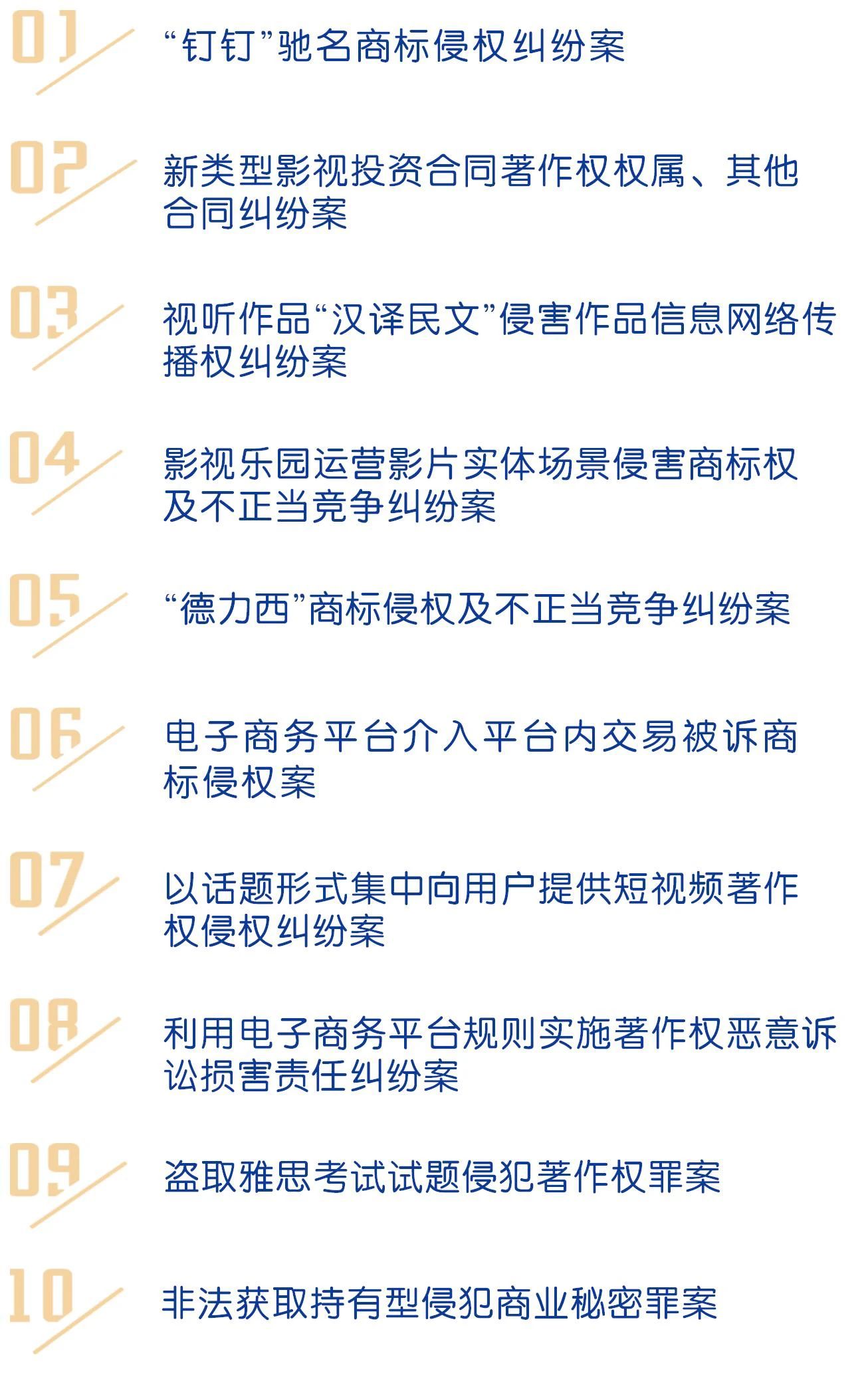
---
Case 1 / “DingDing” Well-Known Trademark Infringement Dispute
Dingmo Technology Co., Ltd. et al. vs. Chengdu He & Co. Catering Management Co., Ltd. et al. – Dispute over Trademark Infringement
(Shanghai Higher People’s Court Civil Judgment; Panel: Xu Jun, Ma Jianfeng, Zhang Ying)
Facts:
“DingDing” is an enterprise-grade smart mobile office platform launched by the Ali Group. Plaintiff Dingmo Technology Co., Ltd. and its co-plaintiffs hold registered “DingDing” word and wing-logo trademarks in Class 42 and have authorization to enforce them. Through long-term use and promotion, these marks have become widely known and highly influential in China. Defendants Chengdu He & Co. Catering Management Co. and others operate a chain of “Ding Yi Ding” hot-pot shops both online and offline, and have used a combined “DingDing Hot Pot” logo on shop signs, promotional boards, the delivery-platform storefront run by Shanghai Han & Co. Ltd., and on some food products. In their “DingDing Hot Pot” trademark application, they deliberately enlarged the “DingDing” characters horizontally and reduced “Hot Pot” vertically alongside. He & Co. also contracted a VI-design firm under an agreement stating it would “ride the coattails” of the “DingDing” brand’s endorsement to “quickly build awareness and drive brand associations.” The plaintiffs sued, asking the court to order the defendants to cease infringement, issue a public apology, and pay RMB 3 million in damages and costs.
Judgment:
The trial court held that, to find infringement, it must first establish that the “DingDing” word and wing-logo marks are well-known in Class 42. On the evidence, both marks were indeed well-known in Class 42 software services at the time of the defendants’ unauthorized use. Under Chinese law, a well-known mark enjoys cross-class protection into Classes 29, 35, and 43. The defendants’ use of non-identical reproductions in those classes would lead the public to associate their logo with the well-known “DingDing” marks, weakening the marks’ distinctiveness and misappropriating their reputation, harming the plaintiffs’ interests. The court therefore ordered He & Co. and the individual defendant to cease use of the “DingDing” word and wing logo, jointly pay RMB 500,000 in damages, and publish a statement to eliminate the adverse impact. No party appealed, and the judgment became final.
Significance:
Protection for a well-known mark is an extension of ordinary trademark rights. Courts must “look from a higher vantage point and further horizon” to align with commercial ethics and public policy. This decision applies the principle of “well-known status as needed,” ensuring robust civil remedies. Whether a well-known mark merits cross-class protection depends on its distinctiveness, renown, relevance, and similarity—considered holistically. After the first-instance ruling, the parties complied and settled, achieving positive legal and social outcomes.
---
Case 2 / New-Type Film-Investment-Contract Copyright and Other Contract Dispute
Wang M. vs. Shanghai Feng & Co. Film & Media Communication Co., Ltd. and Wu F. – Dispute over Copyright Ownership and Other Contracts
(Shanghai Xuhui District People’s Court Civil Judgment; Judge: Lü Qingfang; Shanghai IP Court Civil Judgment; Panel: Qian Guangwen, Ling Zongliang, Fan Jingbo; Shanghai Higher People’s Court Civil Judgment; Panel: Wang Jing, Zhang Ying, Zhu Jiapin)
Facts:
Plaintiff Wang M. contracted with defendant Feng & Co. to write a screenplay and handle official approvals; Feng & Co. and co-defendant Wu F. would arrange funding, shooting, and distribution. After the screenplay passed institutional review and public-platform approval, Feng & Co. and Wu F. would pay fees and, if approved, the script’s copyright would be co–owned under a separate script-writer contract. Wang M. delivered the script and received a RMB 100,000 deposit, but Feng & Co. and Wu F. delayed signing the writer’s contract and paying the balance. Wang M. attempted to rescind, but the parties disagreed. He returned the deposit and sued to confirm sole copyright ownership of the script, rescind the contract, and recover RMB 200,000 in losses.
Procedural History and Outcome:
First Instance: Held the script copyright was co-owned as agreed and that project-platform approvals were outside the parties’ control, so performance should continue in good faith. Found no breach by Feng & Co. or Wu F. and dismissed Wang M.’s claims.
Second Instance: Agreed the contract was a work-for-hire agreement; script approval gave rise to co-ownership as promised, but payment conditions (platform approval) were unmet. Dismissed the appeal.
Rehearing (Supreme Court review): Found that the parties failed to set clear performance deadlines or termination and penalty clauses, Franklin & Co. and Wu F. never actively performed, and after deposit return, the relationship had collapsed. Since forcing Wang M. to continue would be unfair to the fully performed author, the court recognized his right to rescind. The conditional transfer of copyright never matured, so sole ownership remained with Wang M. While Feng & Co. fulfilled reporting obligations, both parties bore some fault; without loss-evidence, no damages were awarded. The rehearing judgment rescinded the contract and confirmed Wang M.’s sole copyright.
Significance:
Contracts in film finance span creative, financing, production, and distribution phases, often lacking standard clauses and involving many stakeholders. This “unnamed,” bespoke contract combined those elements in novel ways. By restoring the parties’ true intentions, assessing industry practice, and balancing fairness, the court dissolved an impasse, protected the individual author’s rights, and prevented the work from becoming unmarketable—thus fostering cultural innovation and offering a model for novel-contract disputes in the creative industries.
---
Case 3 / Audiovisual “Chinese-to-Minority-Language” Network-Dissemination Infringement Dispute
Huan (Tianjin) Cultural Investment Co., Ltd. vs. Xinjiang Kuo & Co. Information Technology Co., Ltd. et al. – Infringement of Information Network Dissemination Right
(Shanghai Pudong New Area People’s Court Civil Judgment; Panel: Yuan Tian, Cao Wenjia, Xu Hongtao; Shanghai IP Court Civil Judgment; Panel: Hu Mi, Du Lingyan, Xu Tingzi)
Facts:
Plaintiff Huan (Tianjin) holds the exclusive online-release rights for the films Sheep Without a Shepherd and Crazy Alien. Defendant Kuo & Co. operates a mobile app offering paid streaming of these films, dubbing only the dialogue into a minority language while leaving visuals, music, and the original Chinese and English subtitles intact. Huan claimed this unauthorized use infringed its online-dissemination rights and sought RMB 200,000 in damages and costs—even though Kuo & Co. had ceased the service.
Judgment:
First Instance: Held that the Copyright Law’s “reasonable use” carve-out for minority-language adaptation must not undermine rights holders. For audiovisual works, the core creative expression resides in the sequence and selection of continuous images. Kuo & Co.’s service—monetizing full-film streaming with only dialogue redubbed—exceeded reasonable use. Awarded Huan RMB 40,000. Kuo & Co. appealed.
Second Instance: Agreed that, although Kuo & Co. could fairly use the dialogue text alone, that did not extend to the entire film. Denied the appeal and upheld the first-instance judgment.
Significance:
China’s “Chinese-to-Minority-Language” provision aims to share works among all ethnic groups and promote cultural development. This case clarifies that dubbing alone does not legitimize paid full-film streaming: the “minority-language” exception has clear limits. The ruling maps a balanced path to encourage high-quality creation while safeguarding rights holders’ interests across diverse linguistic communities.
---
Case 4 / Film-Park Physical-Set Trademark Infringement & Unfair Competition Dispute
Shanghai Kai & Co. Foodstuffs Co., Ltd. vs. Shanghai Shang & Co. Film Production Co., Ltd. et al. – Trademark Infringement & Unfair Competition
(Shanghai Songjiang District People’s Court Civil Judgment; Panel: Tang Zhen, Yang Qiuyue, Yao Qi; Shanghai IP Court Civil Judgment; Panel: Lu Fengyu, Chen Yaoyao, Du Lingyan)
Facts:
Defendant Shang & Co. built a Western-style restaurant set for the film Lust, Caution and, without permission, used plaintiff Kai & Co.’s registered trademarks on metal nameplates, on WeChat-Channel and Douyin videos, and in Weibo and WeChat-Official-Account posts, calling it “Commander Kai’s Western Café.” Kai & Co. sued for trademark infringement and unfair competition, seeking to eliminate the impact and RMB 3.04 million in damages and costs.
Judgment:
First Instance: Found Shang & Co. knowingly capitalized on Kai & Co.’s trademark fame and committed infringement by using identical and confusingly similar marks. Their social-media posts also amounted to unfair competition by unauthorized use of a well-known trade name. Awarded Kai & Co. RMB 340,000 in damages and costs. Both sides appealed.
Second Instance: Upheld the lower court ruling in full.
Significance:
Film parks blend shooting locations, tourism, and cultural promotion; its prevailing model leverages popular film IP to drive commercial projects. This decision delineates the boundary for using a known trade name in such venues, guiding healthy development of cultural-creative tourism and safeguarding brand and consumer interests.
---
Case 5 / “Delixi” Trademark Infringement & Unfair Competition Dispute
Delixi Group Co., Ltd. vs. Shanghai Delixi Switch Co., Ltd. – Trademark Infringement & Unfair Competition
(Shanghai Putuo District People’s Court Civil Judgment; Panel: Lu Jun, Lin Shuwei, Jiang Xinhong; Shanghai IP Court Civil Judgment; Panel: Qian Guangwen, Shao Xun, Ye Jufen)
Facts:
In the 1980s–’90s, private low-voltage-electrical companies emerged in Liushi Town, Yueqing City, Zhejiang Province; Delixi Group rose to prominence. Its predecessor was founded on June 26, 1991, later becoming Delixi Group Co. It opened a Shanghai sales department in 1992 and an affiliated industrial company in 1993. Local newspapers had reported on these businesses before 1994. Delixi’s affiliates registered “Delixi” trademarks for low-voltage electrical goods. Defendant Shanghai Delixi Switch Co., Ltd., established on February 3, 1994, prominently used “Shanghai Delixi” and “Shanghai Delixi Switch” on its products. Delixi Group sued to stop the infringement, require a corporate-name change, and recover RMB 30 million in damages and costs.
Judgment:
First Instance: Held the defendant’s use of “Shanghai Delixi” on goods infringed plaintiff’s trademarks. Because Delixi Group could not prove its trade name had acquired renown by the defendant’s establishment date, there was no unfair competition. Ordered the defendant to cease infringement and pay RMB 2 million. Both parties appealed.
Second Instance: Found Delixi Group’s name was indeed well known before February 1994, and the defendant’s founders—local residents—should have known this. Using “Delixi” in their corporate name was deliberate freeriding and likely to confuse the public, constituting unfair competition. Ordered cessation of trademark infringement, prohibition on using “Delixi” in the company name, and payment of RMB 5 million in damages and costs.
Significance:
After nearly forty years, Delixi Group has become a national leader in the electrical industry, with high brand recognition. The long–running “Delixi” name dispute was finally settled in this ruling, which robustly deters freeriding and secures stable conditions for enterprise growth, protecting both business and consumer interests.
---
Case 6 / E-Commerce Platform’s Role in Alleged In-Platform Trademark Infringement
Lu & Co. Group Co., Ltd. vs. Shanghai Shi & Co. Information Technology Co., Ltd. – Trademark Infringement
(Shanghai Yangpu District People’s Court Civil Judgment; Judge: Zhang Cheng; Shanghai IP Court Civil Judgment; Panel: Liu Junhua, Fan Jingbo, Sun Yan)
Facts:
Plaintiff Lu & Co. Group owns the “PicPic” trademark for sun-glasses and related goods. Defendant Shi & Co. runs the “MaiWu” platform, which matches buyers and sellers and forwards orders to a qualified authenticator before shipping. Lu & Co. claimed some “RayBan”-labeled sunglasses sold through MaiWu used printing and labeling inconsistent with genuine goods, or that MaiWu failed in its duty of care to block infringing products, and sought RMB 200,000 in damages.
Judgment:
First Instance: Found that, although MaiWu’s authenticator blocked some fakes, MaiWu merely provided matchmaking services and was not the seller. Having published service agreements and rules, and given warnings and management, MaiWu discharged a higher-than-usual duty to prevent infringement. Its occasional failure to filter every fake did not prove knowledge of infringement or intent to facilitate it. Dismissed Lu & Co.’s claims.
Second Instance: Agreed that as a platform operator—not a seller—MaiWu discharged reasonable pre-, mid-, and post-transaction monitoring. Its reliance on a third-party authenticator with contractual indemnity for errors, and the fact the allegedly infringing goods were not manifest counterfeits, meant no knowledge or facilitation. Upheld the first-instance judgment.
Significance:
This novel case clarifies platform liability where the platform intervenes in transactions. It pinpoints that e-commerce operators are liable only if they know or should know of infringement and fail to fulfill legal duties of prevention, monitoring, and supervision—balancing innovation in platform models with IP protection.
---
Case 7 / Short-Video “Topic” Interface as Collective Infringement of Information Network Dissemination Right
You & Co. Information Technology (Beijing) Co., Ltd. vs. Beijing Kuai & Co. Technology Co., Ltd. – Infringement of Information Network Dissemination Right
(Shanghai Pudong New Area People’s Court Civil Judgment; Judge: Yang Jie; Shanghai IP Court Civil Judgment; Panel: Hu Mi, Yi Jia, Du Lingyan)
Facts:
Plaintiff You & Co. runs the “You” portal; defendant Kuai & Co. runs the “Kuai” app. On Kuai’s app were over 4,000 links to short clips from the TV series Empresses in the Palace (aka The Legend of Zhen Huan), most of which were direct excerpts. Kuai also offered a “Zhen Huan” topic page that aggregated these clips for users. After receiving takedown notices, Kuai removed only some links. You & Co. sued for RMB 4 million in losses and costs.
Judgment:
First Instance: Held that You & Co. owns rights in The Legend of Zhen Huan. Kuai’s app enabled users to upload identical short clips and topic pages that centralized access to them. As an information-storage provider, Kuai knew—or should have known—of the infringement, given the series’ enduring popularity and the explicit topic titles (e.g. “Zhen Huan Drama Discussion”). Kuai’s partial takedowns were unreasonable. Ordered Kuai to pay RMB 1.6 million. Kuai appealed.
Second Instance: Ruled that Kuai’s algorithmic-recommendation defense did not apply: organizing infringing clips under a unified topic heightened its duty of care and demonstrated knowledge. Denied the appeal and maintained the judgment.
Significance:
A landmark in the “long vs. short video” rights battle, this case clarifies when a short-video platform’s aggregation and recommendation trigger increased liability. It defines “must-know” for hit series—covering works that maintain high popularity beyond initial broadcast—and refines the boundary between legitimate recommendation and infringement, supporting healthy competition in online video.
---
Case 8 / Abuse of E-Commerce-Platform Rules to File Malicious Copyright Suits
Xu M. vs. Chen P. and Shanghai Tech Co., Ltd. – Dispute over Liability for Malicious Copyright Litigation
(Shanghai Changning District People’s Court Civil Judgment; Judge: Luo Jingshen; Shanghai IP Court Civil Judgment; Panel: Xi Jianlin, Lu Fengyu, Du Lingyan)
Facts:
Xu M. and Chen P. both sold jeans on the e-commerce platform run by Shanghai Tech Co. Chen P. asked Xu M. to lower his prices; Xu M. refused. Chen P. then sued Xu M. for infringing Chen P.’s “INC Jeans” design copyright. After the platform froze Xu M.’s listings, Chen P. voluntarily withdrew the suit. Xu M. sent a lawyer’s letter pointing out ongoing suspension and loss of income, asking Chen P. to re-file and clear his account. When Chen P. ignored this, Xu M. sued both Chen P. and the platform for RMB 527,000 in damages and to restore his listings.
Judgment:
First Instance: Found Chen P. never owned the design rights—he could not produce originals or prove publication priority, and identical designs were already on the market. His suit was objectively malicious, aimed at suppressing competition. The resulting platform suspension and Xu M.’s legal costs were a direct consequence. Ordered Chen P. to pay Xu M. RMB 177,000 and Shanghai Tech to restore the listings. Chen P. appealed.
Second Instance: Upheld that Chen P.’s suit—though withdrawn—caused real losses in lawyer fees and lost sales opportunities; the malicious intent and causal link were clear. Denied the appeal.
Significance:
Malicious copyright litigation violates litigation-good-faith principles and core socialist values. With new forms of “platform-rule” abuse, this decision defines the elements of such malicious suits, links platform actions to actual losses, and delineates the scope of recoverable damages—sending a strong deterrent against predatory IP enforcement.
---
Case 9 / Theft of IELTS Exam Papers – Criminal Copyright Infringement
Defendants Xu W. et al. – Criminal Case for Copyright Infringement
(Shanghai No. 3 Intermediate People’s Court Criminal Judgment; Panel: Cheng Tingting, Gao Weiping, Cao Qian; Shanghai Higher People’s Court Criminal Ruling; Panel: Xu Jun, Ma Jianfeng, Zhang Ying)
Facts:
From March 2019 to December 2020, Xu W. colluded with employees of the logistics company transporting IELTS exam papers. Logistics staff Ding J. and Zhou stole sealed exam boxes before tests; Ding J. and Li M. disabled surveillance. Xu W., Cui D., Zou M., and Gu M. then opened the packages, photographed and transcribed the papers, resealed them in imitation envelopes, and returned them. Gu M. prepared answer keys and arranged for others to hire writers to produce model essays. The ring recruited students nationwide for pre-exam cram classes, distributing the stolen papers and answers for memorization.
Evidence:
Audit records showed illegal revenues of over RMB 15.89 million for Xu W., Cui D., and Zou M.; Gu M. accounted for RMB 15.47 million. Co-defendants Xu M., Liu M., and Liang L. earned RMB 1.4–6 million each from training fees. Ding J., Li M., and Zhou earned significant kickbacks for their roles.
Judgment:
First Instance: Held all ten defendants guilty of criminal copyright infringement for illegally obtaining, reproducing, and distributing exam materials. Sentences ranged from three years and six months (Xu W.) with RMB 2.4 million fine, to one-to-two-and-a-half years for other participants, each with fines. Several appealed.
Second Instance: Confirmed that IELTS exam questions qualify as protected works due to their unique selection and arrangement. Defendants’ use of near-identical materials for distribution constituted reproduction and distribution. Rejected appeals, upheld all sentences and fines.
Significance:
Chinese criminal law explicitly covers national exams but not foreign-administered tests like IELTS or TOEFL. The legal character of stealing such materials had been disputed—whether as trade-secret theft or copyright infringement. This case analyzes those issues, affirming that foreign exam questions are works protected by copyright, and setting a crucial precedent for similar transnational-exam cases.
---
Case 10 / Unauthorized Possession-Type Trade Secret Theft – Criminal Case
Defendant Guo M. – Criminal Case for Trade Secret Infringement
(Shanghai Pudong New Area People’s Court Criminal Judgment; Panel: Zhu Dan, Tao Ye, Jiang Yinxin)
Facts:
Two victim companies jointly developed and sold an AI-chip project, with two core self-developed technical modules kept strictly confidential. Guo M., a company founder under a confidentiality agreement, copied large volumes of secret data—including those two modules—onto his personal network drive to leverage in future negotiations and projects after leaving the company.
Judgment:
First Instance: Found that this was unauthorized-possession-type trade-secret theft. The victims’ losses were assessed by the cost method, as the modules’ sales were few and at pre-production phases, making income- or market-based methods inapplicable. The victims’ detailed R\&D expense records supported the cost valuation. Total losses were RMB 2.31 million. Guo M. was sentenced to two years’ imprisonment (suspended for two years) and fined RMB 100,000. No appeals were filed and the judgment became final.
Significance:
As a criminal case in the AI-chip field, this ruling clarifies that, for unauthorized-possession trade-secret crimes, courts may choose the most appropriate valuation method—often cost-based for cutting-edge tech—guided by scientific and fair principles. It underscores strict protection for core technological secrets while fostering healthy development of early-stage tech enterprises.
---
Contributed by the IP Trial Division of the Shanghai Higher People’s Court
Editor-in-Charge: Guo Yan
Compiled by: Zuo Yuxin
本文原文为中文,本文由AI辅助翻译
The original text of this article is in Chinese; it was translated with the assistance of AI.
 {{item.truncatedText}}
{{item.basicDescription&&item.basicDescription.slice(0,150)}}{{item.basicDescription&&item.basicDescription.length>150?"...":""}}
{{item.truncatedText}}
{{item.basicDescription&&item.basicDescription.slice(0,150)}}{{item.basicDescription&&item.basicDescription.length>150?"...":""}}