
Special website for the 2019 Design Law amendments
Time:2025-08-12
Publication Date:2025-08-12
1. Background of the amendment
The Design Act amendment bill was prepared based on discussions at the "Study Group on Industrial Competitiveness and Design" and the "Design System Subcommittee of the Intellectual Property Subcommittee of the Industrial Structure Council.
" The "Bill for Partial Amendments to the Patent Act, etc.", which includes the bill, was approved by the Cabinet on March 1, 2019, passed and enacted on May 10, 2019, and promulgated as Law No. 3 on the 17th of the same month.
Subsequently, necessary amendments to Cabinet Orders and Ministerial Ordinances were made in preparation for the enforcement of the revised Design Act.
Please refer to the links below for materials from each meeting.
| July 2017~ | Study Group on Industrial Competitiveness and Design (1st to 11th Meetings) (Link to external site) Study Group Report |
| August 2018~ | Industrial Structure Council Intellectual Property Subcommittee Design System Subcommittee (6th to 10th Meetings) Study Group Report |
| March 2019 | Cabinet Decision on Bill to Partially Amend the Patent Act, etc. |
| April 2019 onwards | 198th ordinary Diet session |
| May 10, 2019 | Bill to amend the Patent Act, etc. passed and enacted |
| May 17, 2019 | Promulgation of the Law Partially Amending the Patent Act, etc. ( Official Gazette (External link) ) |
| November 7, 2019 | Promulgation of a Cabinet Order to Establish the Effective Date of the Law Partially Amending the Patent Act, etc. |
| February 27, 2020 | Promulgation of a Cabinet Order on the Improvement of Provisions of the Design Registration Order and Transitional Measures in Accordance with the Enforcement of the Law Partially Amending the Patent Act, etc. |
| March 10, 2020 | Ministerial Ordinance amending the Design Act Enforcement Regulations |
| March 30, 2020 | Promulgation of a ministerial ordinance amending the Enforcement Regulations of the Design Registration Order and the Enforcement Regulations of the Act on Special Provisions Concerning Procedures, etc. Concerning Industrial Property Rights |
| July 28, 2020 | Promulgation of a Cabinet Order specifying the effective date of a part of the law amending the Patent Act, etc. |
| March 19, 2021 | Cabinet Order Partially Amending the Patent Law and Other Related Fees Order Promulgated |
| March 31, 2021 | Promulgation of a ministerial ordinance amending the Enforcement Regulations of the Design Act and the Act on Special Provisions for Procedures, etc. Concerning Industrial Property Rights |
2. Amendments and effective date
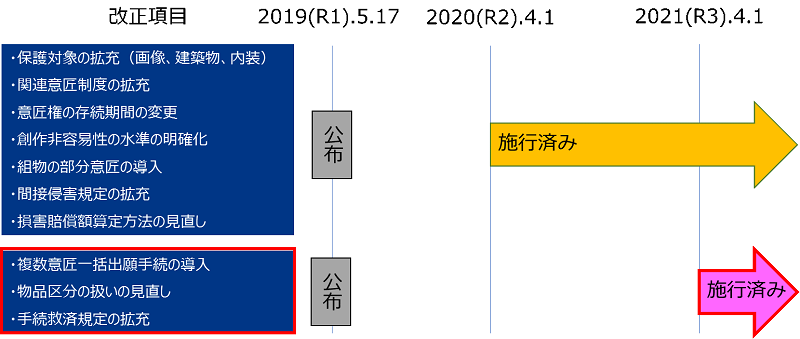
The Design Act has been revised in the following areas (circled in blue). Most of the provisions of the revised Design Act came into effect on April 1, 2020, and the remaining provisions came into effect on April 1, 2021.
3. Details of the amendment
(1) Expansion of the scope of protection (effective April 1, 2020)
Until now, the protection of the Design Act was limited to "articles," and non-"articles," such as real estate and non-solid objects, were not protected. However, the amendment has expanded the scope of protection, and it is now possible to register designs of "images," "buildings," and "interiors."
The scope of protection now includes "images" themselves, so that image designs that are not recorded or displayed on an item can also be protected. Also, the scope of protection now includes "buildings," so that designs of buildings that are real estate can also be protected.

Designs for "interiors" consisting of multiple items, walls, floors, ceilings, etc. can now be registered as a single design.

(2) Expansion of the related designs system (effective April 1, 2020)
Previously, the application period for a related design was up until the publication of the design gazette for the principal design (approximately eight months from the application for the principal design), but the amendment has extended this to up until 10 years have passed since the application for the basic design. Additionally, previously, designs that are only similar to related designs could not be registered, but the amendment now allows the registration of related designs that are only similar to related designs.
The period for filing a related design application has been extended to "up to 10 years before the filing date of the original design."
(The expiration date of the design right for a related design is "25 years after the filing date of the original design.")
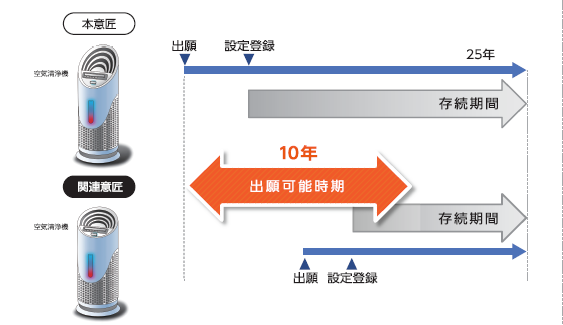
It is now also possible to file an application for a "related design" that uses a related design as the principal design.
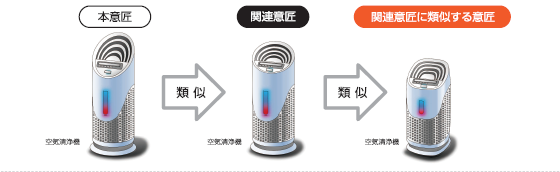
*The image is for illustrative purposes only. In order for a design to be actually registered, it must meet the registration requirements stipulated in the Design Act (novelty, non-creativity).
(3) Duration of design rights (effective April 1, 2020)
Previously, the expiration date of a design right was "20 years from the date of registration," but with the amendment, it has now become "25 years from the date of application."
(4) Clarification of the level of creative difficulty (effective April 1, 2020)
Previously, the materials used as the basis for determining whether something was not easy to create were limited to those that were publicly known, but with the amendment, shapes, patterns, etc. published in publications or on websites, regardless of whether they were publicly known, will also be used as the basis for determining whether something was not easy to create.
(5) Expansion of design scope for set items (effective April 1, 2020)
Previously, design registrations were not permitted for the assembled parts, but the amendments have made it possible to register designs for the assembled parts as well.
(6) Expansion of scope of indirect infringement (effective April 1, 2020)
Previously, the act of dividing an infringing product into its component parts and manufacturing, importing, etc. was not considered to be an act of infringing a design right. However, with the amendment, the act of dividing an infringing product into its component parts with bad faith and manufacturing, importing, etc. is now considered to be an act of infringing a design right.
(7) Revision of the method for calculating damages (effective April 1, 2020)
Until now, the amount of damages for infringement of a design right was excluded from the amount of damages that exceeded the right holder's production and sales capacity, etc. However, with the amendment, the amount that exceeds the right holder's production and sales capacity, etc. will no longer be excluded.
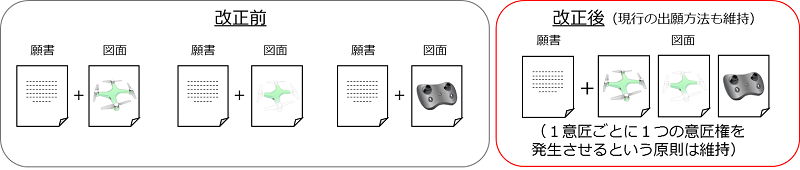
(8) Introduction of a combined multiple design application procedure (effective April 1, 2021)
Previously, it was necessary to prepare an application form for each design registration application, but the amendments have made it possible to file multiple design registration applications together using a single application form.
(9) Review of handling of product classification (effective April 1, 2021)
Until now, the granularity of the classification of goods to be entered in applications was determined by the "Table of Classification of Goods." However, with the amendment, this has been abolished and the criteria for what is subject to "unique designs" will be established in the Ordinance of the Ministry of Economy, Trade and Industry.
(10) Expansion of procedural relief provisions (effective April 1, 2021)
Previously, it was not possible to request an extension of the designated period after the expiration of the designated period, or to file an application for design registration that claims priority after the priority period has expired. However, the amendments have made both of these possible.
Extension of the specified period upon request after the specified period has elapsed
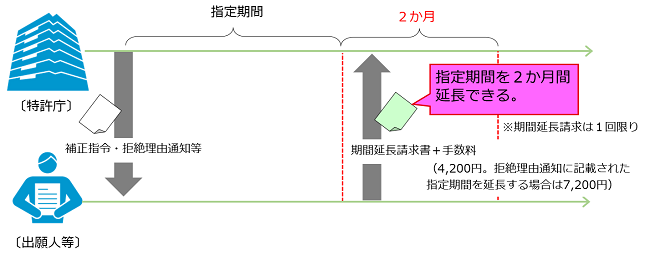
*Not applicable to notices of reasons for refusal after filing an appeal against a decision of refusal.Design applications claiming priority after the priority period has expired
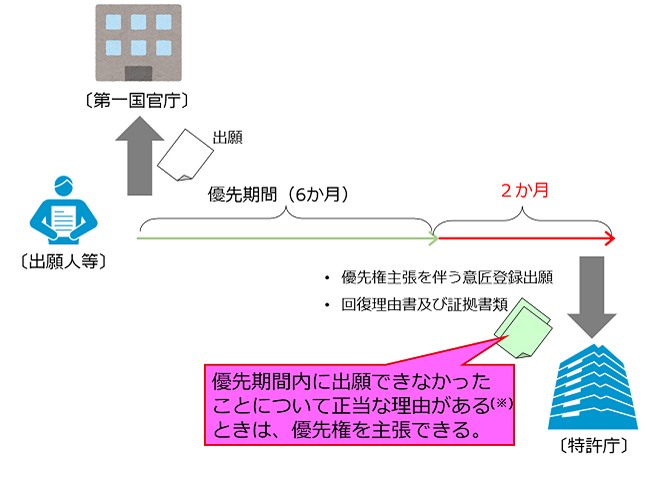
(※) The requirement for restoration for applications whose “priority period expired” is after April 1, 2023
is that the application must be “not intentional.”
Source: https://www.jpo.go.jp//system/design/gaiyo/seidogaiyo/isyou_kaisei_2019.html
 {{item.truncatedText}}
{{item.basicDescription&&item.basicDescription.slice(0,150)}}{{item.basicDescription&&item.basicDescription.length>150?"...":""}}
{{item.truncatedText}}
{{item.basicDescription&&item.basicDescription.slice(0,150)}}{{item.basicDescription&&item.basicDescription.length>150?"...":""}}