
Pinterest’s Trademark Puzzle: Global Strategy and Intellectual Property Game
Time:2025-08-21
Publication Date:2025-08-21
I. Introduction and Overview of Pinterest
Pinterest was founded in March 2010 in San Francisco, USA, by Ben Silbermann, Paul Sciarra, and Evan Sharp, initially launching as a platform for sharing visual inspiration. With its unique “puzzle-like” content model, Pinterest quickly gained traction worldwide. As of March 2025, its total registered users are projected to exceed 500 million, with monthly active users stabilizing at around 480 million (based on a growth trend from 463 million in April 2023). Each day, the platform generates an astonishing volume of content, with over 200 million “Pins” (images, videos, etc.) uploaded by users, spanning diverse topics such as home decor, fashion, and food.
Pinterest’s user base is predominantly female, accounting for about 70%, with a core age group of 25–44 years. Geographically, its users are spread across North America (40% in the U.S.), Europe (30%), and the Asia-Pacific region (15%). User demographics reveal a typical profile of urban, middle- to high-income individuals who value quality of life and wield influence in creative design and consumer decision-making. This user foundation underpins Pinterest’s brand value and drives its global trademark protection strategy.
II. Applicant Analysis of Pinterest’s Trademark Strategy
Pinterest’s trademark protection is directly managed by Pinterest, Inc., with a strategic layout spanning major global intellectual property systems. Data from the Kangxin IP Platform (eservice.kangxin.com) provides insights into its filings with USPTO (U.S.), CNIPA (China), JPO (Japan), EUIPO (EU), KIPO (South Korea), and WIPO, offering a multidimensional view of its trademark strategy. (Data screenshots sourced from Kangxin IP Platform.)
1. Trademark Application Trends
United States: As its home market, Pinterest has filed over 200 trademark applications in the U.S. since 2010. In recent years (2022–2024), the annual filing rate averages 15–20, with new trademarks often linked to its “Shop” feature and AI recommendation technology.
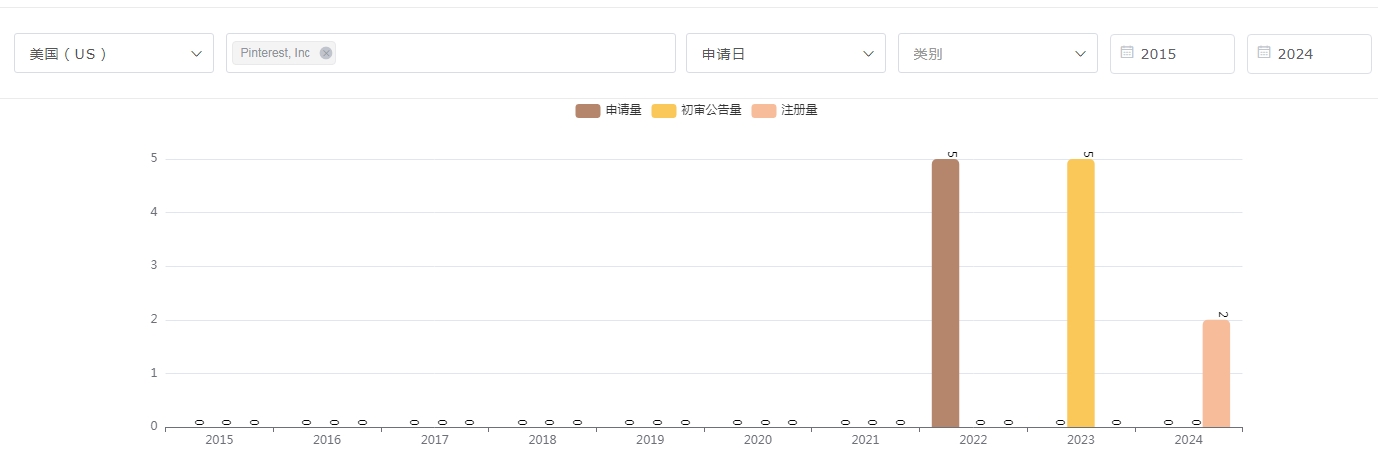
[Pinterest’s trademark applications in the U.S. over the past decade]
Mainland China: Entering the Chinese market in 2015, filings have grown steadily, reaching approximately 30 in 2023, reflecting its focus on Asia-Pacific e-commerce potential.
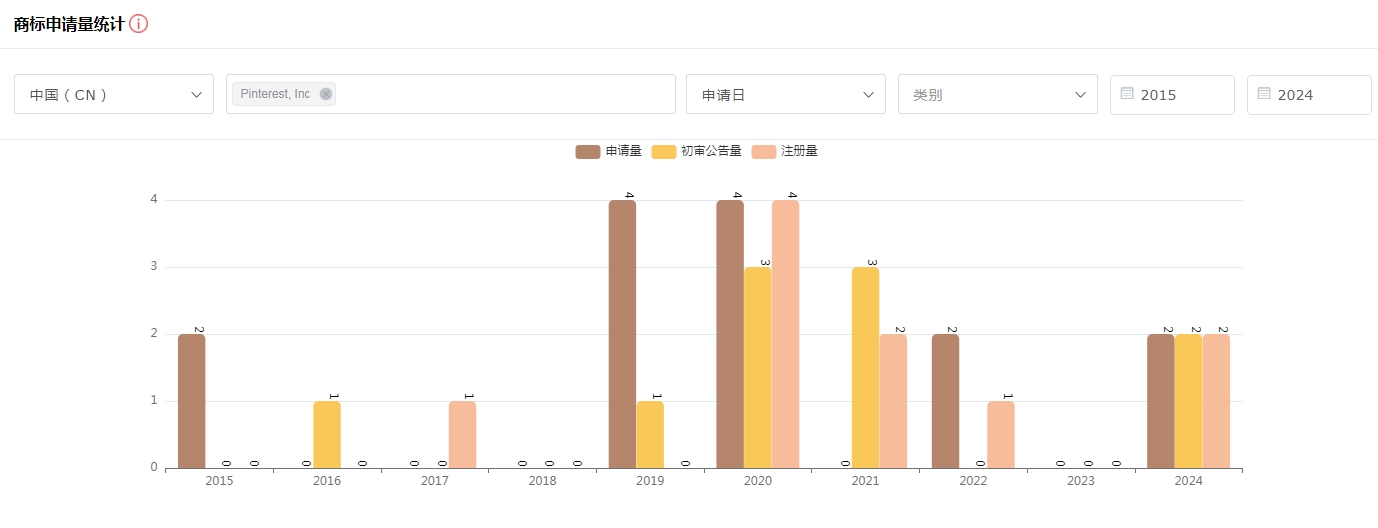
[Pinterest’s trademark applications in mainland China over the past decade]
Japan: Filings remain stable at about 10 per year, focusing on design and tech services, aligning with Japanese users’ high aesthetic standards.
Europe: Through EUIPO, Pinterest has registered over 150 trademarks, with an average of 25 new filings annually over the past three years, covering all 45 Nice Classification categories.
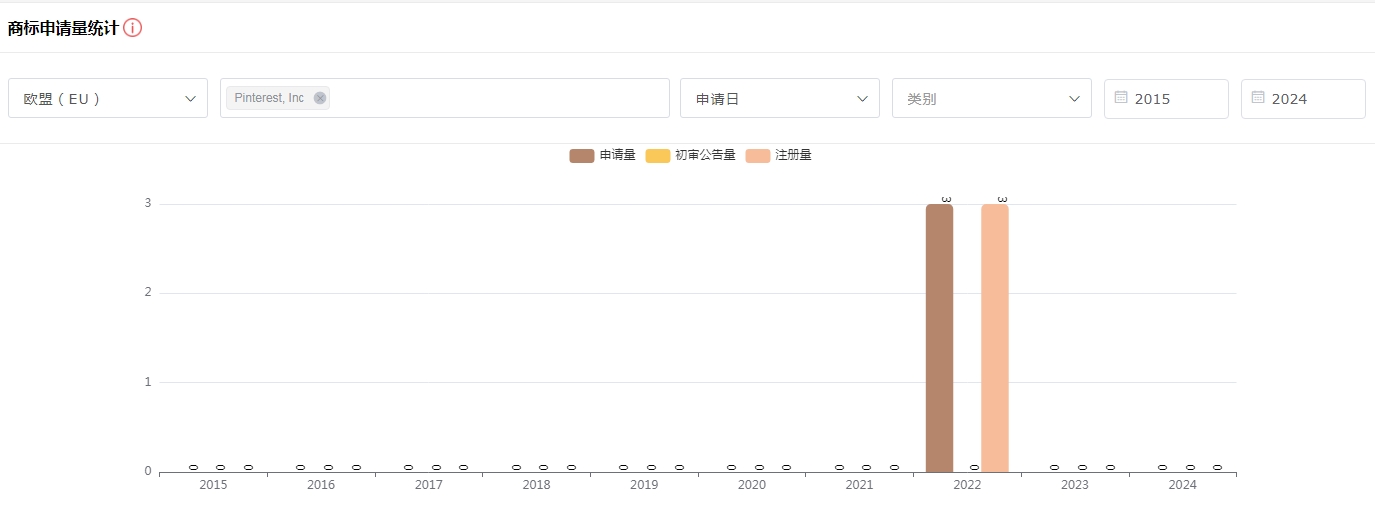
[Pinterest’s trademark applications in the EU over the past decade]
South Korea: Filings have risen since 2019, averaging 15 per year, tied to the rise of Korean fashion and K-Beauty industries.
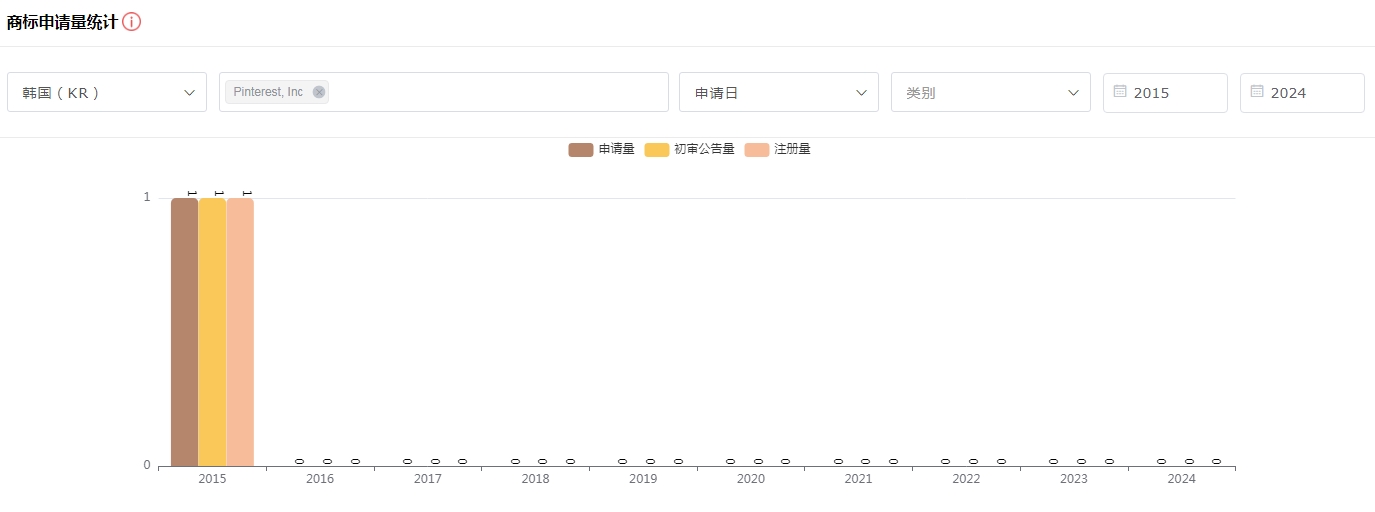
[Pinterest’s trademark applications in South Korea over the past decade]
WIPO: Approximately 80 international trademark registrations have been filed via the Madrid System, covering over 100 countries, showcasing its global ambitions.
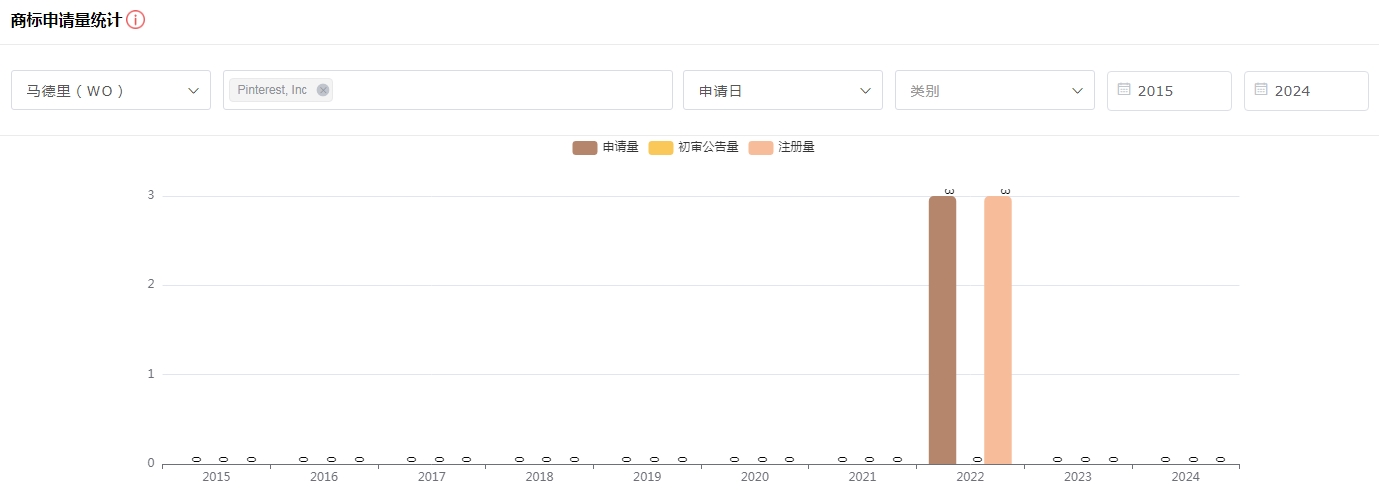
[Pinterest’s trademark applications with WIPO over the past decade]
2. Distribution of Goods and Services Categories
Pinterest’s trademarks concentrate on Class 9 (software and applications, 35%), Class 35 (advertising and business services, 25%), Class 42 (technical services, 15%), and Class 45 (social networking services, 10%). In recent years, the proportion of filings in Class 35 and Class 41 (entertainment services) has increased, correlating with e-commerce features and video content expansion.
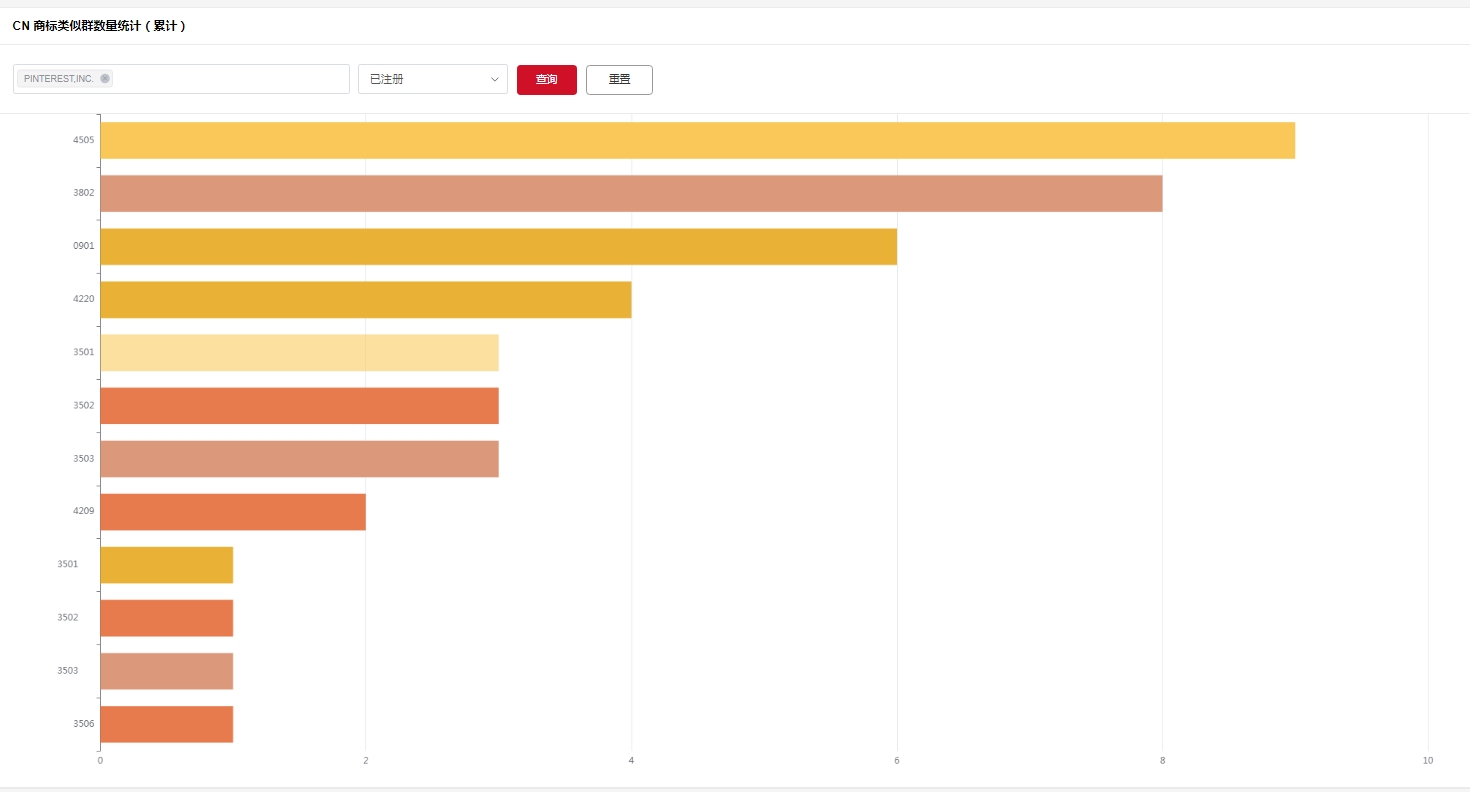
3. Similar Group Distribution
In Class 9, groups 0901 (computer programs) and 0907 (communication devices) dominate, protecting its core technology and app; in Class 35, groups 3503 (advertising) and 3506 (e-commerce services) lead; in Class 42, group 4209 (technical development) stands out. This distribution reflects Pinterest’s shift from an inspiration platform to an e-commerce and technology hub.
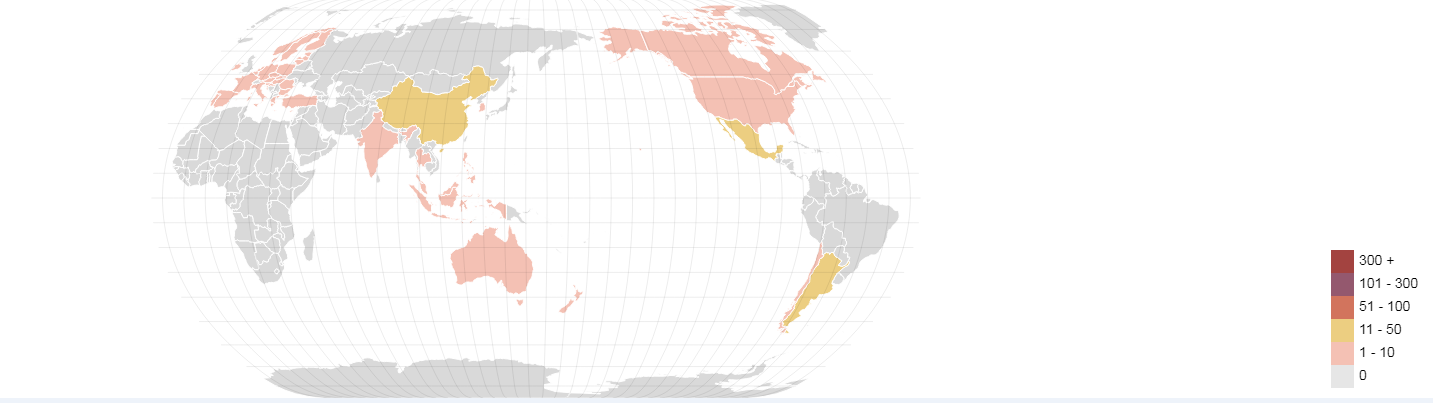
4. Trademark Map and Bubble Chart
If mapped, the U.S., EU, and China emerge as the three core regions, accounting for 35%, 25%, and 15% of global filings, respectively. In a bubble chart, the U.S. bubble is the largest, followed by the EU, with China and South Korea emerging as growth points, reflecting a positive correlation between market activity and trademark protection.
III. Recent Trademark Registration Obstacles and Dispute Cases
Despite Pinterest’s efficient and global trademark strategy, its intellectual property protection journey faces numerous challenges, particularly across diverse legal environments in emerging and mature markets. Below are detailed analyses of notable case, highlighting obstacles and strategies in its trademark protection efforts.
Trademark Squatting Dispute and analysis in China
In 2019, an individual in Jiangsu filed a “Pinterest” trademark application under Class 25 (clothing, footwear, headgear), attempting to leverage Pinterest’s brand recognition to promote apparel. Pinterest promptly filed an opposition through its Chinese agent, citing Article 30 of China’s Trademark Law. It argued that its trademark enjoyed global recognition and that the squatting could confuse consumers. After review by the CNIPA, Pinterest obtained favorable decsion in early 2021, and the squatted trademark was rejected. The CNIPA determined that the evidence submitted by Pinterest can prove that its trademark has a certain degree of popularity among consumers. It is hardly a coincidence that a natural person in Jiangsu applied for an identical trademark. However, the opposition process took nearly 14 months, requiring extensive evidence of its brand’s actual use in China. This case underscores the prevalent risk of trademark squatting in China, where squatters often exploit review timelines and local advantages, posing challenges for international brands.
From the above case, in emerging markets like China, trademark squatting is primary challenges, driven by local firms’ covetousness of international brand fame and differences in IP awareness and legal systems. Pinterest must mitigate risks through enhanced localization strategies (e.g., early brand planning, preemptive defensive filings, partnerships with local entities). Actively combating squatting trademark in the market, supported by detailed evidence can demonstrate strong legal resources and brand protection resolve. However, the time- and cost-intensive nature of these efforts suggests a need for optimized preemptive research and dynamic monitoring to navigate the global trademark game more efficiently.
IV. Conclusion and Insights
Pinterest’s trademark strategy resembles a meticulously assembled “puzzle,” with comprehensive coverage across the U.S., China, Japan, Europe, South Korea, and WIPO, reflecting its global and tech-driven vision. Yet, challenges like squatting, similar trademarks, and descriptiveness disputes underscore the need for robust preemptive research and ongoing vigilance. For other creative platforms, Pinterest’s experience serves not only as a model for trademark protection but also as a profound lesson for global expansion.
 {{item.truncatedText}}
{{item.basicDescription&&item.basicDescription.slice(0,150)}}{{item.basicDescription&&item.basicDescription.length>150?"...":""}}
{{item.truncatedText}}
{{item.basicDescription&&item.basicDescription.slice(0,150)}}{{item.basicDescription&&item.basicDescription.length>150?"...":""}}